
Should You Apply for Multiple Jobs at the Same Company?
Check the employer's rule, test whether the openings tell one coherent career story, and lead with the role your evidence supports best.

You can apply for more than one job at the same company when the employer allows it, the roles belong to one credible direction, and you can support each application with distinct truthful evidence. But more applications are not automatically better. Start by choosing one primary role. Keep a second only when it passes the same rule, requirements, and evidence checks.
The useful output is a one-page role matrix, not a guess about what recruiters prefer. It should show the employer rule, hard requirements, shared work, evidence for each opening, location or team conflicts, and your primary choice. That gives you a defensible decision even when the answer is to apply once.
Check the employer's rule before comparing roles
Read the careers FAQ, candidate portal, job posting, and any recruiter instruction. The rule may limit concurrent applications, distinguish career stages, restrict locations, or say nothing. If it is unclear, ask the listed recruiting contact rather than assuming every applicant-tracking system works the same way.
Current first-party policies show why this comes first. As of October 2026, Google Careers Help says candidates may apply to up to three jobs in a rolling 30-day window and should focus on the strongest matches. BCG's careers FAQ currently encourages experienced candidates to apply to one position at a time, while allowing students and recent graduates up to four open applications. These are employer-specific examples, not a universal number for your search.
Rule note: “Employer careers FAQ checked on [date]. The rule says [exact wording or short summary]. It applies to [career stage, region, or programme].”
Put the openings through one role-family test
Two similar titles can hide different work, while different titles can describe related work. Compare what the person will actually deliver. Put each opening in a column and use these rows:
- Employer rule: is another active application permitted for you?
- Hard requirements: work authorization, location, language, licence, clearance, schedule, or experience the posting treats as mandatory.
- Shared skill family: the work both roles genuinely have in common.
- Unique evidence: two or three facts from your history that support this specific role.
- Team or location conflict: anything that makes the applications incompatible or changes your real availability.
- Priority: primary, justified secondary, or do not apply.

Move both openings through the same checks. A second application remains only when the rule permits it and the evidence creates a coherent, distinct case.
Indeed's current guide to several jobs at one company also recommends comparing interests, qualifications, and postings. Do not copy its percentage threshold as a rule. A hard requirement is not interchangeable with a preference, and a percentage cannot tell you whether two roles form one credible path.
Choose the role you will lead with
Your primary role is where three things align: you meet the non-negotiable requirements, your current evidence is strongest, and you can explain why that work is the priority. If one role wins clearly, apply to it first. This is the same principle behind replacing application volume with fewer, more relevant applications, now applied inside one employer.
Annotated fictional example
Candidate: Lina, a customer-operations specialist. Opening A: Customer Success Specialist, requiring portfolio ownership and renewal support. Opening B: Operations Analyst, requiring workflow analysis and dashboard reporting. Shared evidence: Lina improved a support handoff and documented recurring customer issues. Distinct evidence: for A, she can show onboarding and account communication; for B, she can show process mapping and a reporting dashboard. Decision: B is primary because her strongest recent work is operational analysis. A stays secondary only if the employer permits both and she can explain a real interest in customer-facing ownership.
The facts do not change between applications. Only the evidence emphasis changes. If Lina cannot explain why both roles fit the same direction, or lacks a hard requirement for one, she should choose one.
Keep a second role only when it earns its place
A secondary application should survive four questions:
- Does the employer rule allow it for your career stage and location?
- Can one honest career direction explain your interest in both roles?
- Do you have different, relevant evidence for the second role?
- Would you seriously accept and perform that job if it became the only offer?
If any answer is no, stop at the primary role. Do not apply to unrelated openings just because they share an employer. A marketing role and a risk role may both sound interesting, but interest alone does not create a credible application story.
Tailor the evidence without changing your identity
Keep dates, titles, employers, qualifications, authorization, location constraints, and application history consistent. Then select the achievements and language that match each posting. For one role you may foreground customer onboarding; for another, the same job may support a process-improvement example. The underlying work, ownership, and result must remain accurate.
Do not paste a new title over the same generic resume. Map two or three real achievements to each role, explain the relevant scope, and remove material that distracts from the role without hiding material facts. Never invent a second professional identity or imply that team results were yours alone.
Explain concurrent interest only when it is useful
You do not need to send an apology for every permitted application. If a recruiter asks, answer directly, name the primary role, and explain the related secondary interest in one or two sentences.
“My primary interest is the Operations Analyst role because my strongest recent evidence is in workflow analysis and reporting. I also applied to Customer Success Specialist because the same work included onboarding and client handoffs. I would be glad to discuss where my background is most relevant.”
Do not chase several hiring managers, ask them to compete for you, or conceal an application when the employer asks directly. If a recruiter advises you to focus on one process, clarify which application should remain active and follow the stated route.
Track each application as a separate process
Record the role title and ID, team, location, date applied, materials sent, current status, recruiter contact, and the employer rule you checked. Keep the primary and secondary labels visible. This prevents you from sending the wrong resume, confusing interview details, or following up on the wrong timeline.
Use the employer's portal as the status authority. If a follow-up becomes appropriate, follow up on each application separately and name the exact role. Do not assume silence on one role answers the other.
Use Job Fit Analysis as an optional evidence check
After narrowing the openings to a related shortlist, you can inspect your evidence against each role with Tadween Job Fit Analysis. Run each job description separately. The current feature evidence supports a role-specific report that separates strengths from gaps and suggests preparation priorities. It does not compare several roles side by side, approve an application, or predict an employer decision.
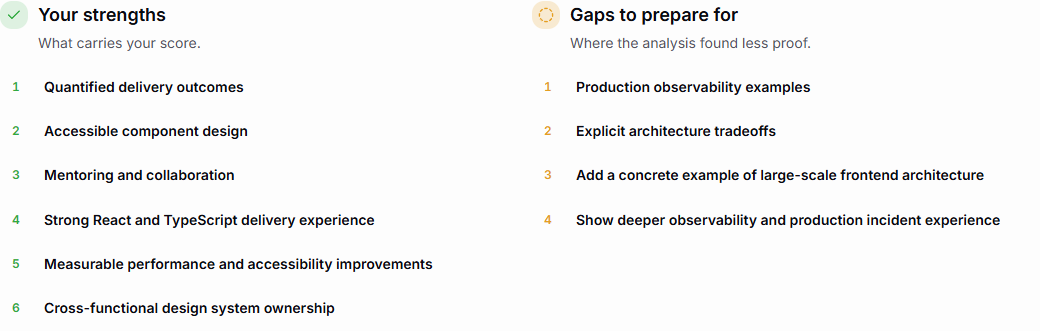
The approved English view shows strengths and evidence gaps for one role report. Repeat the check separately, then make the primary-role decision yourself.
Know when one application is the stronger decision
Choose one role when the employer requires it, the openings point in unrelated directions, hard requirements conflict, the second application has no distinct evidence, or you would not genuinely take the second job. Also pause when neither role is well supported. Waiting for a better fit can be more useful than turning uncertainty into duplicate generic applications.
The goal is not to maximize the number of entries in one company's portal. It is to make one clear primary choice and, only when justified, one related secondary case that uses the same truthful career history.
Lead with the role your evidence supports best
Check the rule, complete the matrix, and keep a second application only when it tells the same truthful career story.