
How to Make a Resume With No Experience: A First Job Guide
You have more experience than you think. Academic projects, volunteering, coursework, and part-time jobs all count. Here's how to turn them into a resume that gets interviews.

The "No Experience" Myth
Here's a fact that career centers don't emphasize enough: there is no such thing as a resume with zero experience. If you've completed a class project, volunteered at an event, led a student club, worked a summer job, or managed a personal project, you already have material for a strong resume. The challenge isn't a lack of experience. It's recognizing what counts.
This guide walks you through building a resume that lands your first professional role, even when your work history section is currently blank.
Reframe What Counts as Experience
Hiring managers filling entry-level positions don't expect five years of industry tenure. They're looking for signals: Can this person learn quickly? Do they follow through on commitments? Can they work with a team? Your background already contains these signals. You just need to surface them.
Here's what qualifies as legitimate resume material:
- Academic projects: That capstone project, group research paper, or lab experiment you designed? That's project experience. You scoped a problem, chose a methodology, executed a plan, and delivered results.
- Volunteering: Organized a charity drive? Tutored younger students? Coordinated logistics for a community event? These demonstrate initiative, responsibility, and interpersonal skills.
- Relevant coursework: Courses with practical components show domain knowledge. A course in data analysis, financial modeling, or marketing strategy tells an employer you've engaged seriously with the field.
- Extracurricular activities: Leading a debate team, managing a student publication's social media, or serving as club treasurer all translate directly to leadership, communication, and organizational skills.
- Part-time and freelance work: Retail, food service, tutoring, freelance design. Every paid role teaches transferable skills, even when the industry is unrelated to your target position.
The question isn't "Do I have experience?" It's "How do I present the experience I already have?"
Use the Education-First Resume Format
Traditional resumes lead with professional experience. When you're entering the job market for the first time, flip the order. Put your education section at the top, directly below your contact information and professional summary.
Your education section should include:
- Degree name and institution
- Expected or actual graduation date
- GPA (if 3.0/4.0 or above, or equivalent in your grading system)
- Relevant coursework (3-6 courses most aligned with your target role)
- Academic honors, scholarships, or awards
This format works because it leads with your strongest credential. As a recent graduate, your education is current, relevant, and demonstrates years of sustained commitment and intellectual growth.
When to switch: Once you've accumulated roughly one year of relevant professional experience, including internships and full-time roles, move your education section below your work experience. The transition happens naturally as your experience section becomes the more compelling story.
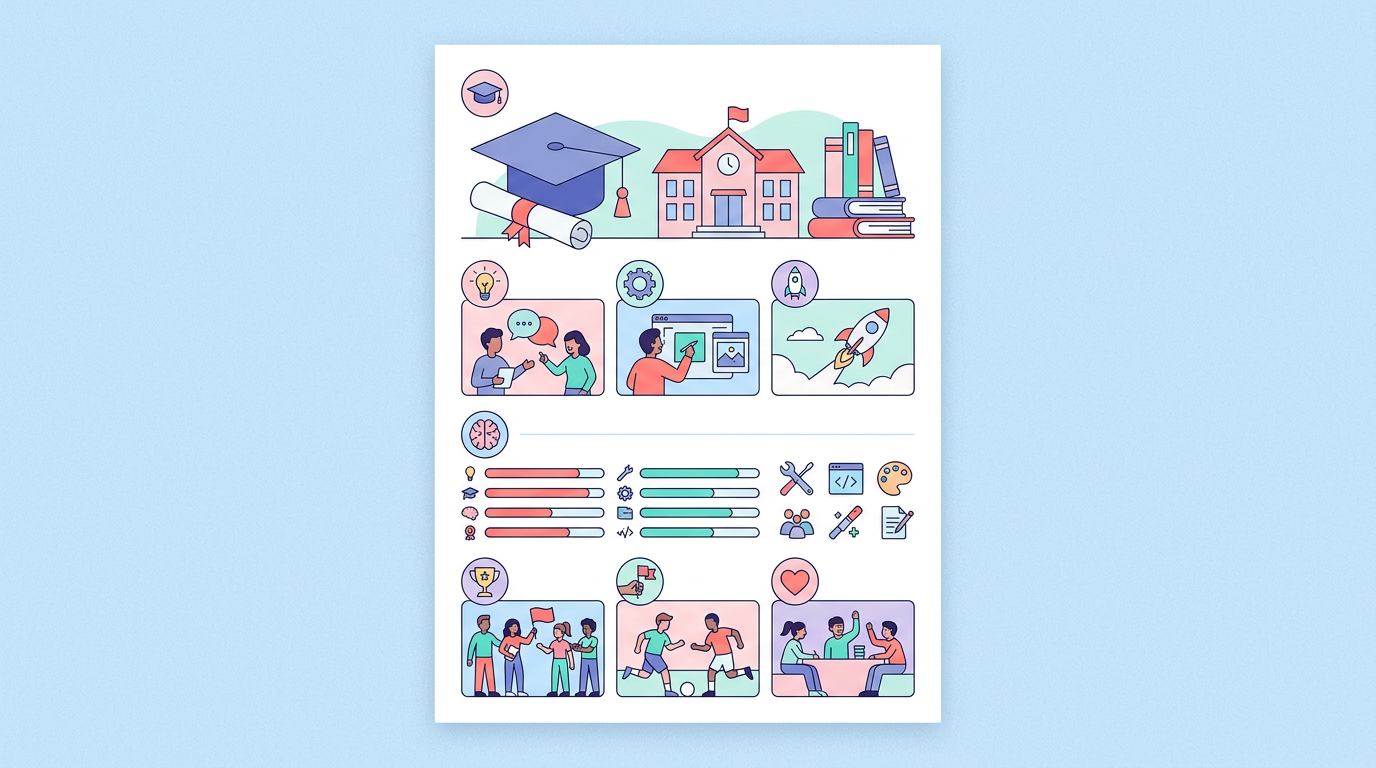
The education-first resume format puts your strongest qualifications front and center when work experience is limited.
Write About Academic Projects Like Professional Achievements
The difference between a forgettable project entry and a compelling one comes down to structure. Use the same format professionals use for work accomplishments: action verb + what you did + measurable result or context.
Compare these two versions of the same project:
Weak: "Worked on a group project about social media marketing."
Strong: "Developed a social media marketing strategy for a local nonprofit, increasing their Instagram engagement by 45% over 8 weeks through targeted content scheduling and audience analysis."
The second version uses a strong action verb ("Developed"), specifies the context (local nonprofit), and quantifies the result (45% increase over 8 weeks). Even academic projects have outputs you can measure: datasets processed, prototypes tested, pages researched, presentations delivered, users surveyed.
Strong action verbs for project descriptions: Built, Designed, Analyzed, Researched, Implemented, Coordinated, Presented, Authored, Tested, Created, Proposed, Evaluated.
Extract Transferable Skills from Every Role
That summer job at a coffee shop taught you to handle high-pressure situations, manage multiple orders simultaneously, and resolve customer complaints diplomatically. These are transferable skills, and they carry real weight on a first resume.
Here's how to reframe common part-time roles for your resume:
- Retail associate: Customer communication, inventory tracking, point-of-sale systems, conflict resolution, persuasion and upselling
- Food service: Time management under pressure, team coordination, health and safety compliance, cash handling accuracy
- Tutoring: Breaking down complex concepts, adapting communication to different learning styles, patience, session planning and tracking progress
- Student organization officer: Budget management, event planning and logistics, stakeholder communication, team leadership, meeting facilitation
- Internship (any duration): Industry exposure, professional communication norms, project contributions, workplace collaboration
Don't dismiss a role because it isn't in your target field. Employers hiring for entry-level positions understand that your retail job won't be directly relevant to your engineering career. They're evaluating the underlying competencies: reliability, communication, problem-solving, and professionalism.
Build a Skills Section That Carries Real Weight
When your experience section is thin, your skills section does heavy lifting. This is where you demonstrate tangible, verifiable competencies that match the job description.
Structure your skills into clear categories:
- Technical skills: Programming languages, software tools, platforms, frameworks. Be specific: "Python, SQL, Tableau, Google Analytics" rather than "computer skills" or "Microsoft Office."
- Language skills: List languages with proficiency levels. Bilingual Arabic and English proficiency is a significant differentiator in the Gulf and MENA job markets.
- Industry tools: Any software, platforms, or methodologies relevant to your target role. Figma for design roles, SPSS for research, AutoCAD for engineering.
A practical approach: pull up 5-10 job descriptions for roles you're targeting. Identify the skills that appear repeatedly across multiple postings. If you genuinely possess those skills, they belong on your resume. If you don't have them yet, you've just built a focused learning roadmap.
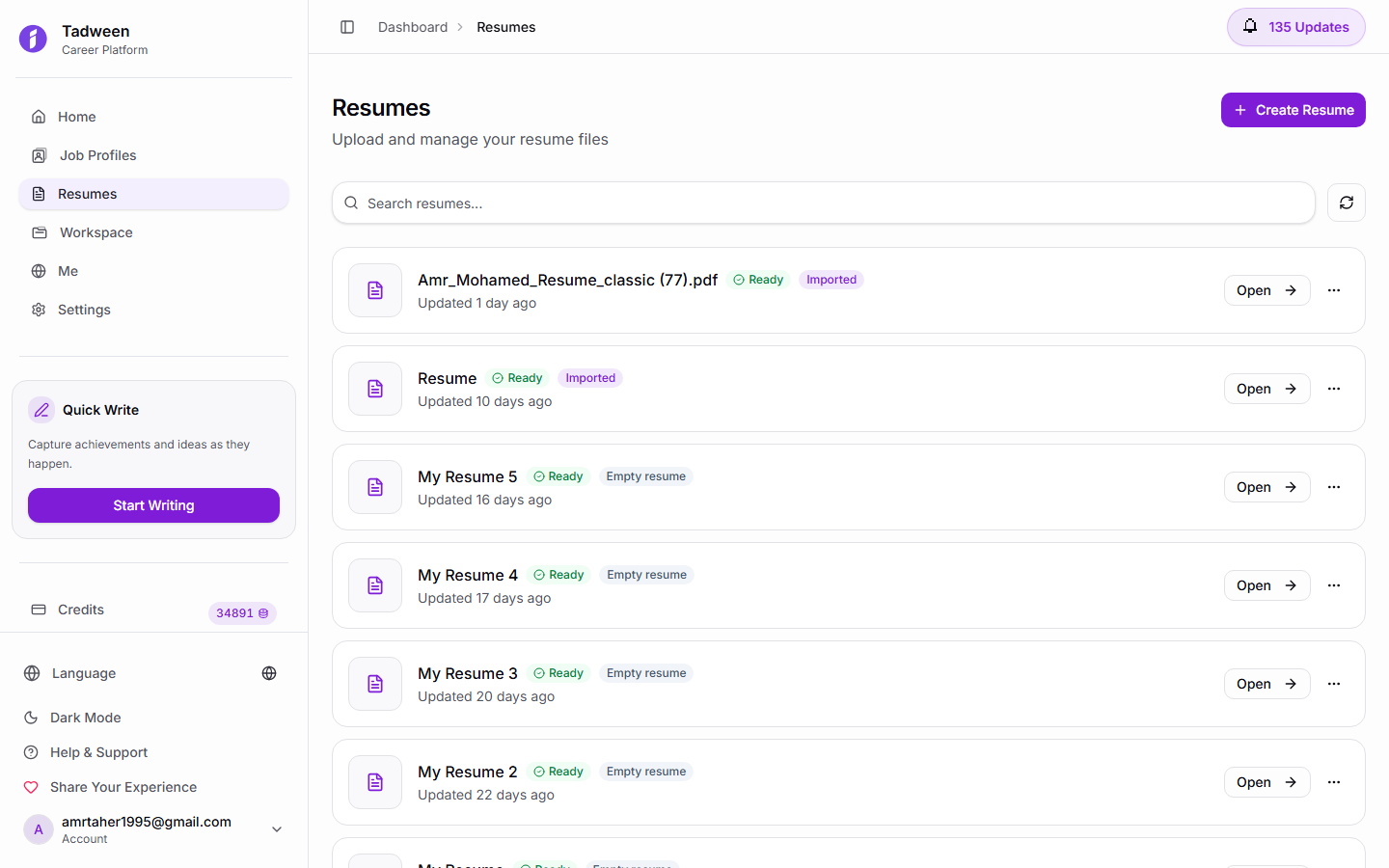
Tadween's resume builder organizes your skills and experience into a polished, ATS-friendly format, even when you're starting with limited work history.
A skills section that mirrors the language in job postings can be the difference between your resume reaching a human reviewer and getting filtered out by applicant tracking systems (ATS).
Your Cover Letter Strategy: Enthusiasm Plus Specificity
First-time job applicants often make one of two cover letter mistakes: apologizing for their lack of experience, or writing something so generic it could apply to any company. Neither approach works.
Instead, lead with what you bring to the table. Research the company. Reference a specific project they've shipped, a value they've stated, or a product feature that resonates with you. Then connect your skills and interests to their actual needs.
A simple framework that works:
- Opening: Why this specific company and role interests you. Be concrete: "I applied because I used your platform during my senior thesis and noticed how your team approaches accessibility differently from competitors."
- Middle: Two to three examples of relevant skills, projects, or experiences that directly connect to the role's requirements.
- Close: What you're excited to contribute and learn, followed by a clear, confident call to action.
"I'm applying because I've followed your product since beta and used it to solve a real problem in my coursework" beats "I am a motivated, hard-working individual seeking an entry-level opportunity" every single time. Specificity signals genuine interest; generic enthusiasm signals a mass application.
Your cover letter doesn't need to compensate for missing experience. It needs to demonstrate that you've done your homework, you understand what the role involves, and you're ready to contribute from day one.
Where to List Awards, Certifications, and Honors
Dean's List recognition, academic scholarships, competition wins, and relevant certifications all deserve prominent placement on a first resume. These credentials carry extra weight when professional experience is limited because they provide third-party validation of your abilities.
Two approaches, depending on how many you have:
- If you have 1-3 honors: Include them in your education section, directly below your degree. For example: "Dean's List, Fall 2024 and Spring 2025" or "Recipient, Merit Scholarship for Academic Excellence."
- If you have 4 or more: Create a dedicated "Honors and Awards" section. List each with the awarding organization and date. Place this section after education and before or after your skills section.
For certifications, always include the issuing organization and completion date. "Google Data Analytics Professional Certificate, Coursera, 2025" tells an employer significantly more than "Data Analytics Certificate." Online certifications from recognized platforms (Coursera, edX, Google, HubSpot, AWS) are widely accepted and demonstrate self-directed learning.
Build Your First Professional Profile with Tadween
Writing a resume from scratch feels harder when you're staring at empty sections and a blinking cursor. Tadween is built for exactly this situation: turning minimal input into a polished professional profile.
Here's how it works: paste a job description you're interested in, and Tadween generates a tailored job profile complete with a professional summary, 8-12 matched skills, and structured achievement bullets. All of this is drawn from whatever background you provide. Even if your input is a degree, two class projects, and a summer internship, the AI structures it into a cohesive, professional narrative that speaks directly to the role's requirements.
Every profile Tadween creates is fully bilingual. If you're applying to roles across Arabic and English-speaking markets, you get both versions with proper RTL formatting for Arabic. This isn't a machine translation layer; both languages are generated natively.
You also get a public portfolio page at tadween.me/u/your-alias, giving you a professional online presence before you've even started your first role. Think of it as your career homepage.
Start building your profile with free credits. No credit card required.
Your First Resume Starts Here
Paste a job description. Tadween's AI builds a tailored resume from your education, projects, and skills. Bilingual, ATS-friendly, and ready in minutes.