
How to Handle Conflicting Resume Feedback
Turn competing opinions into one targeted, truthful revision and a short record of why each change earned its place.

When one reviewer says to cut a section, another says to add detail, and a tool proposes a third change, the answer is not to obey the loudest voice or combine every suggestion. Anchor the review to one application, sort each comment by what it is trying to solve, ask for its reason, and accept only the changes you can support with facts and context.
Your output from this guide is deliberately small: one revised resume for a named target role, plus an edit record showing what you corrected, clarified, adapted, or set aside. The record protects you from endless revision because every decision has a reason.
Anchor the review to one application
Before comparing advice, write down the target role, the exact resume version, the application channel, and the language requested. Preserve an untouched copy of the draft. Two comments may look contradictory because they refer to different jobs, different files, or different readers.
A general suggestion such as “keep it to one page” does not automatically override an application that explicitly requests more detail. Likewise, advice for a design portfolio may not fit a conservative operations role. University of Illinois resume guidance notes that conflicting advice should be judged against the adviser’s experience and the field you want to enter, while Kalamazoo College guidance explains that resume advice varies by industry and that application-specific exceptions exist. Treat context as evidence, not as an excuse to ignore inconvenient feedback.
Sort the comment, not the person
Use this four-part editorial classification. It is a practical decision tool, not a scientifically validated ranking.
- Factual correction: a wrong date, title, spelling, qualification, link, or unsupported claim. Verify it against your own records and correct it.
- Explicit requirement: a field, format, language, file type, or instruction stated by the employer. Follow it unless it asks for something unsafe or impossible, in which case clarify before submitting.
- Role-relevance or clarity issue: the reader cannot see why an experience matters, or the wording hides the evidence needed for this role. Test the exact line against the job description and your real work.
- Preference: a stylistic opinion with no clear requirement or reader benefit. You may use it, but it does not outrank accuracy, relevance, or readability.
Do not rank advice by confidence, seniority, follower count, or the number of people repeating a rule. Relevant experience and a specific explanation matter more than certainty alone.
Ask for the reason and the exact location
A useful comment identifies where the problem appears, why it matters for this reader, and what the proposed change would improve. Ask a calm question instead of defending the draft or accepting a vague rule.
Clarification script
Thank you for reviewing it. For this role, which part is unclear, and what would your suggested change help the reader understand?
If the reviewer cannot point to a line, a requirement, or a reader problem, record the suggestion as a preference. If the explanation reveals a real gap, revise the gap rather than copying the reviewer’s exact wording. The resume must still sound like you and remain something you can explain in an interview.
Work through three common conflicts
One page versus more detail. A general one-page preference and a specific employer request are not equal. Follow the stated application requirement. If no length is specified, keep the information that proves fit and remove repetition rather than chasing a universal page count.
“Add numbers” versus no defensible metric. Ask what the number would prove. If you have a real scale, frequency, time, budget, or outcome, add it accurately. If you do not, show the problem, action, scope, constraint, or observable result without inventing precision. Tadween’s guide to writing credible achievements without numbers gives a fuller method for that case.
Literal translation versus natural bilingual writing. Names, dates, qualifications, and employment facts should remain consistent across languages, but sentence structure and professional phrasing do not need to be identical. Use the language expected for the application and preserve meaning rather than awkwardly mirroring every phrase. The guide to preparing consistent English and Arabic resume versions covers the implementation details.
Treat automated feedback as another review input
An automated review can help locate a weak section or propose a question, but it does not know an unrecorded fact and it is not the employer’s decision. The University of Illinois Career Center advises users to fact-check AI output, protect sensitive information, and retain their own judgment. Indiana University career guidance similarly separates feedback and analysis from wholesale rewriting and recommends using human coaching to prioritize edits.
Check the exact line, the reason, and the proposed wording against your real experience. Remove unnecessary personal or confidential information before submitting a resume to any review service. Never add a skill, credential, title, date, or metric merely to satisfy a score.
Tadween can give you another structured view of the draft through Resume Review. Its report organizes scores and recommendations, but you still apply the same evidence-and-context test before adopting a change. Explore the verified public Tadween features hub for the broader career workflow.
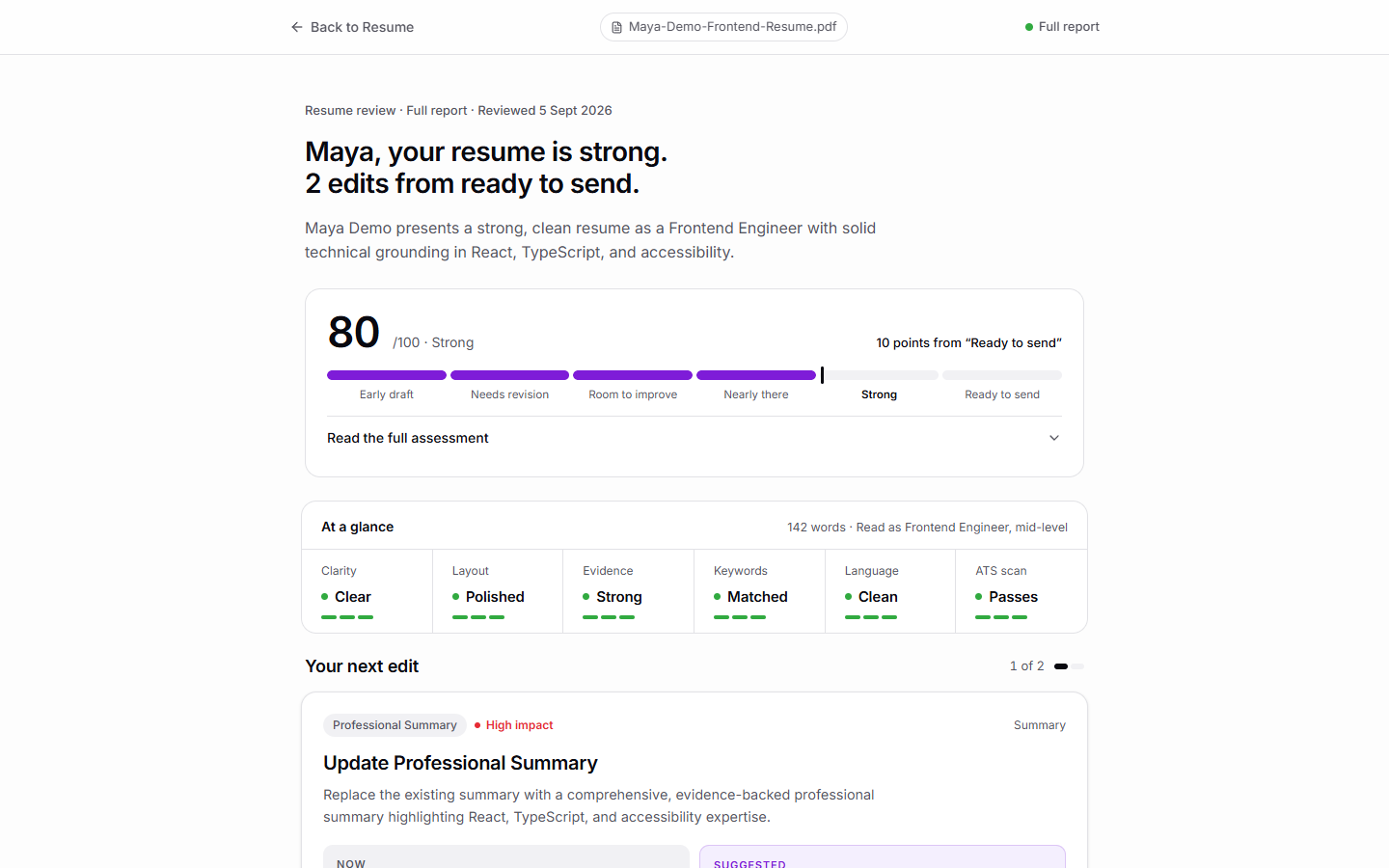
The approved demonstration report is a structured feedback source, not a hiring verdict and not proof that every recommendation is correct for your application.
Choose one of four actions
Once the reason is clear, give the comment one action:
- Correct: fix a verified factual error or unsupported claim.
- Clarify: ask for the missing requirement, reader concern, or location before editing.
- Adapt: revise truthful material so its relevance is clearer for this role and channel.
- Set aside: retain the current wording when the suggestion is only a preference or would weaken accuracy, relevance, or natural language.

The source of a comment does not decide the outcome. Evidence, application requirements, reader benefit, and truth determine the action.
Keep a small edit record
Use six fields: comment, source and context, evidence or reason, decision, exact revision, and final check. This can be a simple note or spreadsheet. It is not a Tadween feature, and it should not contain confidential reviewer details.
Worked example
Comment: Add a percentage to the onboarding bullet.
Source/context: Friend reviewing an operations resume.
Evidence/reason: No percentage was tracked; the real evidence is a revised checklist and fewer repeated questions documented in team notes.
Decision: Adapt.
Exact revision: Rewrote the bullet around the checklist, audience, and observable result without a fabricated number.
Final check: Matches records and can be explained in an interview.
Copyable template
Comment: [exact suggestion]
Source/context: [who, which role, which version]
Evidence or reason: [record, requirement, reader problem, or preference]
Decision: [correct / clarify / adapt / set aside]
Exact revision: [the change, or “no change”]
Final check: [truth, relevance, readability, file rendering]
Stop when the resume is fit for purpose
Revision is complete when verified factual errors are corrected, stated application requirements are met, the most relevant evidence is easy to find, the language is natural, and the final file opens and renders correctly. There is no magic number of reviewers or universal time limit.
Reopen the decision only when you gain new facts, receive a specific employer instruction, discover a real error, or target a meaningfully different role. A new opinion without new context does not automatically justify another rewrite.
Final decision check
- The target role, resume version, channel, and language are recorded.
- Every accepted change has a factual, required, or role-relevant reason.
- No edit invents a metric, skill, credential, title, date, or responsibility.
- English and Arabic versions preserve the same facts without forced literal wording.
- Automated suggestions were checked against real experience and sensitive data was protected.
- The final document was inspected in the actual file format before submission.
You do not need every reviewer to agree. You need a resume whose choices you can explain, whose facts you can defend, and whose evidence fits the application in front of you.
Turn feedback into changes you can defend
Review the draft, test each recommendation against evidence and context, then keep only the edits that improve this application.