
International CV and Resume Formats: What Each Country Expects
Your perfect resume in one country is a red flag in another. This guide breaks down what hiring managers actually expect in the US, UK, Germany, the Gulf, Japan, and beyond — so you stop guessing and start getting callbacks.
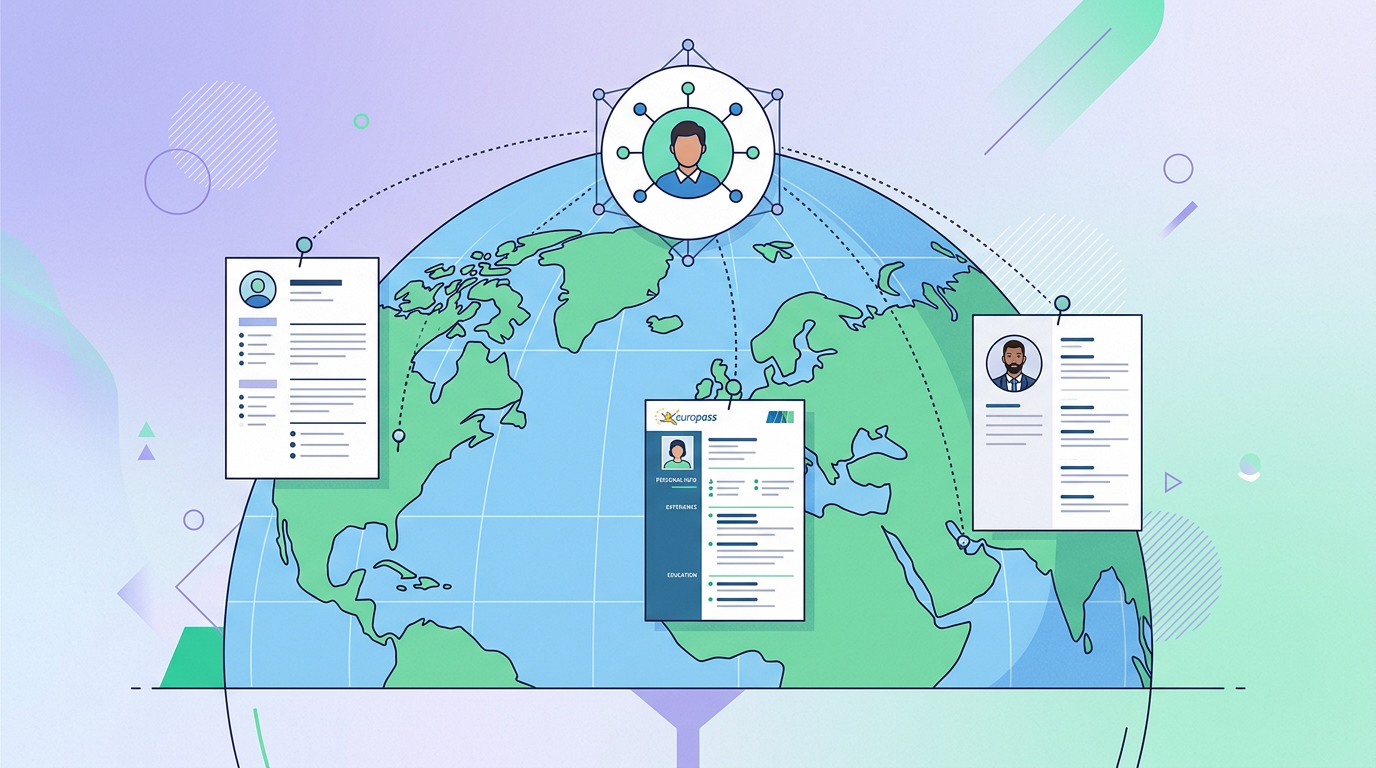
The Resume That Got You Interviews at Home Might Get You Rejected Abroad
Here's something no one tells you until it's too late: resume and CV conventions are not universal. A perfectly optimized American resume — clean, one page, no photo — would look suspiciously incomplete to a German recruiter. A detailed Gulf-style CV with your photo, nationality, and marital status would get immediately discarded by most US hiring managers, not because of the content, but because including that information signals that you don't understand their market.
If you're applying internationally, you need to understand what each market expects. Not as a nice-to-have, but as a baseline requirement. This guide covers the major markets, explains the reasoning behind each convention, and gives you a practical framework for maintaining multiple versions without drowning in formatting chaos.
United States and Canada: Keep It Tight
The North American resume is the most minimalist format in the world, and it's minimalist by design. Anti-discrimination laws in both countries mean that anything suggesting age, gender, ethnicity, religion, or appearance is a liability for employers. That's why the conventions exist the way they do.
What's expected:
- Length: One page for early and mid-career. Two pages only if you have 15+ years of highly relevant experience. Three pages is almost never appropriate.
- No photo. Ever. Including a headshot will get your resume filtered out by most large companies' compliance processes before a human sees it.
- No personal details: No date of birth, no nationality, no marital status, no gender. Just your name, phone, email, LinkedIn URL, and optionally your city and state (not full address).
- Professional summary: 2-3 sentences at the top. Not an objective statement ("Seeking a position in...") — those died in 2010. A summary of what you bring.
- Reverse chronological: Most recent role first. Each role gets 3-5 bullet points starting with action verbs and including quantified results wherever possible.
- ATS optimization: The US market runs on Applicant Tracking Systems. Keywords from the job description need to appear naturally in your resume. Fancy formatting, tables, and graphics break ATS parsing.
What trips people up: International applicants often include too much. A three-page CV with a passport photo and a section listing hobbies immediately signals to American recruiters that you haven't adapted to their market. It doesn't matter how strong your experience is — the format itself creates friction before anyone reads the content.
Canadian conventions are nearly identical to the US, with one small regional note: bilingual roles in Quebec may expect a French-language CV, and listing French proficiency is a genuine differentiator for federal government positions.
United Kingdom: The Two-Page CV

The UK uses the term "CV" (curriculum vitae) for what Americans call a resume. Confusingly, they don't mean the academic CV that Americans also call a CV. In the UK, a CV is simply your standard job application document — but with different conventions than its American counterpart.
What's expected:
- Length: Two pages is standard and expected. One page can feel thin. Three is too much unless you're in academia.
- Personal statement: A short paragraph at the top (3-5 sentences) summarizing your professional identity, key strengths, and what you're looking for. More narrative than the American professional summary.
- No photo: The UK follows the same anti-discrimination logic as the US. Photos are not expected and can work against you.
- No date of birth or marital status. The Equality Act 2010 means employers actively avoid seeing this information.
- References: "References available upon request" is still common at the bottom, though it's becoming optional. Some recruiters find it redundant.
- Education placement: For experienced professionals, education goes near the bottom. For graduates, it can lead.
Key differences from the US: UK CVs are slightly more narrative. You have room to breathe — two pages lets you provide more context for each role. Skills sections are less common as standalone blocks; skills are woven into your experience descriptions instead.
One practical note: if you're applying through UK recruitment agencies (which handle a massive share of the market), they'll often reformat your CV into their own template before sending it to the client. Don't over-invest in visual design — clean and readable beats beautiful and fragile.
Germany, Austria, and Switzerland: The Lebenslauf
German-speaking markets have the most structured CV expectations in Europe, and they take them seriously. The Lebenslauf (literally "course of life") follows conventions that would feel invasive in the US or UK but are completely standard in DACH countries.
What's expected:
- Photo: A professional headshot in the top-right corner is standard. Not a selfie, not a casual shot — a formal, studio-quality portrait. This is such an established convention that submitting without one raises questions.
- Personal details: Date of birth, nationality, and sometimes marital status are included in a personal information block at the top. This is not considered discriminatory in this market; it's simply the norm.
- Chronological order: Traditionally, German CVs listed experience from earliest to most recent (chronological, not reverse-chronological). This is shifting — many modern German CVs now use reverse-chronological order, especially in international companies and tech. Know your audience.
- Exact dates: Month and year for every position. Gaps are noticed and will be asked about. The German job market values completeness and continuity.
- Hand signature: Traditionally, the Lebenslauf ends with your handwritten signature and the date. This practice is declining in digital applications but still appears, especially in traditional industries and public-sector applications.
- Length: Two pages is standard. One page can work for early-career applicants.
- Certifications and training: Germans take continuing education seriously. List relevant Weiterbildung (further training) and Zertifikate prominently.
What trips people up: The gap-intolerance is real. If you took six months to travel or had a period between jobs, you'll need to account for it. "Career break — personal development" or "Sabbatical" is acceptable. An unexplained gap between two positions is not.
Swiss German-speaking regions follow similar conventions to Germany. French-speaking Switzerland leans slightly toward French norms (more design-forward, slightly less rigid). Austria mirrors Germany closely.
Gulf States and MENA: Detail Is Expected
The Gulf job market — UAE, Saudi Arabia, Qatar, Kuwait, Bahrain, Oman — operates with a different set of assumptions than Western markets. CVs tend to be longer, more detailed, and include information that would be considered inappropriate or illegal to request in Europe or North America.
What's expected:
- Photo: A professional headshot is expected on most CVs. Some companies and government entities require it.
- Personal details: Nationality, visa status, date of birth, and sometimes marital status and number of dependents. These aren't optional extras — they're practical information that employers use for visa sponsorship planning and compliance.
- Length: Two to three pages is normal. Senior professionals may go to four. The Gulf market values thoroughness over brevity.
- Language skills: Arabic and English proficiency levels should be clearly stated. In Saudi Arabia, Arabic fluency can be a requirement for many roles. In the UAE, English often takes priority for private-sector positions.
- Detailed role descriptions: Each position should include a company overview (one line), your title, dates, and 5-8 bullet points describing responsibilities and achievements.
- Professional certifications: PMP, CPA, CIPD, AWS certifications — these carry significant weight in the Gulf market and should be prominently listed.
Regional nuances: Saudi Arabia's Saudization (Nitaqat) policies mean that nationality is genuinely relevant to hiring decisions, not just administrative data. Companies have quotas for Saudi national employment, which affects how they evaluate international candidates. In the UAE, the market is overwhelmingly expatriate, and visa status tells the employer whether sponsorship will be needed.
For MENA professionals applying within the region, Tadween generates CVs that align with Gulf expectations by default — including the personal details section, photo placement, and the level of role detail that recruiters in Dubai, Riyadh, and Doha expect to see.
Japan: The Rirekisho
Japan's resume conventions are among the most rigid in the world. The standard format — the rirekisho (履歴書) — is a pre-printed template, not a free-form document. Understanding this format is non-negotiable if you're applying to Japanese companies, especially traditional ones.
What's expected:
- Rirekisho format: A standardized template (JIS standard) with fixed fields. You fill in boxes rather than designing a layout. The format includes personal information, education history, work history, licenses/certifications, and a motivation section.
- Photo: A formal passport-style photo (3cm × 4cm) is glued or attached to the top-right corner. Suit and tie for men, professional attire for women. No smiling — a neutral, composed expression is standard.
- Handwriting: In traditional companies, handwritten rirekisho are still valued. The quality of your handwriting is considered an indicator of diligence and character. Digital submissions are increasingly accepted, especially in tech and international companies, but don't assume.
- Paper size: B5 or A3 (folded to A4). The paper size matters. JIS-standard rirekisho forms are widely sold at convenience stores (konbini) and stationery shops.
- Chronological order: Education and work history are listed from earliest to most recent.
- Motivation section (志望動機): A brief paragraph explaining why you want to work at this specific company. Generic statements are transparent and poorly received.
- Commute time: Yes, there's a field for how long your commute would be. Companies consider this when evaluating candidates.
The shokumukeirekisho (職務経歴書): For experienced professionals, a second document — the shokumukeirekisho — accompanies the rirekisho. This is a free-form career summary that functions more like a Western-style resume, allowing you to describe your roles, achievements, and skills in detail. It's typically 1-2 pages.
What trips people up: Western professionals applying to Japan often send a standard English resume and wonder why they don't hear back. If the company is Japanese (not a foreign company's Japan branch), they expect a rirekisho. Some international companies in Japan accept Western-format CVs, but you should confirm before submitting.
The Europass CV: When It Works and When It Doesn't
The Europass CV is a standardized format created by the European Commission to simplify cross-border job applications within the EU. It has a specific template, a consistent structure, and it's free to create online. It's also, to put it diplomatically, divisive.
When Europass works:
- Applying for EU institutional positions (European Commission, European Parliament, EU agencies)
- Academic and research positions within EU mobility programs
- Government and public-sector roles in EU member states that specifically request it
- When a job posting explicitly asks for Europass format
When Europass doesn't work:
- Private-sector applications in most EU countries — recruiters in Germany, France, the Netherlands, and Scandinavia generally prefer country-specific formats over Europass
- Tech companies and startups — Europass signals "hasn't customized for this role"
- Applications outside Europe — the format is unknown in the US, Gulf, Asia, and most other markets
- Senior positions — the rigid template doesn't allow for the differentiation that senior roles require
The Europass updated its design significantly in 2020, and the newer version is cleaner and more modern than the old one. But the fundamental limitation remains: it's a one-size-fits-all template in a world where each market has its own sizing chart.
Use Europass when it's requested. Otherwise, adapt to the specific market you're targeting.
France, the Netherlands, and the Nordics: Quick Notes
France: Photos are common but not mandatory. CVs tend to be one page and design-forward — French recruiters appreciate visual polish. A "Centres d'intérêt" (interests/hobbies) section is standard and expected. Handwritten cover letters were once mandatory; they're now rare but not extinct in traditional sectors.
The Netherlands: Similar to the UK in structure. Two pages, no photo (though it's not uncommon), emphasis on practical skills and certifications. Dutch directness extends to CVs — be specific about your contributions and results. LinkedIn is heavily used as a secondary CV in the Dutch market.
Nordic countries (Sweden, Denmark, Norway, Finland): Clean, understated formatting. One to two pages. Photos are optional and increasingly omitted. The emphasis is on skills and achievements over titles. Swedish CVs, in particular, tend to be very concise and no-nonsense. Cover letters are still important in the Nordics and should be customized for each application.
How to Maintain Multiple Country-Specific Versions
If you're applying across borders, you'll need multiple versions of your CV. This is where most people's systems break down — they start with one document, make a copy for another market, and within a month they have six slightly different files with no clear master version.
Here's a framework that actually works:
- Create a master document: One comprehensive file that contains everything — all roles, all details, all personal information. This is your source of truth. It's not designed to be sent anywhere; it's designed to be complete.
- Build market-specific templates: Create a template for each market you're targeting. Each template specifies what to include and exclude. US template: no photo, no DOB, one page. German template: photo, DOB, two pages. Gulf template: photo, nationality, visa status, detailed roles.
- Generate from the master: Each time you apply, pull from the master into the appropriate template. Add, remove, and adjust based on the specific role and market.
- Version control: Name files with market and date:
CV_US_2026-03.pdf,Lebenslauf_DE_2026-03.pdf. Never overwrite — always create new versions.
This sounds like a lot of work because it is. It's also why most international job seekers eventually give up and send the same CV everywhere, which is a losing strategy. The professionals who get callbacks across markets are the ones who invest in proper localization.
How Tadween Handles This for You
Tadween's multi-profile system is built around exactly this problem. Instead of maintaining separate documents, you maintain one career profile — your complete professional history, skills, and achievements — and generate market-specific outputs on demand.
Need a one-page US resume for a tech role in Austin? Generate it. Need a two-page German Lebenslauf with photo placement for a Munich position? Same profile, different output. Applying to a company in Dubai that expects nationality and visa status? It's already in your profile; just select the Gulf format.
Every version is bilingual (English and Arabic) by default, which is particularly valuable for MENA professionals who apply across both Arabic-speaking and English-speaking markets. The Arabic version isn't a translation — it's natively generated with proper RTL formatting and culturally appropriate phrasing.
Your career data lives in one place. Your presentations adapt to each market. That's how international job applications should work.
Create your Tadween profile and generate your first market-specific resume with free credits.
FAQ
Should I include a photo on my resume?
It depends entirely on the market. Germany, the Gulf, Japan, and France expect or strongly prefer photos. The US, UK, and Canada do not — including one can actually hurt your chances. Always research the specific country's conventions before submitting.
Is the Europass CV good for international applications?
Only in specific situations: EU institutional roles, academic mobility programs, or when explicitly requested. For private-sector applications — even within Europe — most recruiters prefer country-specific formats. Outside Europe, Europass is essentially unknown.
How long should my CV be for international applications?
US/Canada: 1 page. UK: 2 pages. Germany: 2 pages. Gulf: 2-3 pages. Japan: Rirekisho template (fixed format) plus optional 1-2 page shokumukeirekisho. There is no universal 'correct' length — it's market-specific.
Do I need separate CVs for each country?
Yes, if you're serious about getting callbacks. Each market has distinct expectations for format, content, and personal information. Sending a US-style resume to a German company (or vice versa) signals that you haven't done your homework.
Can Tadween create different CV formats from one profile?
Yes. Tadween lets you maintain one complete career profile and generate market-specific outputs — different lengths, different personal detail levels, different formatting conventions — all from the same source data. Both English and Arabic versions are generated natively.
One Career. Every Format.
Stop maintaining six different CV files. Build one Tadween profile and generate market-specific resumes for any country — bilingual, ATS-optimized, and correctly formatted.