
How to Manage Multiple Resume Versions for Different Jobs
Keep one truthful source of career facts, branch only the evidence each role needs, and record the exact English or Arabic file you submit.

You may need different resumes for different jobs, but you do not need a different career history for each application. The safest system has three layers: one complete source record, a small set of role-family branches, and an application log that identifies the exact file sent. Tailoring changes selection, order, and emphasis. It must not change employers, dates, credentials, ownership, or results.
The useful output is not a folder full of “final-final” files. It is a controlled path from evidence to submission. Current university guidance supports the underlying distinction: keep a comprehensive master record, then select and reorder truthful material for a specific opportunity. The workflow below turns that principle into a bilingual system you can audit.
Separate the source from the document you send
A master career record is an unsent inventory. It may be longer and messier than a resume because its job is completeness, not persuasion. Include every verified role, date, accurately clarified title, responsibility, achievement, project, skill, credential, language, and useful evidence note. Add context you might otherwise forget: who shared the result, what changed, where the number came from, and whether the work was individual or shared.
UW–Madison Employee Career Counseling recommends a master resume that contains all experience and can be updated before material is selected for a tailored version. The University of Southern Maine's master-versus-tailored guide similarly distinguishes a comprehensive source from the shorter document built for one position. Treat your source as a private working record, not as the file you automatically submit.
Before branching, refresh the source resume and remove stale assumptions. A new project, corrected date, or clarified ownership should be fixed once in the source, then checked in every active branch.
Freeze the facts that must never drift
Create a short fixed-facts ledger beside the master record. This is the part every version must inherit without creative rewriting.
- Identity and contact: name, location, phone, email, and public profile links.
- Employment history: employer names, official or accurately clarified titles, and dates.
- Education and credentials: institution, award or credential type, status, issuer, and date.
- Language claims: the same defensible level and task evidence in every language version.
- Achievement facts: scope, ownership, result, source, and any confidentiality boundary.
Tailoring may shorten a title explanation, foreground one achievement, or omit irrelevant older material. It may not turn participation into leadership, an unfinished credential into an award, or a team result into sole credit. When you have useful work but no reliable metric, use specific evidence without inventing a number.
Fixed-facts rule: if a sentence changes what happened rather than how the same truth is presented, return to the source and verify it before using the sentence.
Group opportunities into role families
Do not create a fresh identity for every posting. Group opportunities only when they share real work and evidence. Operations coordination and project coordination might share planning, handoffs, documentation, and stakeholder follow-up. Customer success may overlap through onboarding and issue resolution, but it needs distinct customer-facing proof. If two targets require unrelated histories, they may need separate families—or one may simply be a weak fit.
There is no universal number of branches. Start with the smallest set that reflects your real directions. Each branch should answer four questions:
- Which roles belong here, based on tasks rather than titles alone?
- Which two to four capabilities recur across those roles?
- Which verified examples best demonstrate those capabilities?
- Which material belongs in the master record but not in this submission?
Western Washington University Career Services explicitly advises keeping a master resume while producing more than one version and matching truthful qualifications to a posting. A branch is therefore a reusable starting point, not permission to copy every keyword or claim experience you do not have.

The source remains stable. Role families choose relevant evidence, while the sent-file log preserves traceability across languages and applications.
Branch from the source with a job-description check
For one real vacancy, mark the required outcomes, hard constraints, repeated capabilities, and evidence the employer asks to inspect. Then compare them with the source record. Select proof first; rewrite second.
- Confirm hard requirements. Check location, work authorization, language, licence, schedule, and requested file type. Do not hide a conflict through wording.
- Choose relevant evidence. Pull achievements and examples that demonstrate the work. Keep enough context to defend them.
- Reorder for the role. Put the strongest relevant summary, skills, and experience early. Remove material that competes for attention without erasing necessary history.
- Adapt employer language honestly. Use a posting term only when it accurately describes your work. Never paste keywords into unsupported claims.
- Compare with the source. Check every changed noun, number, date, title, and ownership verb.
UC Santa Barbara Career Services advises beginning with a master resume, tailoring for the employer, keeping information trustworthy, and following the application's requested format. The employer's instructions override your preferred template or file convention.
Worked example: one bank, two related branches
Consider Noor, a fictional operations coordinator. Her source record says: “Coordinated a shared onboarding checklist with support and sales; documented handoffs; followed up on missing inputs; team adoption covered three departments.” The source does not claim she designed the entire onboarding programme or caused a revenue result.
- Operations branch: foreground the checklist, handoff timing, documentation, and three-department coordination.
- Customer-success branch: foreground the customer onboarding context, cross-team issue follow-up, and clear ownership transitions.
- What stays fixed: employer, title, dates, three-department scope, collaborative ownership, and the absence of an unsupported revenue claim.
- What changes: order, summary language, selected bullets, and which verified capability is made most visible.
Noor records each file separately. If an interviewer asks about either version, she can return to the same source note and explain the work without reconciling two conflicting stories.
Keep English and Arabic parallel in facts, not phrasing
A bilingual system should preserve the same dates, organizations, credentials, scope, and results. It should not force literal translation. English may favor a compact action-result sentence; Arabic may need a more natural professional order or a familiar translated role term followed by the original title. The facts remain identical even when syntax and register change.
Maintain one parity checklist for every bilingual pair:
- Do the role title and clarification describe the same position?
- Do dates, counts, currency, percentages, and scope match?
- Is individual versus team ownership equally clear?
- Is a credential's completed, in-progress, or expired status identical?
- Do both versions omit the same confidential details?
- Can you explain both phrasings from the same source evidence?
Keep role tailoring separate from country-format decisions. If the destination market requires a different convention, use the international CV format guide as a separate check rather than mixing market assumptions into every role branch.
Name the file and log what was actually sent
A naming convention is useful only if you can follow it. One workable pattern is Name_Role_Company_Date_Language.pdf, but you may choose another. Avoid labels such as “final,” “new final,” and “final2” because they do not identify the application. Keep the editable source file, exported PDF, and sent record distinct.
For each application, record:
- employer, role title, job URL or reference ID, and submission date;
- role-family branch and source revision used;
- language and exact exported filename;
- requested file type and whether the portal changed the document;
- status, next action, and any correction made after submission.
This log is not a guarantee that an employer received or read the file. It is your trace of what you controlled. If you discover a material error after sending, use the employer's allowed update route and record the correction rather than silently changing only your local copy.
Use Tadween as an optional implementation step
Once your independent source and branching method are clear, you can start a tailored application with Tadween Job Profiles. The current approved setup state lets you provide role context and choose an uploaded resume source before creating the tailored item. This makes the source-to-target transition inspectable, but it does not prove every fact, compare document revisions, submit an application automatically, or predict a hiring decision.
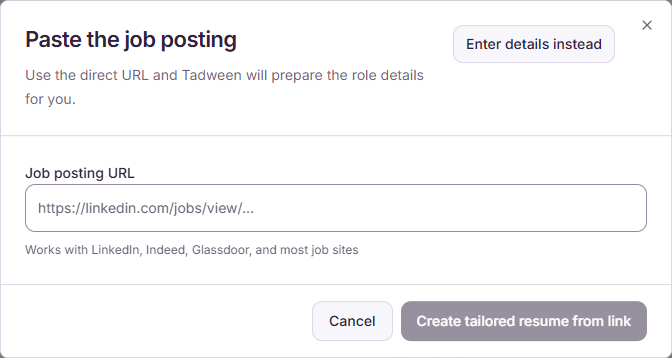
The approved English setup shows the role-context and resume-source choices. Review every generated claim and submit through the employer's stated process.
The application board can help organize tailored applications across hiring stages. Keep your external sent-file log if you need exact filenames, portal confirmations, or a record outside the product.
Run a truth, format, and parity audit
Before uploading, compare the exported file with the source, the posting, and the log. This check is more useful than proofreading the editable document and assuming the PDF is identical.
- The contact details are current and belong to the correct language version.
- Employer names, titles, dates, credentials, and language levels match the fixed-facts ledger.
- Every achievement preserves real scope and ownership.
- Every posting term is supported by work you can explain.
- English and Arabic versions preserve the same factual claims.
- The employer's required format, size, and naming instructions are followed.
- The PDF opens correctly and the filename matches the application log.
- The exact sent file—not a later edit—is attached to the record.
When the source changes, decide which active branches need the correction. When only one posting changes, update that application copy without turning it into the new master by accident.
Keep the system small enough to trust
A good version-control system reduces ambiguity. It does not reward you for maintaining the largest number of files. Keep one complete career source, only the role-family branches you can defend, and one clear sent record per application. Archive old branches with a date instead of letting them compete with current files.
The result is simple: completeness lives in the source, relevance lives in the branch, and accountability lives in the log. You can adapt the presentation for a role or language without allowing your career facts to drift.
Build a tailored resume without losing the truth
Verify the source, choose role-relevant evidence, audit the exported file, and record exactly what you submit.