
Personal Branding for Professionals: Why LinkedIn Alone Isn't Enough
You've invested years in your career. Your professional identity deserves more than a single platform you don't control. Here's how to build an owned career presence that works alongside LinkedIn, not instead of it.
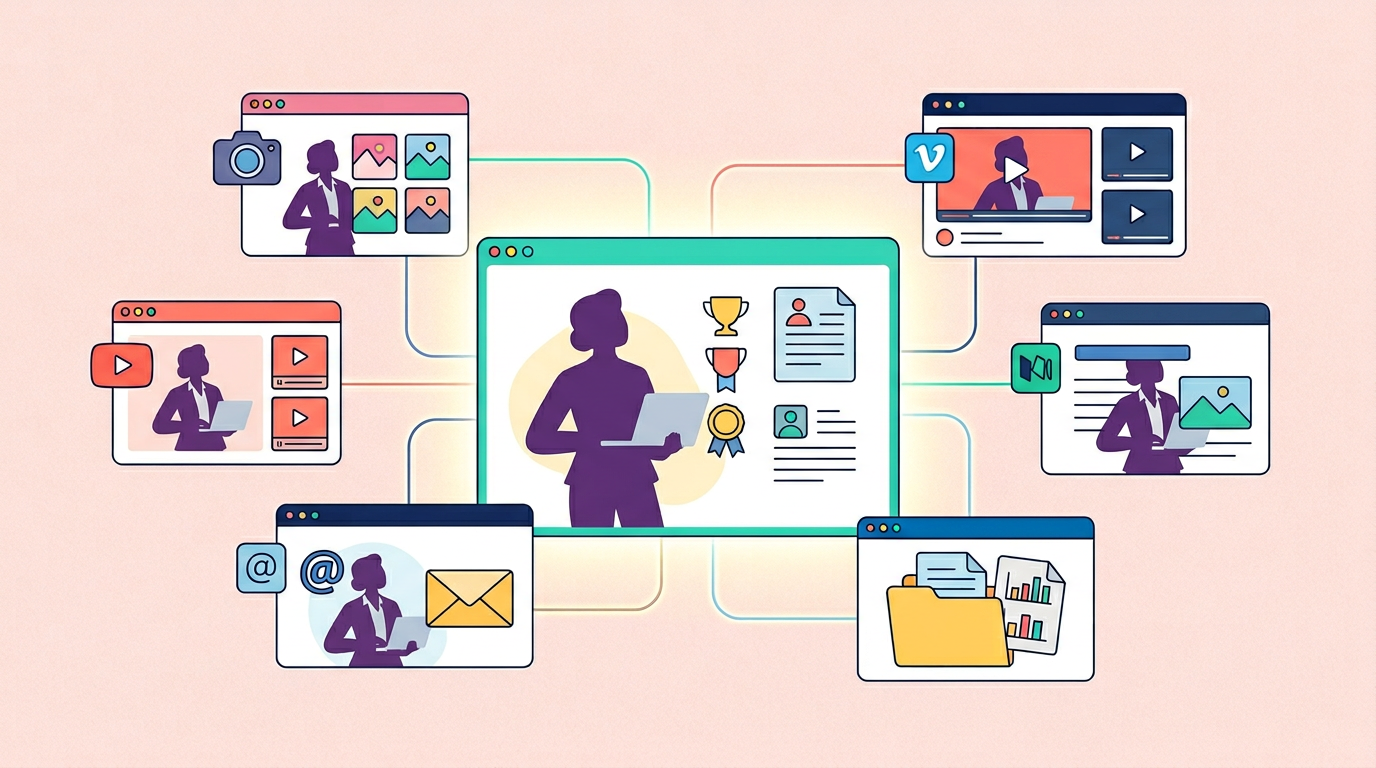
Your Career Lives on Someone Else's Server
You've spent a decade building your career. You have a polished LinkedIn profile with the right headline, the right connections, 500+ endorsements for skills you actually possess. And yet, when a potential client or hiring manager Googles your name, what they find is LinkedIn's version of you. Not yours.
Your professional identity sits inside a platform that decides who sees your posts, surrounds your profile with competitor suggestions, and can change its algorithm overnight. You can't control the layout, the sidebar recommendations, or the "People also viewed" section that sends visitors to your competition. Your carefully crafted content competes with engagement bait and viral reposts for visibility.
None of this makes LinkedIn bad. It makes LinkedIn limited. And for professionals who think seriously about their career trajectory, limited is a risk.
Think of LinkedIn as a storefront on a busy street. It brings foot traffic, it has credibility, it's where people expect to find you. But it's not your home. You don't set the rules. And if the street changes, so does your presence.
LinkedIn Is Rented Land
The phrase "rented land" comes from content marketing, but it applies perfectly to professional branding. When you build your entire professional identity on LinkedIn, you're building on a foundation you don't own.
Here's what that means in practice:
Algorithm dependency. LinkedIn's feed algorithm determines who sees your posts and profile updates. You might publish a thoughtful article about supply chain resilience. It reaches 200 people. The next week, someone posts "I got rejected 47 times and then became CEO" and reaches 200,000. You're competing for attention in a system designed for engagement, not professional substance.
Template constraints. Every LinkedIn profile looks the same. Same layout, same sections, same character limits. Whether you're a creative director with a visual portfolio or a strategy consultant with case studies, you get the same text-heavy format. There's no way to showcase work samples, embed presentations, or structure your narrative beyond the rigid sections LinkedIn provides.
Data you don't control. LinkedIn owns your connection graph, your engagement data, and your content history. If the platform changes its terms, restricts features, or prioritizes paid content over organic reach (which it already does), your professional visibility adjusts accordingly. You have no recourse.
Platform risk. This isn't hypothetical. Twitter (now X) went from the default professional conversation platform to something entirely different in under a year. Professionals who built their entire presence there had to start over. LinkedIn is more stable, but no platform is permanent.
The solution isn't to leave LinkedIn. It's to stop relying on it as your only professional presence.
The Portfolio Approach: Own Your Narrative
The professionals who stand out online share one thing in common: they own their narrative. They have a dedicated space, a portfolio page or personal site, that exists outside any single platform and presents their career story on their terms.
This isn't about vanity. It's about control. A professional portfolio page lets you:
- Curate what matters most, not everything you've ever done
- Tell your career story with structure and intention
- Showcase work that doesn't fit LinkedIn's rigid format
- Provide a single, permanent URL you can share anywhere
- Present different facets of your career to different audiences
Your portfolio becomes the canonical version of your professional identity. LinkedIn, conference bios, email signatures, and social profiles all point back to it. When someone wants the full picture, they know where to go.

The strongest professional brands don't choose between platforms and portfolios. They use both strategically.
What to Include (and What to Leave Out)
The biggest mistake professionals make with personal sites is trying to include everything. Your portfolio isn't a database. It's a narrative.
Here's what the most effective professional portfolios include:
A clear positioning statement. Who are you, what do you do, who do you serve? This should be visible within the first three seconds. Not a job title. A value proposition. "I help SaaS companies build product-led growth engines" tells the visitor exactly what to expect. "Marketing Professional" tells them nothing.
Curated projects or achievements. Pick three to five that demonstrate range and depth. Each should tell a mini-story: what was the challenge, what did you do, what was the outcome? Specificity matters. "Increased conversion rate by 34% through checkout flow redesign" is memorable. "Improved key metrics" is forgettable.
Your career story. Not a chronological resume. A narrative arc that connects where you started, what shaped your path, and where you're heading. People remember stories. They forget bullet points.
Social proof. Testimonials from colleagues or clients, published articles, speaking engagements, press mentions. Anything that lets others vouch for your expertise without you having to claim it yourself.
Contact information. Make it easy. A contact form, an email address, a scheduling link. Don't make people hunt for a way to reach you.
What to leave out: every certification you've ever earned, exhaustive job descriptions from roles you held eight years ago, skills matrices, or anything that makes the page feel like a government application. Curation is the point. If everything is highlighted, nothing is.
Consistency Is the Brand
Your personal brand isn't your LinkedIn headline or your portfolio's color scheme. It's the pattern people recognize across every touchpoint. When someone sees your name on a conference agenda, visits your LinkedIn, reads your portfolio, and receives your email, they should encounter the same person.
Consistency means:
- Same professional photo across LinkedIn, your portfolio, conference bios, and social profiles
- Same core positioning: the one-sentence answer to "what do you do?" should match everywhere
- Same tone of voice: if you're thoughtful and measured on your portfolio, don't be breathless and salesy on LinkedIn
- Same visual identity where possible: colors, typography, presentation style
This doesn't mean copying your LinkedIn summary onto your portfolio word for word. It means both platforms tell a coherent story. Your LinkedIn can be optimized for search and networking. Your portfolio can go deeper, be more visual, more personal. They complement each other when the core message is aligned.
Inconsistency, on the other hand, raises questions. If your LinkedIn says "Product Leader" but your portfolio says "UX Consultant," visitors wonder which is real. If your photo is five years old on one platform and current on another, the mismatch creates subtle distrust. Small details, big impact.
Content Strategy for Professionals: Substance Over Frequency
"You should post more on LinkedIn" is the career advice equivalent of "you should exercise more." Everyone says it. Few explain what it actually means for someone with a real job and limited time.
Here's what most LinkedIn advice gets wrong: it optimizes for platform metrics (likes, comments, impressions) rather than career outcomes (opportunities, reputation, relationships). Posting daily doesn't build authority. Having something genuinely useful to say does.
A professional content strategy that actually works:
Write about what you know deeply, not what's trending. The professional who writes one well-researched piece about regulatory compliance in Gulf markets creates more career equity than the one who posts 50 generic leadership quotes. Depth signals expertise. Volume signals free time.
Publish substance on your owned platform, distribute summaries elsewhere. Write the full article on your portfolio. Share the key insight on LinkedIn with a link back. This drives traffic to your owned presence while leveraging LinkedIn's distribution. Both platforms win.
Update quarterly, not daily. Four substantive portfolio updates per year, each shared on LinkedIn and through your network, builds a more credible body of work than 200 quick posts. Consistency matters more than volume.
Let your work speak. The professionals who build real authority aren't the loudest voices on LinkedIn. They're the ones with the most useful thing to say when their name comes up in a conversation they're not part of. That's the real measure of a personal brand.
One well-crafted article on your portfolio page, shared once on LinkedIn, creates more career equity than 50 generic posts about lessons learned on a Monday morning.
How a Tadween Portfolio Complements LinkedIn
This is where a platform like Tadween changes the equation. Tadween's portfolio builder gives you a public career page at tadween.me/u/your-alias that works alongside LinkedIn as your owned professional presence.
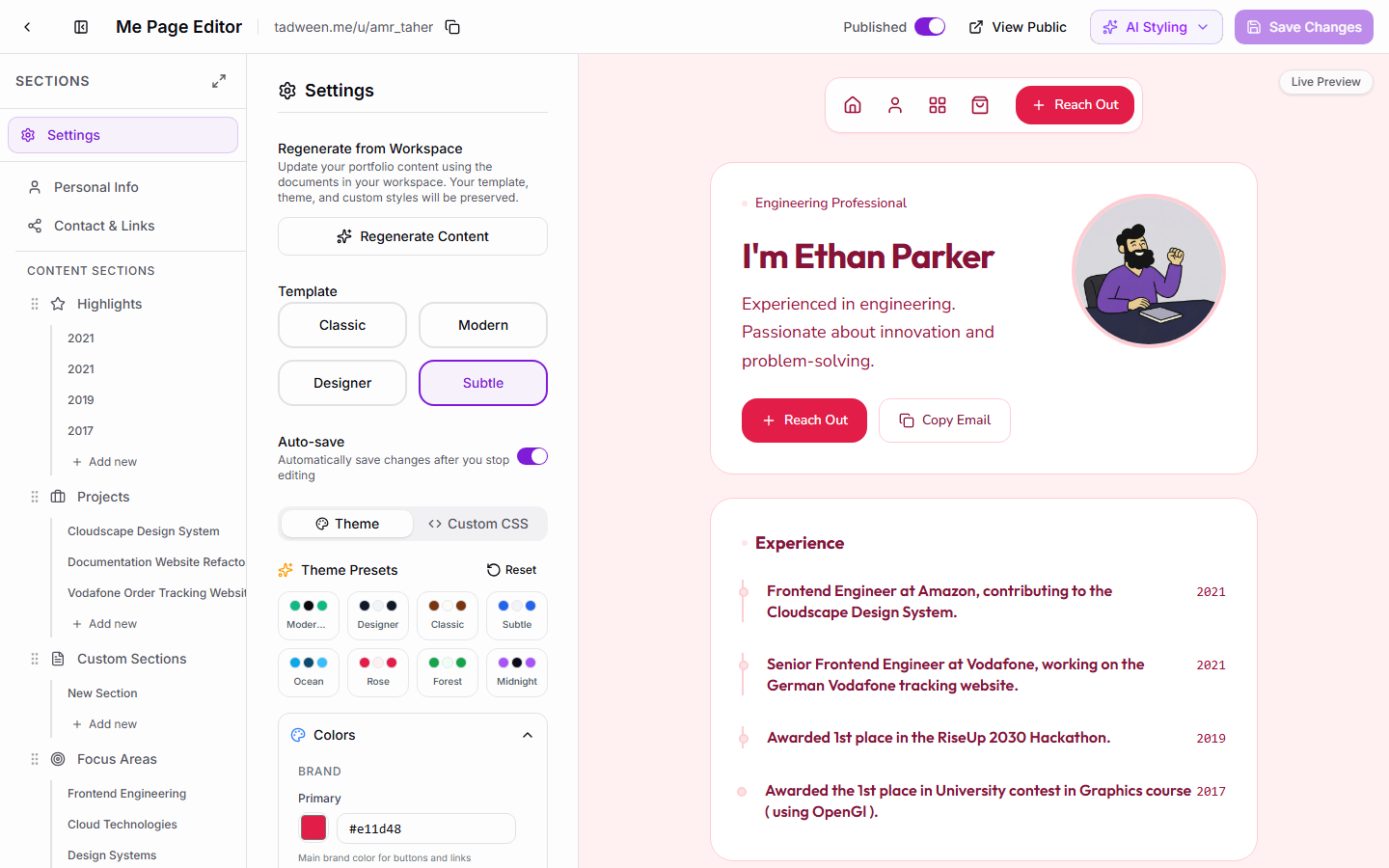
Your Tadween portfolio: a public career page that presents your full professional story, on your terms.
The difference from a static personal website: your Tadween portfolio is built from your actual career data. When you create job profiles in Tadween, each tailored to a different role or market, your portfolio page pulls from that context. Your skills, achievements, and professional summary aren't generic filler. They're the same AI-generated, role-specific content you've already refined for each career direction.
For professionals managing multiple career paths (consultant and full-time engineer, designer and educator, executive and board member), this matters. LinkedIn forces you into one headline, one summary, one narrative. Your Tadween portfolio can present multiple facets of your professional identity without confusing the viewer. Each career path gets its own space, its own tailored content, its own story.
And because Tadween works natively in both English and Arabic with proper RTL support, professionals in the Gulf and MENA region get a career presence that actually represents them in both languages with proper formatting. Not a bolted-on translation layer. Real bilingual career content, built from the ground up.
The workflow is straightforward: build your profiles on Tadween, let the AI generate tailored content from your career history, share your portfolio URL everywhere LinkedIn can't reach, and use LinkedIn itself to drive people to your full story. Two platforms, one coherent brand.
What Works in Professional Portfolios (and What Doesn't)
After studying hundreds of professional portfolios across industries, clear patterns emerge. The best ones share common traits. So do the worst.
What works:
- A hero section with a clear, specific value proposition visible immediately
- Visual hierarchy that guides the eye from positioning to proof to contact
- Real project outcomes with specific numbers and context
- Testimonials from named individuals that speak to specific working qualities
- A single, clear call to action (hire me, contact me, see my work)
- Fast load times and mobile-friendly design
What doesn't work:
- Landing pages that look like a resume printed on a website
- Walls of text without structure, headings, or visual breathing room
- Stock photos used as project thumbnails (visitors notice immediately)
- "I'm passionate about..." statements that say nothing specific about what you actually do
- Contact pages with no actual way to contact you (a LinkedIn link is not enough)
- Portfolios that haven't been updated in two years
The best portfolios feel like a conversation. They answer the questions a hiring manager, client, or collaborator would naturally ask, in the order they'd ask them: Who is this person? What do they do? Are they credible? How do I reach them?
Start With What You Have
Building an owned career presence doesn't require a weekend-long project. Start with your positioning statement: one sentence that captures what you do and who you do it for. Add your three best career achievements with specific outcomes. Include one testimonial from someone who's worked with you. That's a portfolio.
LinkedIn will remain important. It's where professional search happens, where networks live, where opportunities surface through connections. But a LinkedIn profile alone is a single point of failure for your professional identity. Algorithms change. Platforms pivot. Features get paywalled. The professionals who control their own narrative are the ones who stay visible regardless.
Tadween's portfolio builder lets you create that owned presence in minutes, not days. Your career data powers AI-generated content tailored to each role you pursue. Your public page lives at a permanent URL you control. And it works in both English and Arabic from day one.
Your career is too important to exist on rented land alone. Build your home.
Own Your Professional Story
Build a bilingual portfolio page powered by your career data. Multiple career profiles, AI-generated content, and a permanent URL that's yours. Free credits to start.