
The Portfolio Career: Managing Multiple Careers Without Losing Your Mind
You're not confused about your career. You just have more than one. Here's how to manage the complexity without sacrificing your sanity or your professional identity.

You Don't Have One Career. And That's Not a Problem.
Someone asks you what you do at a dinner party. You hesitate. Do you lead with the consulting work? The freelance design projects? The startup you're building on weekends? The teaching gig you took because you genuinely love it?
You settle on something vague. "I work in tech" or "I do a few things." The person nods politely and moves on, and you're left feeling like you failed a test you shouldn't have to take.
Here's the thing: you didn't fail. The question is broken. "What do you do?" assumes one answer. But for a growing number of professionals, particularly in the MENA region, the answer is plural. You don't have a career. You have a portfolio of careers.
And that portfolio is becoming the norm faster than most people realize.
The Rise of the Portfolio Career
The term "portfolio career" was coined by Charles Handy in the 1990s, but it took three decades and a global pandemic for the concept to go mainstream. Remote work removed geographic constraints. The creator economy gave people monetizable platforms. Economic uncertainty made relying on a single income source feel reckless rather than responsible.
The numbers tell the story. In the Gulf states alone, side businesses among employed professionals have surged. A software engineer in Dubai runs an e-commerce brand. A marketing manager in Riyadh teaches workshops. A government employee in Abu Dhabi consults for startups on weekends. These aren't hobbies. They're parallel careers with separate revenue streams, separate networks, and separate professional identities.
This isn't just a MENA phenomenon, but the region has unique drivers. Gulf professionals often have the financial stability and time structure (government roles with defined hours, for example) that make portfolio careers particularly viable. Add a culture that values entrepreneurship and family business alongside employment, and you get a professional landscape where multi-career paths aren't just accepted; they're expected.

Portfolio careers mean choosing all the paths, not just one
The Identity Problem No One Talks About

The practical challenges of running multiple careers are obvious: time management, context switching, separate invoicing. But the deeper challenge is identity.
Traditional career advice is built on the premise that you are your job title. Your LinkedIn headline, your elevator pitch, your resume; all of these tools assume a single professional identity. They work beautifully when you're a "Senior Product Manager at Company X." They fall apart completely when you're a product manager, a UX workshop facilitator, and a career coach.
The most successful portfolio careerists don't try to merge their identities into one. They maintain distinct ones and switch between them deliberately.
This is where most people get stuck. They try to create one unified brand that encompasses everything they do. The result is a LinkedIn profile that reads like a word cloud: "Product | Design | Strategy | Education | Consulting | Speaker." It communicates nothing because it tries to communicate everything.
The alternative is more work, but it works: maintain separate professional identities. Not separate personalities; you're still you. But separate presentations of yourself that speak to different audiences, highlight different skills, and tell different professional stories.
Multiple Profiles vs. One Resume
Think about it from a hiring manager's perspective. If you're hiring a UX designer, you want to see a focused UX portfolio with relevant case studies, design process documentation, and industry-specific experience. You don't want to wade through someone's consulting credentials and teaching history to find the design work buried in the middle.
The same principle applies to every career in your portfolio. Each one deserves its own:
- Professional profile that speaks directly to that specific audience
- Portfolio or work samples relevant to that domain
- Network connections who know you in that context
- Communication style that matches the industry norms
A single resume trying to serve all these careers will serve none of them well. It will be too long, too unfocused, and too confusing. The reader won't understand what you're offering because you're offering everything at once.
This is why job seekers with portfolio careers often underperform in traditional application processes. Not because they're less qualified, but because their materials don't fit the format. An ATS system scanning for "5 years UX experience" won't know what to do with a resume that also lists consulting engagements, teaching positions, and a startup.
The Logistics of Being Multiple Things
Once you accept that separate identities are the way forward, the logistics get real. Here's what managing a portfolio career actually looks like day to day:
Separate Digital Presence
Each career needs its own footprint. That might mean separate portfolio sites, separate social media approaches, or at minimum, separate sections of your online presence that are clearly delineated. A UX designer who also teaches should have a design portfolio that stands on its own and a teaching page that stands on its own.
Network Segmentation
Your design clients don't need to see your teaching workshop announcements. Your consulting network doesn't need updates about your e-commerce side project. This isn't about being secretive. It's about being relevant. Every time you share content that's irrelevant to a segment of your audience, you dilute your credibility in their eyes.
Time Architecture
Portfolio careers require intentional time design. The most common failure mode is treating everything as equally urgent all the time. Successful portfolio careerists often use time blocking: dedicated days or half-days for each career. Monday through Wednesday is consulting. Thursday is content creation. Friday is the startup. The specifics vary, but the principle is consistent: each career gets focused, uninterrupted time.
Financial Separation
Separate bank accounts, separate invoicing, separate tracking. Not just for tax purposes (though that matters), but because understanding the financial health of each career independently is essential for making decisions about where to invest more time and energy.
The MENA Context: Where Portfolio Careers Are Already Normal
In many Western markets, the portfolio career still feels novel, even rebellious. In the Gulf states, it's been the norm for decades, just without the trendy label.
Consider the typical professional profile in the UAE or Saudi Arabia: a primary employment role (often in government or a large corporation) combined with a family business, investment activities, and increasingly, a personal brand or consulting practice. This isn't new. What's new is the scale, the digital tools available, and the younger generation's desire to formalize and professionalize what previous generations managed informally.
The challenge specific to MENA professionals is that most career tools are built for Western, single-career professionals. Resume formats, LinkedIn optimization advice, portfolio templates; they all assume you're one thing. When you're a government strategist who also runs an educational consultancy and is building a tech startup, those tools don't just fall short. They actively work against you by forcing you into a single-identity box.
Career tools should adapt to how people actually work, not force people to adapt to how tools were designed.
Tadween: One Platform, Multiple Career Identities
This is exactly why we built Tadween with multi-profile support at its core. Not as an afterthought or a premium feature, but as a foundational design principle.
Here's what that looks like in practice: you create one Tadween account, and within it, you build separate job profiles for each career. Your UX design profile has its own tailored resume, its own cover letter templates, and its own set of skills and experiences highlighted. Your consulting profile has completely different materials. Your teaching profile tells a different story entirely.
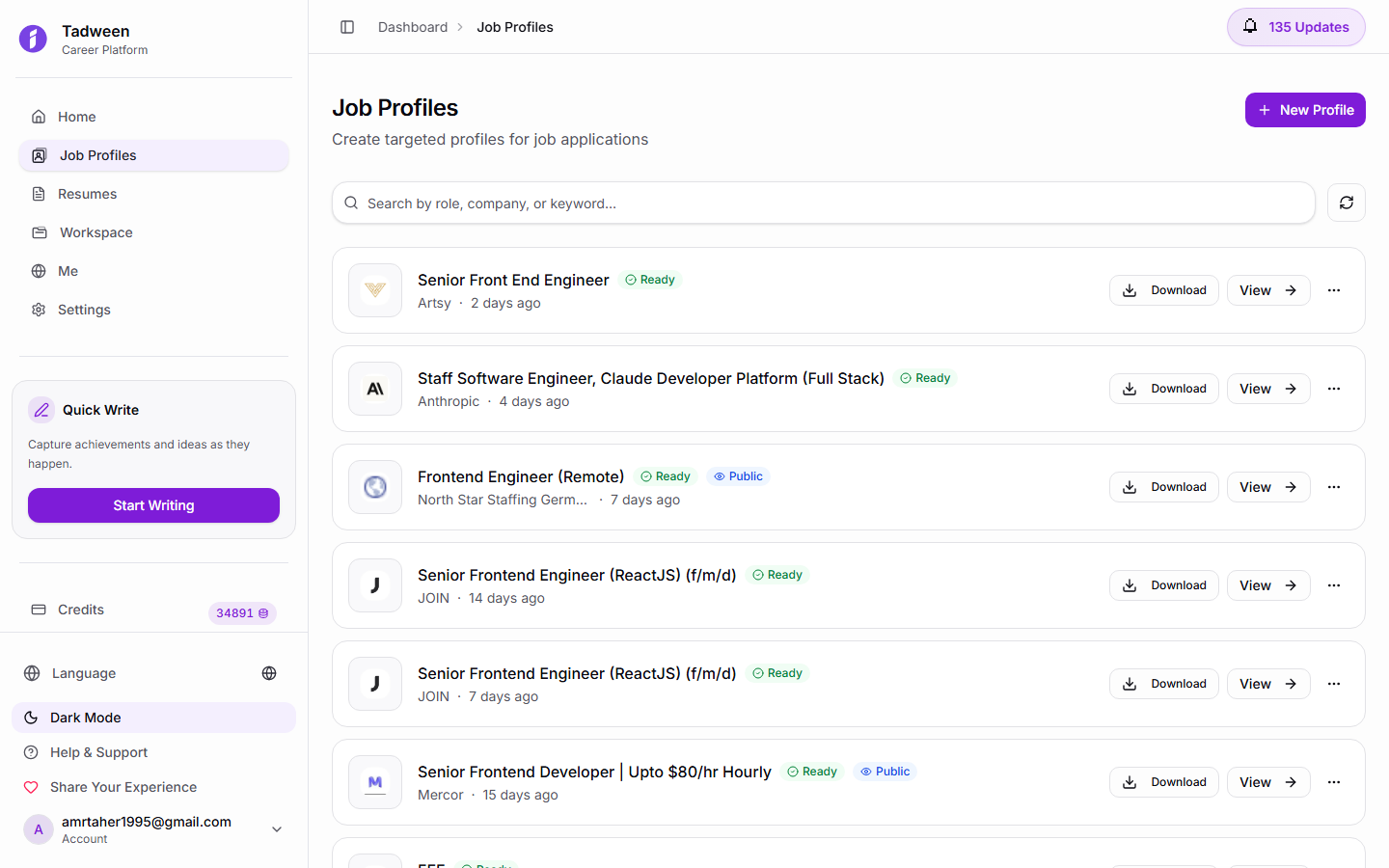
Manage distinct career profiles from a single Tadween workspace
Each profile is independently ATS-optimized. When you apply for a UX role, you send materials from your UX profile. When you pitch a consulting engagement, you pull from your consulting profile. The AI understands the context of each career separately, so the suggestions, skills matching, and document generation are all relevant to that specific identity.
The workspace view lets you switch between careers the way you switch between browser tabs. Your consulting career isn't cluttered with your design portfolio. Your teaching materials aren't mixed in with your startup pitch deck. Everything is organized, separated, and optimized for its specific audience.
And because Tadween is natively bilingual in English and Arabic, you can maintain profiles in both languages. Your Arabic-language consulting profile for Gulf clients. Your English-language design portfolio for international work. Same platform, same data, different presentations.
Making It Work: Practical Steps
If you're building or managing a portfolio career, here's what actually matters:
- Define your careers clearly. Not "I do a bit of everything" but "I have three distinct professional practices." Name them. Give each one boundaries.
- Create separate materials for each. Separate resumes, separate profiles, separate portfolios. Yes, it's more work upfront. It saves enormous time in the long run. Tadween's free credits let you start building multiple profiles immediately.
- Develop a switching ritual. When you move from one career to another during the day, take five minutes to mentally transition. Review your goals for that career. Check your relevant inbox. Get into character, not as performance, but as focus.
- Accept that some people won't get it. Your parents might wish you'd just pick one thing. Some recruiters will be confused. That's fine. The people who hire you for each specific career will value your focus within that domain.
- Track progress independently. Each career has its own metrics, its own goals, its own timeline. A career that's growing slowly isn't failing; it might be in a different phase than your other careers.
The portfolio career isn't a compromise. It's not what you do when you can't decide. It's a deliberate architecture for a professional life that reflects who you actually are: someone with multiple interests, multiple skills, and the ambition to pursue them all.
The tools are finally catching up to the reality. Start building your portfolio career on Tadween and give each of your professional identities the space it deserves.
FAQ
What exactly is a portfolio career?
A portfolio career is when you pursue multiple professional paths simultaneously rather than following a single linear career. This could include a mix of employment, freelancing, consulting, teaching, or running a business. Unlike a side hustle (which implies one primary career and a secondary one), portfolio careers treat each path as a legitimate professional identity.
How do I explain a portfolio career to recruiters or hiring managers?
Don't try to explain all of it at once. When applying for a specific role, present yourself through the lens of that particular career. Use a tailored resume and profile that highlights relevant experience for that role only. Tadween's multi-profile workspace lets you maintain separate, focused materials for each career identity.
Is a portfolio career sustainable long-term?
Yes, but it requires intentional management. The key is treating each career as its own practice with dedicated time, separate finances, and distinct professional materials. Many Gulf professionals have sustained portfolio careers for decades, combining employment with business ownership and consulting.
How many careers can I realistically manage at once?
Most portfolio careerists actively manage two to three careers at any given time. You might have additional dormant ones (a skill you can reactivate when needed). The limit isn't a fixed number; it's the point at which you can no longer give each career the focused attention it needs to maintain professional standards.
Ready to Build Your Portfolio Career?
Create separate professional profiles for each of your careers. ATS-optimized resumes, tailored cover letters, and AI-powered career documents, all from one platform.