
How to Prepare for a Panel Interview
Map the people and their likely perspectives, prepare a small set of truthful stories, and practice bringing every answer back to one coherent conversation.

A panel interview is one candidate speaking with several interviewers in the same session. Prepare for it as one conversation with several work perspectives, not as several separate performances. Confirm the format, build a one-page panel plan, choose four to six reusable evidence stories, and practice answering the asker before reconnecting with the wider room.
The plan should reduce divided attention rather than create more scripts. You cannot know every question or read meaning into every facial expression. You can know the meeting format, the facts you want to communicate, the questions you need answered, and the method you will use when two people follow up at once.
Confirm that it is a panel interview
Employers may use labels inconsistently. A panel interview normally means one candidate meets several interviewers together. A group interview normally means several candidates are assessed in the same session. Santa Clara University's interview-format guide describes panels as meetings with a hiring manager, colleagues, a team, or a search committee, and notes that formats vary by employer.
If the invitation is unclear, ask the recruiter or primary contact for the medium, approximate length, names or roles of attendees, agenda, and whether there is a presentation, task, or separate one-to-one segment. Treat the reply as the source of truth. Do not infer the format from a calendar title or assume that a large attendee list means every person will ask questions.
“Could you confirm the interview format, who is expected to attend, and whether I should prepare a presentation, task, or any materials?”
Build a one-page panel plan
Use one page so you can scan it without memorizing. Include these five blocks:
- Confirmed format: date, time zone, location or platform, approximate length, and any task.
- Panel map: each known name or role, the work perspective they may bring, and one point you want to learn from them.
- Evidence set: four to six truthful stories covering delivery, collaboration, judgment, learning, and one role-specific skill.
- Your questions: two or three questions that help you evaluate the work, team, expectations, or next steps.
- Debrief row: names, questions asked, what you learned, and one answer to improve.
UC Berkeley's interview guidance recommends learning who will interview you, mining your experience for relevant stories, listening closely, keeping answers concise, and recording names and impressions afterwards. Use those as preparation behaviors, not as a promise about how the panel will judge you.
Map perspectives, not predicted questions
A title suggests a possible concern, but it does not reveal the question. A hiring manager may care about ownership and priorities. A future colleague may care about handoffs and daily collaboration. A cross-functional partner may care about decisions and communication. A recruiter may clarify motivation and logistics. Write these as hypotheses, then attach one honest question to each perspective.
Example map: Operations lead → how work moves from plan to delivery → evidence story about resolving a blocked handoff → question: “Where does this role have the most control over delivery, and where does it depend on another team?”
Do not build a different persona for every panelist. The same facts should remain stable. You are changing emphasis, not identity.
Prepare four to six reusable evidence stories
Choose a compact set from real work, study, volunteering, caregiving, or personal projects, and label the context honestly. Each story needs the situation, your responsibility, the action you personally took, the observable result, and what you learned. If you need a starting method, use Tadween's guide to build an evidence bank without memorizing answers.
Reuse one story when it genuinely answers more than one concern. A project-delivery example may show planning to the manager, collaboration to a peer, and judgment to a partner. Keep the underlying facts unchanged. Never add a metric, authority level, employer reaction, or result that you cannot defend.
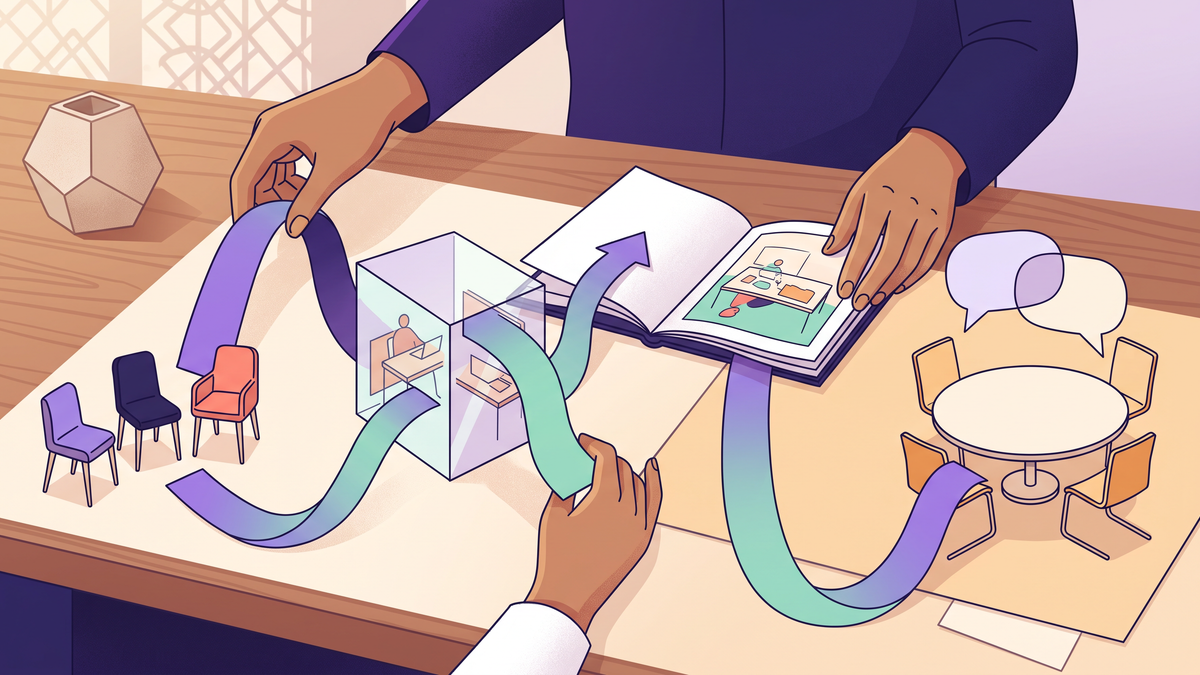
The map is a preparation hypothesis. It organizes evidence and questions without pretending to predict what each person will ask.
Practice the handoff inside each answer
Listen to the whole question, pause briefly, and begin with the person who asked. As the answer develops, include the rest of the panel through natural gaze or a phrase that makes the shared relevance clear. In a virtual meeting, use names when helpful and work with the screen and camera in a way that is comfortable and accessible. There is no universal eye-contact pattern.
Annotated fictional example
Direct answer to the asker: “Yes. The project was delayed because product and operations were using different definitions of complete.” Your action: “I brought both owners into a short review, wrote the two definitions side by side, and asked them to agree the acceptance criteria before we changed the schedule.” Connection to the wider panel: “That mattered beyond the deadline because the same handoff affected reporting and customer communication.” Result and limit: “We agreed one definition and resumed delivery. I owned the clarification and tracking, not the final product decision.”
This answer stays with one evidence story while giving different panel perspectives a place to connect. Replace every detail with your own facts.
Indeed's current panel-interview guide describes a simultaneous conversation with multiple hiring-team members and recommends researching roles and preparing evidence. Use that practical description, but do not assume a panel is designed to create pressure, is more predictive, or follows one fixed question order.
Handle follow-ups and interruptions without guessing intent
Several people may ask follow-ups, take notes, stay quiet, or repeat a topic. None of those behaviors reliably tells you how the interview is going. When a second question arrives before you finish, close your current thought in one sentence and confirm the order:
“I will finish the result in one sentence, then take the question about stakeholder approval.”
“I heard two useful questions. Would you like me to start with the deadline decision or the team disagreement?”
“Could you clarify whether you want the technical tradeoff or how I communicated it?”
Do not become defensive or rush to satisfy both prompts at once. A short clarification protects the accuracy of your answer.
Ask panel-aware questions
Direct a question to the person closest to the topic, then invite another perspective only when it adds value. For example: “From the manager's perspective, what would strong progress look like after three months? And from the team's perspective, which handoff takes the most time to learn?” Keep salary, benefits, formal accommodation, or process questions with the appropriate contact rather than forcing them into a public panel discussion.
End by confirming the next step and primary contact. You are also evaluating the role. Compare what panelists say about priorities, decision rights, support, and collaboration. Differences are questions to clarify, not proof that someone is misleading you.
Rehearse one answer, not a fictional panel
Once the plan is ready, you can review Tadween's current interview tools and optionally rehearse the interview aloud. The current Mock Interviews evidence supports spoken contextual follow-ups, a feedback report, transcript evidence, and a practice plan. It does not show a simulation with several simultaneous human interviewers, so use it to tighten one answer and your evidence structure, not to claim that it recreates the panel.
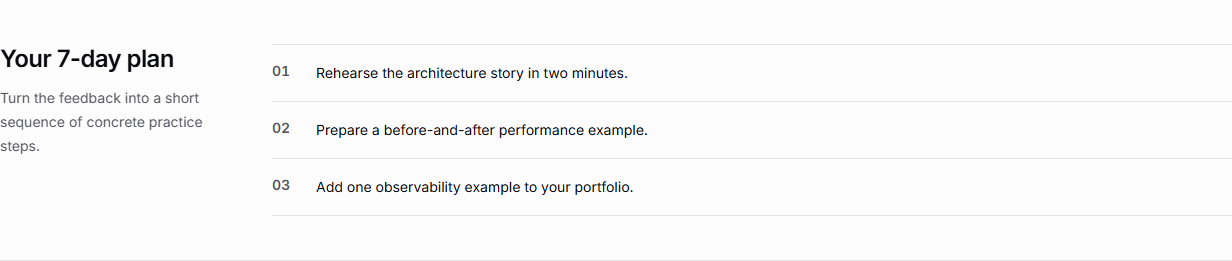
The approved English practice-plan view shows focused actions after rehearsal. It is evidence of a review step, not a multi-person panel simulation.
Keep a concise career introduction ready as well. Tadween's guide can help you practice a role-linked introduction without turning it into a biography.
Use a final-day and debrief check
Follow the employer's instructions for location, security, identification, dress, platform, time zone, and any materials. For a virtual panel, test audio, camera, captions or accessibility tools, and the display name before the call. For an in-person meeting, confirm arrival details and bring only permitted materials. If you need an accommodation, use the employer's stated channel or primary contact.
After the interview, record names, questions, evidence you used, what each perspective taught you about the role, and one answer to refine. Send thanks through the stated contact route; do not guess private addresses. Berkeley recommends thanking the primary contact and extending appreciation to the panel, but the employer's instructions and local norms should guide the channel and timing.
Your goal is not to win the attention of every person separately. It is to make your evidence clear, remain the same truthful candidate across perspectives, and leave with enough information to judge the role and prepare the next step.
Build the panel map, then rehearse the evidence aloud
Keep the facts stable, practice one clear handoff, and enter the room with useful questions of your own.