
Top 10 Soft Skills Employers Want Most in 2026 (And How to Demonstrate Them)
Soft skills now appear in 78% of job postings across industries. Here are the ten that matter most in 2026, with behavioral examples and specific ways to show them on your resume, in interviews, and at work.

The year hard skills stopped being enough
In 2026, the calculus around hiring has shifted. Technical skills still get you through the applicant tracking system, but soft skills are what get you the offer. A recent analysis of over two million job postings found that 78% now explicitly mention soft skills, up from 59% just three years ago. More striking: 80% of hiring managers say adaptability is the single most important skill they screen for when two candidates have comparable technical backgrounds.
This shift has a simple cause. Hard skills decay faster than they used to. The tools, frameworks, and processes a candidate learned eighteen months ago may already be obsolete. What employers are actually hiring for is the capacity to learn, communicate, collaborate, and lead through ambiguity. Those capacities are soft skills, and they have become the real differentiators in a crowded market.
This guide breaks down the top ten soft skills employers prioritize in 2026, how to demonstrate each one credibly on your resume and in interviews, and how to develop them over time. We will also look at what soft skills look like in remote work, in MENA workplaces, and for introverts who are tired of advice that assumes everyone is an extrovert.
The top 10 soft skills employers want in 2026
1. Adaptability
Why it tops the list: economic uncertainty, rapid AI adoption, and organizational restructuring have made change the only constant. Employers want people who absorb disruption without losing productivity.
How to demonstrate it: Instead of writing "adaptable" on your resume, describe a specific pivot. For example: "When our reporting tool was deprecated mid-quarter, I learned the replacement platform in two weeks and migrated 40 dashboards ahead of schedule." Behavioral interview prompt to prepare for: Tell me about a time the ground shifted under you at work. What did you do?
2. Communication
This is not about being articulate. It is about tailoring the message to the audience, being concise under pressure, and writing clearly when nobody is watching over your shoulder.
How to demonstrate it: Point to the artifacts you have produced, the cross-functional presentations you have led, or the documentation you have written that reduced questions. Show evidence that your writing saved someone else time.
3. Critical thinking
Employers are drowning in noise, and they need people who can filter signal from it. Critical thinking is the ability to question assumptions, weigh evidence, and choose the best option when information is incomplete.
How to demonstrate it: Describe a decision where you overturned the default answer after investigation. "The team assumed we needed to rebuild the onboarding flow. After analyzing drop-off data, I proposed a smaller fix that recovered 70% of the benefit at 20% of the cost."
4. Collaboration
Not just "works well with others." True collaboration is the ability to build trust across functions, handle disagreement without damaging the relationship, and ship something better than any one person could alone.
How to demonstrate it: Name the partners you worked with by role ("I partnered with the data team and the customer success lead"), describe the conflict or tension, and point to the joint outcome.
5. Emotional intelligence
EQ is the ability to read a room, regulate your own reactions, and respond to colleagues as humans rather than resources. It is especially prized in client-facing, managerial, and cross-cultural roles.
How to demonstrate it: Share an example where you noticed something beneath the surface: a quiet team member shutting down, a client frustration that nobody named, a conflict that needed surfacing rather than avoiding.
6. Leadership (without authority)
Modern hiring managers distinguish between leadership and management. Leadership is the capacity to influence outcomes without formal authority — rallying peers around a direction, coaching a junior colleague, driving a decision through a matrixed organization.
How to demonstrate it: Describe a moment you stepped up before the title caught up. "Our team lead was on leave for six weeks. I coordinated the sprint planning, unblocked two engineers, and shipped on time."
7. Problem solving
A close cousin of critical thinking, but more action-oriented. Employers want to see how you move from a messy situation to a concrete outcome.
How to demonstrate it: Use the pattern: here was the problem, here is what I tried, here is what worked, here is the measurable result. Numbers make this skill tangible.
8. Time management and self-direction
With hybrid and remote work now the default for knowledge workers, employers screen heavily for the ability to set your own priorities and finish work without supervision.
How to demonstrate it: Describe a period of parallel projects and explain your triage system. If you run your own weekly review, say so — few candidates do, and it is a strong signal.
9. Cultural intelligence
In the MENA region especially, cultural intelligence — the ability to navigate across nationalities, generations, and business norms — is a competitive advantage. Employers hiring regionally want people who can bridge a Gulf client, a North African engineering team, and a European parent company without friction.
How to demonstrate it: Point to specific cross-cultural work: negotiations, onboarding of a teammate from a different market, or facilitation of meetings where English was a second language for most participants.
10. Growth mindset
A growth mindset is the belief that abilities can be developed through effort — and the behavior that follows from that belief: seeking feedback, trying uncomfortable things, and rebounding from failure quickly.
How to demonstrate it: Talk about feedback that changed you. "I received feedback that my presentations were too dense. I joined a speaking group, rebuilt my slide template, and by the next quarterly review, leadership was asking me to present to the board."
How to put soft skills on your resume without the buzzwords
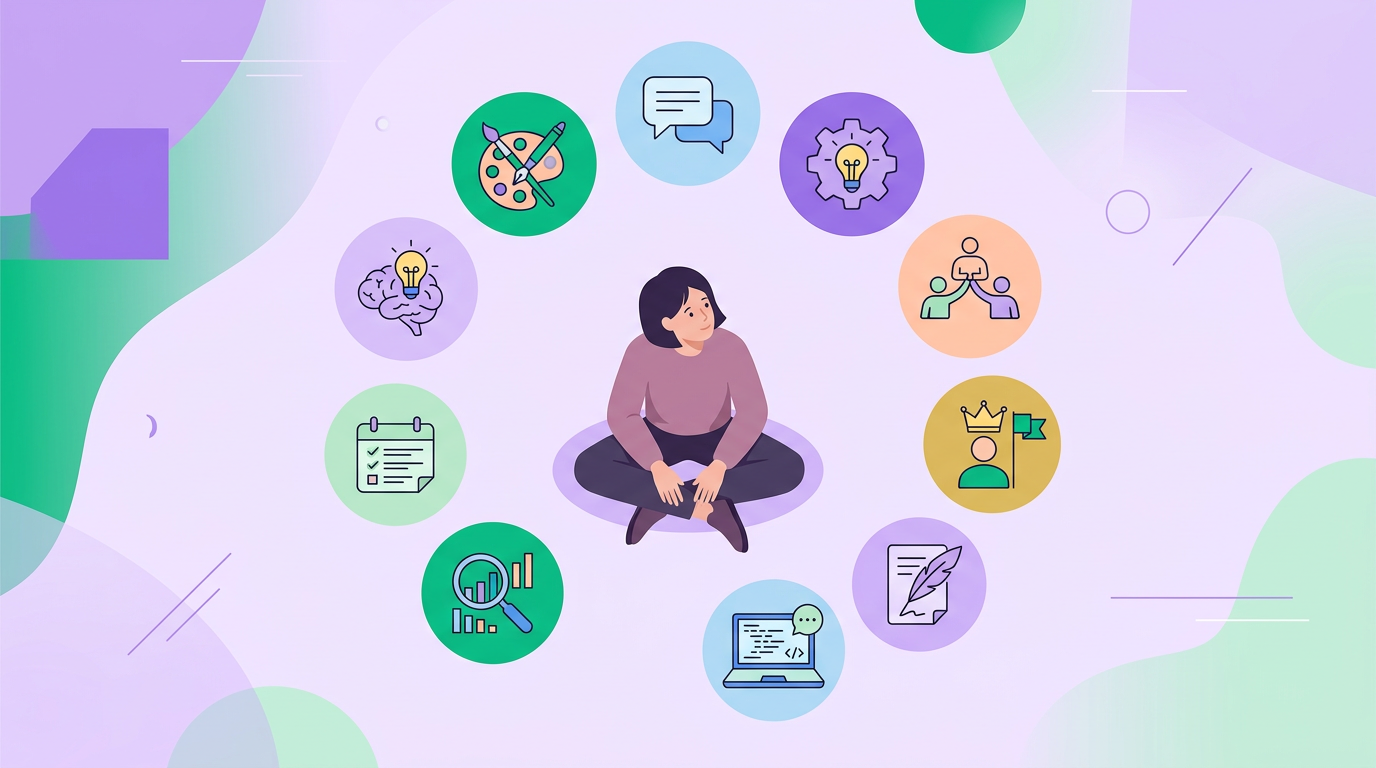
The fastest way to ruin a resume is to list soft skills as a skills block: Adaptable · Team player · Detail-oriented · Strong communicator. Every recruiter has read that sentence a thousand times. It signals nothing.
Instead, bury the soft skills inside your bullet points as evidence. Compare:
Weak: Strong communicator and team player.
Strong: Led a weekly sync across engineering, design, and support to triage customer issues; reduced average resolution time from 9 days to 3.
The second line demonstrates communication, collaboration, and problem solving without naming any of them. That is the trick: show the behavior, let the skill speak for itself.
Behavioral interview examples for the top 10 skills
Most behavioral interviews follow the STAR structure: Situation, Task, Action, Result. But a stronger answer also includes reflection — what you learned, and what you would do differently. For each of the ten skills above, prepare one two-minute story that lands the reflection as strongly as the result. Practice them out loud until they sound like you at dinner, not you at a job fair.
A useful exercise: write out your top ten stories once, tag each with the skills it demonstrates, and note which stories you can recycle across multiple prompts. Most candidates reach for the same story too often; strong candidates have a portfolio.
Remote work soft skills: async communication, self-management, virtual collaboration
Remote and hybrid work have reshaped which soft skills matter most. Three that have climbed sharply:
- Async communication: writing a clear update, decision doc, or proposal that lands without a meeting. Hiring managers screen for this in writing samples and take-home exercises.
- Self-management: structuring your own week, protecting focus time, and surfacing risk before it becomes a crisis. No one is going to tap you on the shoulder at home.
- Virtual collaboration: facilitating a meeting where half the room is on video and half is in the office. Reading a chat window while presenting. Making sure the quiet junior on the call gets a word in.
If you are applying to remote-first employers, weave evidence of these three into your resume and cover letter explicitly. They are no longer assumed.
Cultural intelligence in MENA: navigating cross-cultural workplaces
For professionals in the MENA region, cultural intelligence deserves its own conversation. A team of ten in Dubai may include nationals from eight countries, three generations, and two religions. A junior hire coming from a university abroad, a seasoned executive who has worked across the Gulf, and a remote teammate in Cairo are all operating from different defaults about hierarchy, directness, and time.
Strong cultural intelligence looks like: reading which meetings want consensus and which want a decision, understanding when Arabic is the bridge and when English is, adjusting your written tone between a Gulf client and a Levantine colleague, and knowing when a WhatsApp message is more appropriate than an email. Employers in the region value this skill increasingly, but they rarely ask for it by name. Point to it in your stories.
Developing soft skills as an introvert: practical strategies
Most soft-skills advice assumes you enjoy small talk. Many of the best communicators, collaborators, and leaders in any company do not. What works for introverts:
- Write first, speak second. Before a meeting, draft the point you want to make in two sentences. You will enter the conversation more confident and more concise.
- Invest in one-to-one depth. Group networking drains introverts. Regular one-on-one coffees with colleagues across the company build a stronger network over time than any mixer.
- Volunteer for written visibility. Write the retrospective, the proposal, the quarterly recap. Your name on clear documents builds a reputation without requiring the stage.
- Prepare, do not perform. Every introvert I know who became a strong presenter did it by over-preparing, not by becoming extroverted.
Soft skills vs hard skills: finding the right balance for your industry
The right mix depends on where you sit. Early-career engineers should weight hard skills at about 70%; by the time they are senior, the ratio flips. In client-facing roles — sales, consulting, account management — soft skills are the primary differentiator even at entry level. In highly technical or regulated fields, hard skills remain foundational, but soft skills become the promotion ceiling.
A good diagnostic: look at the next role above yours in your company. What does the person in that role do differently? If the answer involves more influence, more stakeholder management, more coaching, and less individual execution, you have identified where to invest next.
How Tadween helps you articulate soft skills through career evidence
The hardest part of demonstrating soft skills is remembering the examples when you need them. Six months after a tough negotiation, the details blur. A year later, you remember it happened but not the numbers.
Tadween's career journal gives you a place to log the moments that become your interview stories: the cross-functional wins, the feedback that changed you, the conflicts you navigated. The platform tags each entry with the skills it demonstrates, so when you are preparing for an interview or updating your resume, you can pull up three examples of adaptability or five examples of leadership without rereading two years of notes.
When you are ready to apply, Tadween turns that evidence into resume bullets and cover letter paragraphs that show soft skills through behavior rather than buzzwords. Compare the credit-based pricing against subscription tools — you only pay for what you produce.
Measuring and tracking your soft skills growth over time
Soft skills feel unmeasurable, but they are not. A few useful signals:
- Feedback cadence. Are you receiving more specific, more trusting feedback from peers and managers than you were a year ago? Vague praise is often a sign you have not yet earned the hard feedback.
- Scope of influence. Are you being consulted on decisions outside your immediate team? That is a direct measure of communication and trust.
- Meeting efficiency. Are your meetings shorter and more decisive than they used to be? That is leadership and communication compounding.
- Recovery time. After a setback or difficult conversation, how quickly are you back to effective work? That is emotional intelligence and growth mindset in action.
Track these quarterly in a simple document. Over two or three years, the pattern becomes visible — and the evidence becomes your case for a promotion, a new role, or a career pivot.
Soft skills are not soft in the sense of being easy. They are harder to measure, harder to teach, and harder to fake than technical skills, which is precisely why they are worth so much in 2026. Build them deliberately, capture the evidence as you go, and the next time an employer asks for examples, you will have them ready.
Frequently asked questions
Which soft skill should I prioritize developing first?
Start with the one that is most undervalued in your current role. If you are technically strong but rarely included in cross-functional decisions, invest in communication. If you get pulled into many projects but finish few, work on self-management. The highest-leverage skill is usually the one your current environment is quietly penalizing you for lacking.
Can soft skills really be learned, or are they innate?
They are largely learned. Research on deliberate practice applies to communication, emotional intelligence, and leadership just as it does to technical skills. The catch is that soft skills compound slowly and require real-world reps, so the earlier you start a growth loop — try, get feedback, adjust — the further ahead you will be in two years.
How do I demonstrate soft skills if I am changing careers and my examples are from a different industry?
Translate the underlying behavior, not the domain. A teacher who managed parent-teacher conferences has stakeholder management experience. A small business owner who handled a supplier dispute has negotiation experience. Describe the situation in business-neutral language and point to the transferable skill, not the setting.
Do soft skills matter as much in technical roles?
Increasingly, yes. At the entry level, technical skills carry most of the weight, but by mid-career, the engineers who get promoted are the ones who can write clearly, explain trade-offs, mentor juniors, and influence cross-functional decisions. The ceiling in any technical field is set by soft skills.
How does Tadween help me build a portfolio of soft skills examples?
Tadween's career journal and evidence library let you log moments as they happen and tag each entry with the skills it demonstrates. When you need interview stories or resume bullets, the platform surfaces the relevant examples and helps you turn raw notes into polished, behavior-based language.
Turn your soft skills into interview stories
Stop listing adjectives on your resume. Tadween captures the moments that prove your soft skills and turns them into bullets and stories employers remember.