
7 Cover Letter Mistakes That Kill Your Application
You're qualified. Your resume is strong. But your cover letter is costing you interviews. Here are the seven mistakes hiring managers see constantly, with before-and-after fixes for each one.
The Cover Letter Paradox: Qualified but Rejected
You have the skills. You meet every requirement in the job description. Your resume is polished. And yet: silence. No interview, no callback, not even a rejection email.
The problem often isn't your qualifications. It's your cover letter.
Most cover letters fail not because the applicant lacks talent, but because the letter commits one of seven predictable mistakes that hiring managers see hundreds of times a week. Each mistake signals something to the reader: that you're mass-applying, that you didn't read the posting carefully, or that you don't understand what this role actually needs.
Every one of these mistakes has a fix. Here's what to stop doing and what to do instead.
Mistake #1: The Generic Opening That Screams "Mass Apply"
If your cover letter opens with "I am writing to express my interest in the [Position] role at [Company]," you've already lost the reader. This line appears in the vast majority of cover letters. It tells the hiring manager nothing except that you know how to fill in blanks.
The opening is your only chance to break through the noise. A generic opener does the opposite: it confirms you're one of dozens sending the same template.
Before: "I am writing to express my interest in the Marketing Manager position at Acme Corp. I believe my skills and experience make me an ideal candidate for this role."
After: "When I saw Acme Corp's rebrand last quarter, I noticed your team shifted from product-led messaging to story-driven campaigns. That's exactly the transition I led at my current company, where it increased engagement by 40%."
The fix: open with something specific. Reference the company's recent work, a challenge you know they face, or a result you've achieved that directly relates to what they need. If you can't write a specific opening for this company, you haven't researched enough to apply.
Mistake #2: Repeating Your Resume in Paragraph Form
Your cover letter is not a prose version of your resume. If the reader wanted bullet points about your work history, they'd look at your resume. They already have it. Repeating the same information in sentence form wastes their time and yours.
A cover letter exists to do what a resume cannot: explain context, show motivation, and connect your experience to the specific role. It's the "why" to your resume's "what."
Before: "In my current role as a project manager, I manage a team of 8 people and oversee project timelines. Previously, I worked as an assistant project manager where I coordinated meetings and tracked deliverables."
After: "Managing an 8-person team taught me that the hardest part of project delivery isn't the timeline; it's getting stakeholders to agree on what 'done' looks like. I built a lightweight alignment framework that cut our revision cycles by half. Your job posting mentions cross-functional coordination as a key challenge, and that's the exact problem I've spent three years solving."
The fix: pick one or two experiences from your resume and go deeper. Explain what you learned, why it matters, and how it connects to this specific role.
Mistake #3: Writing About Yourself Instead of Their Problem
Count the word "I" in your cover letter. If it appears in every sentence, you've written a letter about yourself when you should have written a letter about them.
Hiring managers don't post jobs because they want to help you advance your career. They post jobs because they have a problem: a team that needs leadership, a market that needs reaching, a system that needs building. Your cover letter should demonstrate that you understand their problem and can solve it.
Before: "I am passionate about data science and I want to grow my skills in machine learning. I am looking for an opportunity to apply my knowledge in a challenging environment."
After: "Your team is scaling its recommendation engine while migrating to a new data infrastructure. That combination of building and rebuilding simultaneously is something I navigated at my previous company, where I maintained model accuracy within 2% during a full platform migration."
The fix: spend the first half of your letter demonstrating that you understand what the company needs. Then show how your experience addresses that need. The ratio should be roughly 60% about them and the problem, 40% about you and the solution.
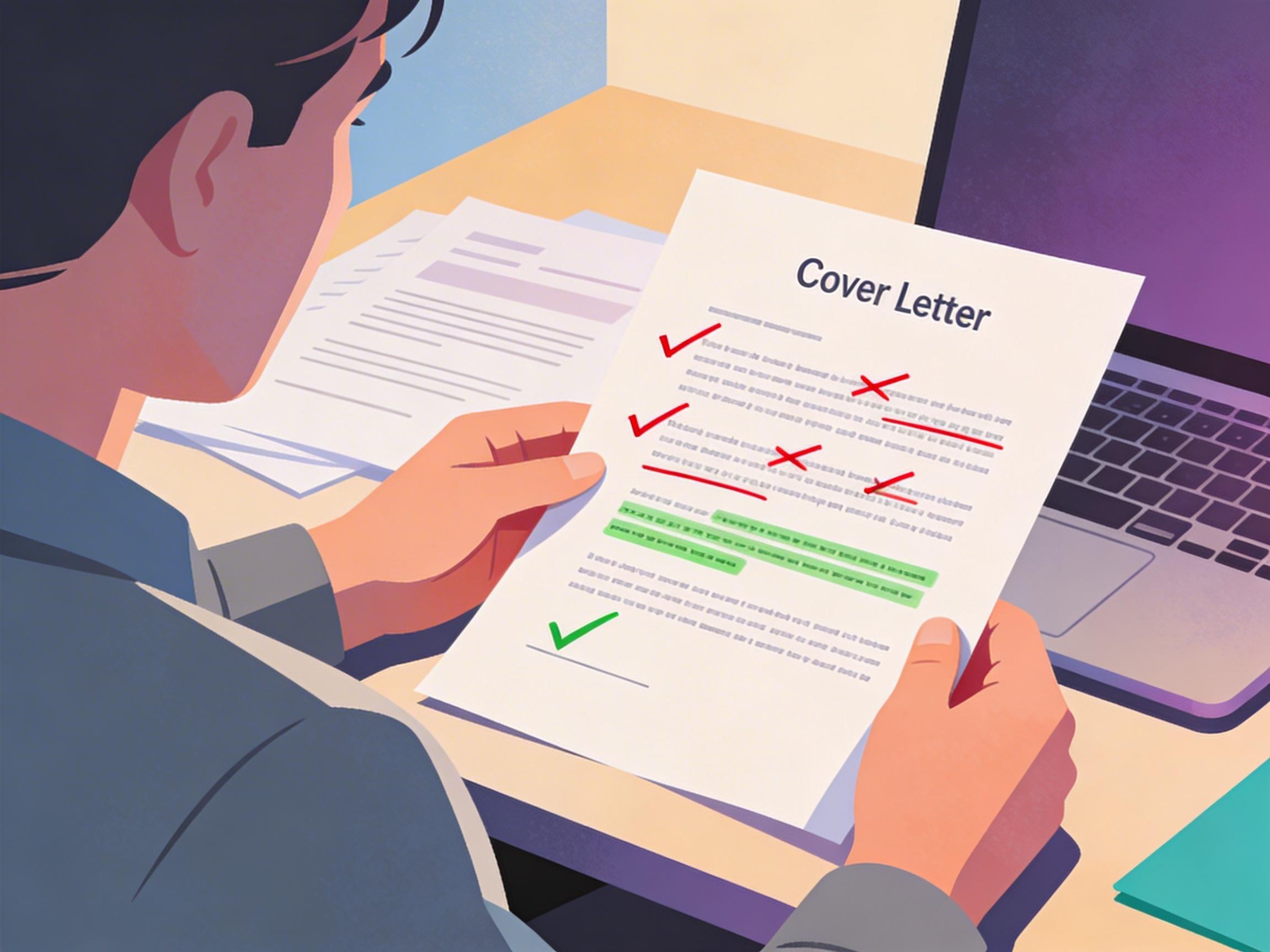
Every cover letter mistake has a fix. The key is knowing what hiring managers actually look for.
Mistake #4: Writing a Novel When They Want a Note
The ideal cover letter is 250 to 350 words. Most are over 500. Some push past 700. Nobody reads them.
A hiring manager spending 30 seconds on a resume is not going to invest two minutes reading your cover letter. Every word beyond 350 reduces the chance that any of your words get read at all.
The rule: If you can't make your case in 300 words, you haven't figured out what your case actually is. Brevity is evidence of clarity.
The fix: write your draft, then cut it by 30%. Remove every sentence that restates something you've already said. Remove qualifiers like "I believe" and "I feel that." Remove the paragraph about your college coursework unless you graduated in the last two years. What remains is your cover letter.
Mistake #5: Ignoring the Job Description's Own Language
When a job posting says "cross-functional collaboration" and your cover letter says "working with different teams," you've missed an easy win. When they say "stakeholder management" and you say "dealing with clients," you've created a gap where there shouldn't be one.
This isn't about keyword stuffing. It's about speaking the same language as the people who will read your letter. Every organization has its own vocabulary, and the job description is a glossary.
Before: "I'm good at working with different departments to get projects done on time and make sure everyone is happy with the results."
After: "I led cross-functional collaboration between engineering, design, and product teams, aligning stakeholders on shared OKRs that reduced delivery timelines by three weeks per quarter."
The fix: read the job description three times before writing. Highlight their key phrases. Use those phrases naturally in your letter, woven into your own narrative rather than forced in. This also helps with AI screening systems that scan for terminology alignment.
Mistake #6: Vague Claims With No Evidence
"I'm a results-driven professional with strong communication skills." This sentence contains zero information. What results? How strong? Compared to what?
Every claim in your cover letter should come with a receipt. If you say you improved something, say by how much. If you say you led something, say how many people and what the outcome was. Unquantified claims are just adjectives pretending to be achievements.
Before: "I significantly improved the onboarding process, resulting in better employee satisfaction."
After: "I redesigned the onboarding process from a 5-day classroom format to a blended 3-day program with async modules. New hire time-to-productivity dropped from 45 days to 28 days, and satisfaction scores increased from 3.2 to 4.6 out of 5."
The fix: for every claim, ask yourself "can I attach a number, a timeframe, or a specific outcome?" If you can't quantify it, at least make it concrete. "Improved the process" becomes "reduced the steps from twelve to four."
Mistake #7: Ending Without a Clear Next Step
Many cover letters trail off with "Thank you for your consideration" or "I look forward to hearing from you." These closings are polite and completely passive. They put the entire burden of action on the hiring manager.
Your closing should do two things: restate your fit in one sentence and propose a specific next step.
Before: "Thank you for considering my application. I look forward to hearing from you at your earliest convenience."
After: "I'd welcome the chance to walk through how I'd approach your Q3 expansion plan. I'm available for a conversation any afternoon this week or next."
The fix: end with confidence and specificity. Mention something concrete about the role, suggest a timeframe for conversation, and make it easy for them to say yes.
The Pattern Behind All Seven Mistakes
Every mistake on this list shares a root cause: writing from your own perspective instead of the reader's. Generic openings are easy for you. Resume repetition is comfortable for you. Long letters feel thorough to you. But none of these serve the person reading.
A great cover letter is an act of empathy. It says: I read your posting carefully, I understand your challenges, and here's specific evidence that I can help.
How AI Can Fix What Humans Keep Getting Wrong
The reason these mistakes persist is that writing a tailored cover letter for every application is genuinely hard. It takes research, self-awareness, and the ability to connect your experience to a specific role's needs, all in 300 words.
This is where AI cover letter tools earn their value. Not by generating generic templates (that just automates Mistake #1), but by pulling from your actual career context to create targeted letters.
Tadween's AI cover letter generator works differently from template-based tools. It draws from your complete career profile, including your job history, achievements, skills, and portfolio, to write cover letters that reference your real accomplishments. When you paste a job description, it maps your experience to the role's requirements and generates a letter that addresses the company's specific needs with evidence from your career.
The result is a cover letter that avoids all seven mistakes by design: it opens with relevance, adds context beyond your resume, addresses the employer's problem, stays concise, mirrors the job description's language, includes quantified achievements, and closes with a clear ask.
That's not magic. It's what happens when a tool has enough context about your career to write something specific instead of something generic.
Frequently Asked Questions
Common questions about cover letters and how to write them effectively.
How long should a cover letter be?
250 to 350 words. That's roughly three-quarters of a page with standard formatting. Anything over 400 words risks not being read at all. Focus on quality over quantity: one compelling connection between your experience and the role is worth more than five paragraphs of generic qualifications.
Should I write a cover letter if the application says it's optional?
Yes, with one caveat: only if you can write a good one. A tailored cover letter that addresses the specific role gives you an edge over candidates who skip it. But a generic, template-based letter is worse than no letter at all, because it signals low effort. If you can't tailor it to this specific company and role, skip it.
Should I address my cover letter to a specific person?
If you can find the hiring manager's name through the job posting, company website, or LinkedIn, use it. But don't waste 30 minutes hunting for a name. 'Dear Hiring Team' or 'Dear [Department] Team' is perfectly acceptable. What matters far more is the content of the letter, not the salutation.
Do cover letters still matter with AI screening systems?
Many ATS systems do parse cover letters for keywords and relevance signals. But even when they don't, your cover letter will be read by a human at some point in the process. The companies most likely to read cover letters carefully are often the ones you most want to work for, because they care about communication skills and cultural fit.
Stop Writing Cover Letters That Get Ignored
Tadween's AI generates tailored cover letters from your real career history. Every letter addresses the specific role, references your actual achievements, and avoids the mistakes that get applications rejected.