
How Many Job Applications Does It Actually Take to Get Hired?
The real numbers behind job searching, and why your strategy matters more than your volume.

The Numbers No One Talks About
You've sent out 50 applications. Maybe 80. Maybe more. The responses? A handful of automated rejections, two screening calls that went nowhere, and a whole lot of silence.
Here's what most career advice gets wrong: they either tell you to "keep going, it's a numbers game" or they shame you for not networking enough. Neither is helpful when you're staring at an inbox full of nothing.
Let's look at what actually happens when people apply for jobs, and more importantly, what separates those who get hired quickly from those who spin their wheels for months.
What the Data Actually Shows
The average job seeker sends between 100 and 200 applications before receiving an offer. That number comes up in nearly every survey on the topic, and it sounds both reassuring and terrifying depending on where you are in the process.
But averages hide more than they reveal. Here's a more useful breakdown:
- Application-to-interview rate: Roughly 5-10% of applications result in a first-round interview. For highly competitive roles (FAANG, top consulting firms, popular startups), this drops to 2-3%.
- Interview-to-offer rate: Once you're interviewing, your odds improve dramatically. About 20-30% of first-round interviews lead to an offer, depending on the role and the number of interview stages.
- Time to hire: The average job search takes 3-6 months. Senior roles and career transitions tend toward the longer end.
These numbers shift significantly based on industry, seniority, and geography. A software engineer in a strong market might get an offer after 30 applications. A mid-career marketing professional switching industries might need 150+.
The point isn't to memorize these percentages. It's to understand that low response rates are normal, not a reflection of your worth.
Why "Apply to 100 Jobs" Is Terrible Advice
The spray-and-pray approach feels productive. You're doing something. Applications are going out. Progress is being made.
Except it isn't.
Here's what actually happens when you mass-apply: you use the same generic resume for every role, write cover letters that could apply to any company, and end up competing against candidates who took the time to tailor their materials.
Recruiters and hiring managers can spot a generic application in seconds. The tell? A professional summary that doesn't mention the specific role. Skills that don't map to the job description. An achievement list that feels copied from a template.
The research consistently shows that tailored applications outperform generic ones by a factor of 3-5x in response rate. Ten carefully crafted applications will typically generate more interviews than fifty generic ones.
This doesn't mean you should spend four hours on every application. It means you need a system.
Tailored vs. Mass Applications: The Real Math
Let's compare two approaches over a month:
Mass approach: 80 applications, generic resume, no cover letter customization. Expected interviews: 2-4 (assuming a generous 3-5% response rate on generic applications).
Tailored approach: 20 applications, resume adjusted per role, cover letter referencing the company's specific needs. Expected interviews: 4-8 (assuming 20-40% response rate on well-matched, tailored applications).
Same month. Same effort. Double the interviews.
The tailored approach wins because it solves the recruiter's actual problem: they're scanning 200+ applications looking for someone who clearly fits this specific role. When your materials directly address their needs, you stand out immediately.
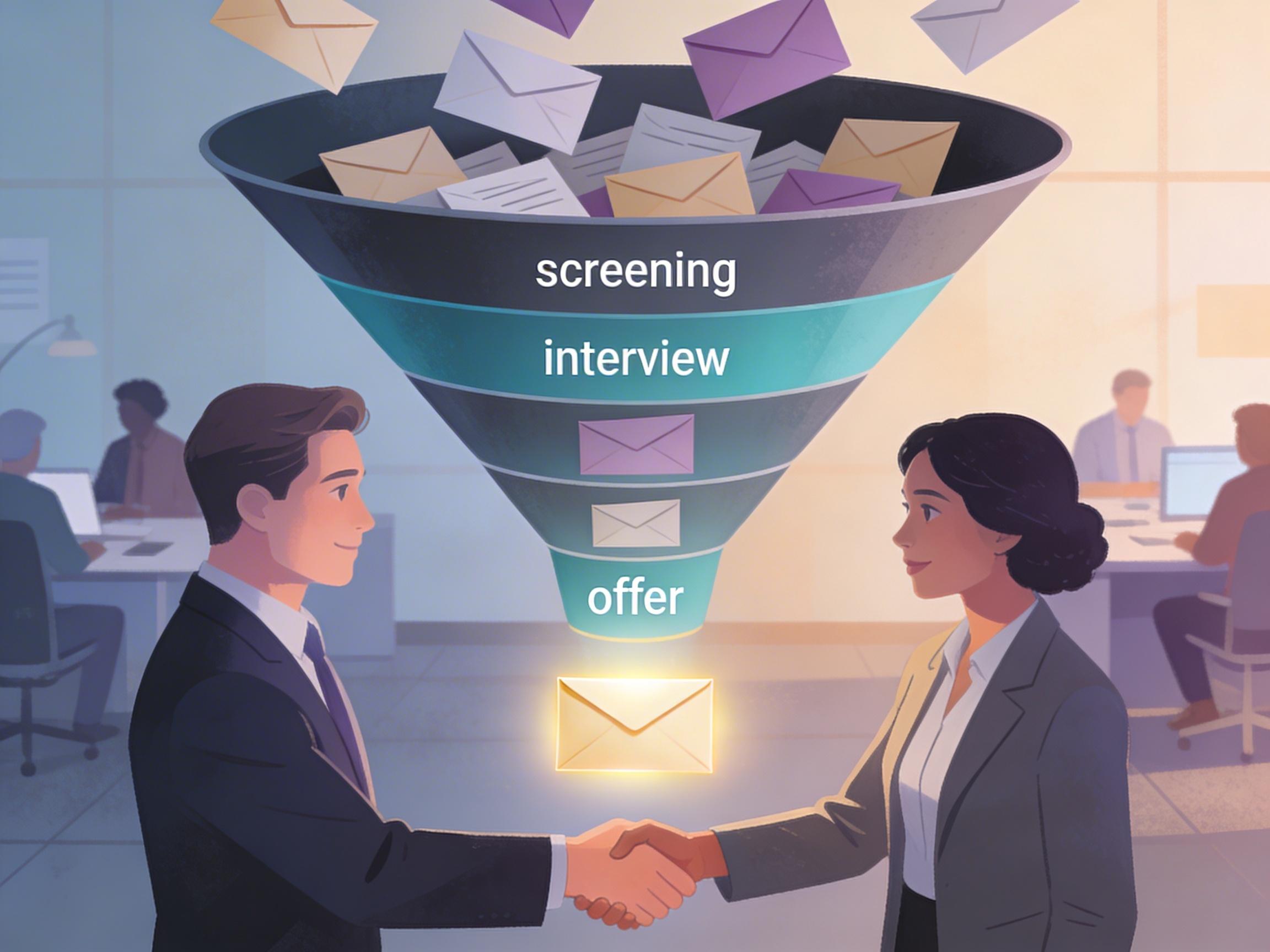
The typical job application funnel: hundreds of applications narrow to a handful of interviews and, ultimately, one offer.
The Hidden Job Market
Here's the number that changes the equation entirely: an estimated 60-80% of jobs are filled through networking, referrals, and internal promotions. They never appear on job boards, or if they do, the company already has a preferred candidate.
This isn't a conspiracy. It's economics. Hiring is expensive. A referred candidate costs less to recruit, comes pre-vetted by someone the company trusts, and statistically stays longer. Companies have every incentive to fill roles through their networks first.
What this means for you:
- Referrals are 4-5x more likely to result in a hire than cold applications
- Informational interviews are not a waste of time; they put you in someone's mental Rolodex for when a role opens
- Being visible in your industry (through content, events, or community participation) creates inbound opportunities
- Former colleagues and managers are your most valuable network, not strangers on LinkedIn
None of this means you should stop applying to posted jobs. It means you should allocate some of your job search time to relationship-building, not just application-sending.
When to Worry (And When to Stay Patient)
The question that keeps job seekers up at night: is my search taking too long?
Normal timelines
- 1-3 months: Standard for roles at your current level in your current industry
- 3-6 months: Typical for career transitions, senior roles, or competitive markets
- 6+ months: Common for executive-level positions or highly specialized roles
Signs your strategy needs adjustment
- You've sent 50+ tailored applications with zero interview invitations
- You're getting first-round interviews but never advancing past them
- Every rejection cites "other candidates more closely matched the requirements"
- You're only applying to reach roles significantly above your current level
Signs you're actually on track
- You're getting interviews, even if they don't convert yet
- Your response rate is improving as you refine your materials
- Recruiters are reaching out, even for roles you wouldn't take
- You're learning something from each interview that improves the next one
The most dangerous phase is weeks 4-8: too early to have meaningful results, late enough to feel anxious. Most people change strategy too early, before their first approach has had time to work.
Track and Improve Your Pipeline
Job searching without tracking is like running a sales team without a CRM. You lose signal in the noise.
Build a simple tracker with these columns:
- Company and role
- Date applied
- Application type (cold apply, referral, recruiter outreach)
- Materials sent (which resume version, cover letter yes/no)
- Current status (applied, screening, interview, rejected, offer)
- Follow-up dates
After 20-30 tracked applications, patterns emerge. You'll see which resume version gets more responses, which types of roles call back, and whether your cover letters are making a difference.
This data turns your job search from a guessing game into an optimization problem.
The Multi-Profile Advantage
Here's where most job seekers create unnecessary friction: they have one resume that they manually edit for every application. Each customization takes 30-60 minutes, most of which is spent reformatting rather than improving content.
A smarter approach is maintaining multiple job profiles, each pre-built for a different type of role you're targeting. A product manager applying to both B2B SaaS companies and fintech startups doesn't need one Frankenstein resume. They need two focused profiles that emphasize different achievements, skills, and positioning.
With Tadween, this is the core workflow. Each job profile is a complete, AI-assisted package: professional summary, skills, achievements, and a cover letter foundation, all tailored to a specific role type. When a matching opportunity appears, you're not starting from scratch. You're customizing a profile that's already 80% ready.
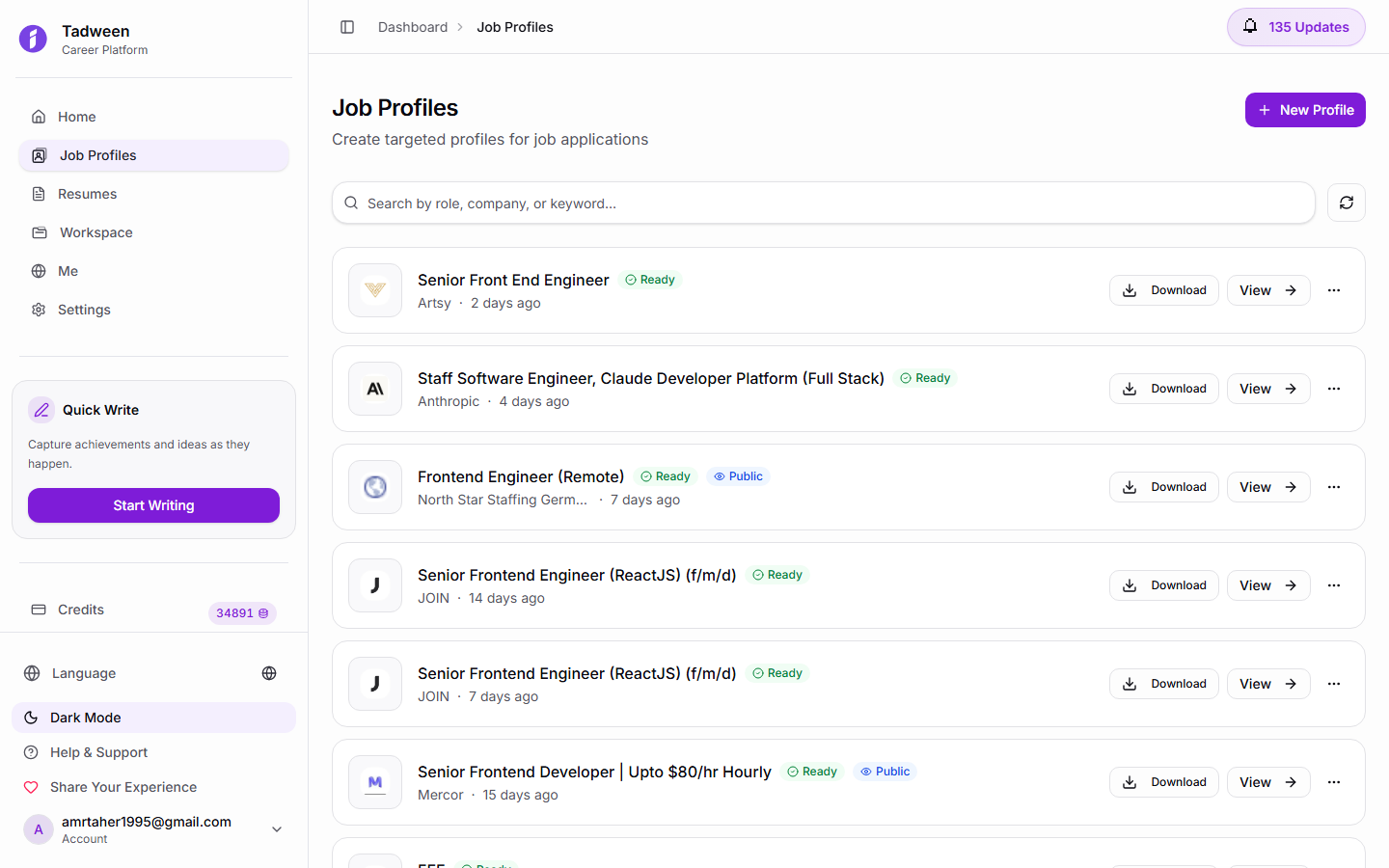
Multiple job profiles in Tadween, each tailored to a different role type and ready to customize.
The difference in speed is significant. Instead of spending an hour customizing a generic resume (and still ending up with something mediocre), you spend 10 minutes fine-tuning a profile that was built for this category of role.
What Actually Gets People Hired
After all the numbers and strategies, hiring comes down to three things:
Relevance. Your materials clearly demonstrate you can do this specific job. Not a similar job. This one.
Timing. You applied when the role was actively being reviewed, not two weeks after the hiring manager already had three strong candidates.
Connection. Someone vouched for you, or your application showed enough genuine interest in the company that the recruiter gave you a closer look.
You can't control timing. You can influence connection. And you can absolutely control relevance by maintaining role-specific profiles that speak directly to each opportunity.
The job seekers who get hired fastest aren't the ones who apply the most. They're the ones who apply with precision, track what works, and invest in both applications and relationships.
Common Questions About Job Applications
Practical answers to the questions job seekers ask most.
How many jobs should I apply to per week?
Quality matters more than quantity. Aim for 5-10 well-tailored applications per week rather than 20-30 generic ones. Each application should include a customized resume and cover letter that directly address the role's requirements. If you're using pre-built job profiles (like those in Tadween), you can move faster because the core content is already tailored.
Should I apply to jobs I'm not 100% qualified for?
Yes, if you meet roughly 60-70% of the requirements. Job descriptions are wish lists, not checklists. Companies routinely hire candidates who don't tick every box but demonstrate strong potential and relevant transferable skills. The exception: don't apply if you lack a hard requirement like a specific license, certification, or security clearance.
How long should I wait before following up on an application?
Wait 7-10 business days after applying before following up. Send a brief, professional email to the hiring manager or recruiter expressing continued interest and adding one specific point of value you didn't include in your original application. If you don't hear back after one follow-up, move on. Two follow-ups maximum.
Is it worth applying to jobs posted more than 2 weeks ago?
It depends. Many companies keep postings active for 30-60 days, and some repost periodically. If the posting is still live, apply. The risk is low and the cost is minimal. However, prioritize fresher postings when possible, as your odds of being reviewed improve when you're among the first batch of applicants.
Does applying through a company's website work better than job boards?
Generally, yes. Applications through the company's career page often go directly into their ATS, while some job board applications can get lost in aggregation. The best approach combines direct applications with networking: apply on the company site, then reach out to someone at the company on LinkedIn to let them know you've applied.
Stop Mass-Applying. Start Applying With Precision.
Create role-specific job profiles with AI-powered content that's ready to customize in minutes, not hours. Free to start.