
How to Write a Bilingual Resume (English + Arabic)
Format, tips, and real examples for professionals applying across English and Arabic-speaking markets. A practical guide to building a bilingual resume that works in the Gulf, MENA, and beyond.

If you are applying for jobs across the Gulf, chances are you need your resume in both English and Arabic. Not as an afterthought, not as a Google Translate pass, but as a professionally crafted document that reads naturally in both languages. This is where most job seekers stumble. They build a strong English resume, then scramble to produce an Arabic version the night before applying to a role in Riyadh or Abu Dhabi.
The result? Awkward translations, broken formatting, and a document that signals to employers that one language was an afterthought. In competitive markets like Saudi Arabia, the UAE, and Qatar, that is a dealbreaker.
This guide walks you through the entire process: when to use a bilingual resume versus two separate documents, how to handle the formatting challenges of mixing left-to-right and right-to-left text, and a section-by-section layout guide you can follow to build your bilingual resume today.
One Bilingual Document or Two Separate Resumes?
This is the first decision, and it depends entirely on the employer and market.
Use a single bilingual document when:
- The job posting is written in both languages
- You are applying to a government or semi-government role in the Gulf (many require Arabic and English on the same CV)
- The employer explicitly asks for a bilingual CV
- You are applying to a bilingual organization where both languages are used daily
Use two separate documents when:
- You are applying to an international company that operates primarily in English
- The role is in a non-Arabic-speaking country
- You want to tailor the content differently for each market (not just translate, but reframe)
- The application system only accepts one document and the role is English-only
The rule of thumb: if the employer operates bilingually, submit bilingually. If they operate in one language, match them.
For Gulf-based professionals, the reality is that you will need both versions eventually. Many apply to roles at Aramco, ADNOC, or Qatar Foundation where Arabic is essential, and simultaneously to roles at McKinsey Dubai or Google MENA where English dominates. The practical move is to maintain both versions and deploy the right one per application.
The LTR/RTL Formatting Problem
Here is where bilingual resumes get technically difficult. English runs left-to-right (LTR). Arabic runs right-to-left (RTL). Putting both on the same page is not just a translation exercise; it is a layout engineering challenge.
What breaks when you mix directions:
- Bullet points flip sides. In an English section, bullets sit on the left. In Arabic, they should sit on the right. Most word processors do not handle this transition gracefully within one document.
- Dates and numbers cause confusion. Arabic text flows RTL, but numbers within Arabic text still read LTR. A date like "2022-2024" embedded in an Arabic sentence can end up in the wrong position.
- Headers and alignment break. If your English headers are left-aligned and your Arabic headers need to be right-aligned, toggling alignment mid-document creates visual inconsistency.
- Tables and columns misalign. A two-column layout with English on the left and Arabic on the right seems simple, but cell padding, text overflow, and alignment behave differently for each direction.
Microsoft Word handles bidirectional text better than Google Docs, but neither makes it easy. You will spend more time fixing alignment than writing content. This is one of the core reasons purpose-built tools exist for bilingual professionals.
Section-by-Section Bilingual Layout Guide
Whether you choose a side-by-side layout or a stacked layout (more on that below), every section of your resume needs careful bilingual treatment.
Header and Contact Information
Your name should appear in both scripts. Place the English name on the left and the Arabic name on the right, or stack them with the primary language on top. Contact information (phone, email, LinkedIn) stays the same in both languages since these are universal identifiers.
Format example:
Ahmed Al-Rashidi | أحمد الرشيدي
Senior Software Engineer | مهندس برمجيات أول
Riyadh, Saudi Arabia | الرياض، المملكة العربية السعودية
ahmed@email.com | +966 XX XXX XXXX
Professional Summary
This section needs true adaptation, not word-for-word translation. Arabic professional writing tends to be slightly more formal than English. A summary that sounds confident and direct in English might need a different register in Arabic to feel natural.
Write your English summary first, then rewrite (not translate) it in Arabic. The core message should be the same, but the phrasing should feel native to each language.
Work Experience
This is the highest-stakes section for bilingual formatting. Each role needs:
- Job title in both languages. Use the official title your employer used. If the company only used English titles, transliterate or provide the closest Arabic equivalent.
- Company name. Keep it in the original language of the company. Do not translate "Google" to Arabic, but do translate "شركة أرامكو السعودية" and provide the English equivalent.
- Dates. Use Gregorian dates in both versions. If the employer requires Hijri dates, add them in parentheses: "January 2022 - March 2024 (Rajab 1443 - Ramadan 1445)". Never use Hijri-only on an English resume or Gregorian-only on an Arabic resume targeting Gulf government roles.
- Achievement bullets. Translate the substance, not the structure. An English bullet that starts with "Reduced infrastructure costs by 35%" might work best in Arabic as a complete sentence rather than a fragment.
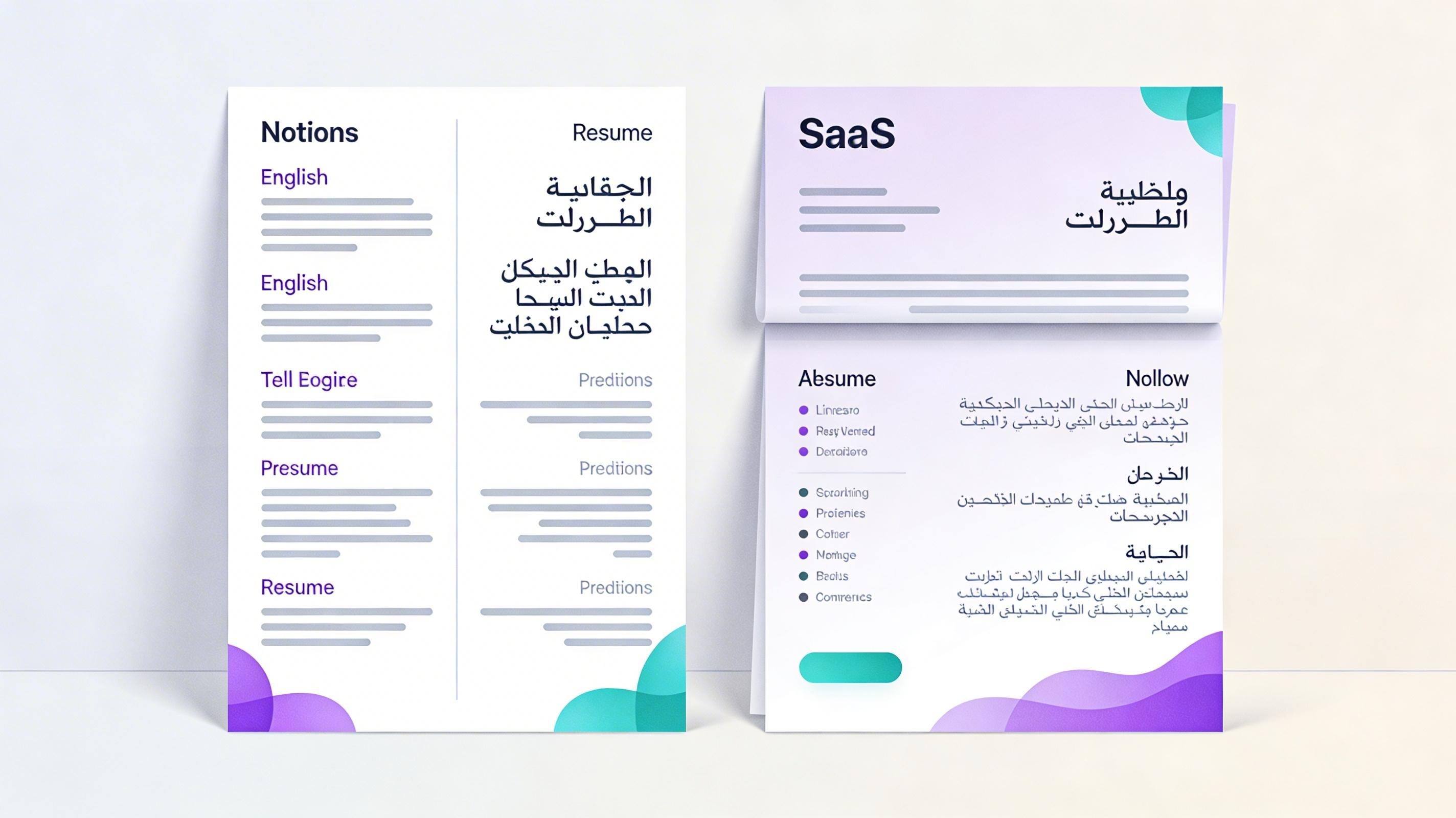
Two common bilingual resume layouts: side-by-side (left) and stacked (right). Each has trade-offs depending on your target market.
Education
List degrees with both the English and Arabic names. For universities, use the official name in both languages if available. "King Saud University" and "جامعة الملك سعود" should both appear. For international universities, keep the original name and add a transliteration if helpful.
Skills
Group skills by category (Technical, Languages, Tools) and present them in both languages. This is one section where a simple two-column table works well: English skill names on one side, Arabic equivalents on the other. Do not translate technical terms that are universally used in English (e.g., "Python", "SAP", "Agile") but do translate soft skills and domain-specific terms.
Common Mistakes That Ruin Bilingual Resumes
Inconsistent translations across sections
If you translate your job title as "مدير المشاريع" in the header but "مدير مشروع" in the experience section, it looks sloppy. Create a personal glossary of your key terms and stick to it throughout the document.
Machine-translating professional terminology
Google Translate handles conversational Arabic reasonably well. Professional and technical Arabic? Not so much. "Project management" might get translated literally instead of using the standard professional term. "Stakeholder engagement" often comes out as gibberish. If your Arabic is not strong enough for professional writing, hire a professional translator for the first version, then maintain it yourself.
Mixing date formats without consistency
Some candidates use "Jan 2022" in English sections and "يناير 2022" in Arabic sections, then switch to "1/2022" elsewhere. Pick one format per language and use it everywhere. Consistency signals professionalism.
Ignoring cultural norms per market
A resume targeting a role in London should not include your photo, marital status, or nationality. A resume targeting a role in Riyadh probably should include all three. Bilingual does not mean identical; the content should adapt to the cultural expectations of each market.
Treating Arabic as a secondary afterthought
If your Arabic sections are noticeably shorter, less detailed, or clearly machine-translated, the employer will notice. In markets where Arabic proficiency matters, this alone can disqualify you. Both versions deserve equal care.
Cultural Expectations: What Each Market Wants
The content of your bilingual resume should shift based on where you are applying.
Gulf/MENA (Saudi Arabia, UAE, Qatar, Kuwait, Bahrain, Oman): Photo on CV is standard and expected. Include nationality, visa/residency status (Iqama holder, transferable visa, etc.), and sometimes marital status. Arabic proficiency is a genuine differentiator, even for roles at international companies. Government and semi-government roles almost always require Arabic documentation.
US and Canada: No photo, no personal details beyond contact information. One-page resume preferred. Arabic version is rarely needed for the application itself but can be a strong asset to mention as a language skill.
UK and Europe: Photo norms vary by country (expected in Germany, not in the UK). Two-page CV is acceptable. Language skills are valued but the document itself is typically in the local language or English.
The bilingual resume is not about proving you speak two languages. It is about demonstrating that you can operate professionally in both, which is a fundamentally different signal to employers.
Side-by-Side vs. Stacked: Choosing Your Layout
There are two primary approaches to bilingual resume layout, and each suits different situations.
Side-by-side layout
English on the left column, Arabic on the right (or vice versa). This works best when the employer wants to see both languages at a glance, typically for government roles or bilingual organizations. The challenge: you have half the horizontal space for each language, which forces shorter bullets and can feel cramped on a single page.
Stacked layout
Full English resume on the first page(s), followed by the full Arabic version. This gives each language room to breathe. The trade-off: the document is longer, and the reader needs to flip between sections to compare. This works well when submitting a PDF where page count is less of a concern.
For most Gulf applications, the stacked layout is more practical. It avoids the formatting headaches of mixed-direction columns and gives each language the space it needs. Reserve side-by-side for situations where the employer specifically requests it or when the content is concise enough to fit comfortably.
How Tadween Handles Bilingual Profiles
Building and maintaining two parallel versions of your career documents is time-consuming. Every time you update an achievement, switch roles, or add a new skill, you need to update both versions and ensure they stay consistent.
Tadween was built with bilingual professionals in mind. When you create a job profile, the AI generates both English and Arabic versions simultaneously, with native RTL formatting that does not break your layout. The Arabic is not a machine translation of the English; it is generated with proper professional Arabic conventions from the start.
You can maintain multiple job profiles for different markets, each with its own bilingual content. A profile targeting a role at Saudi Aramco can emphasize different achievements than one targeting a position at a Dubai-based startup, and both exist in English and Arabic with a single click to switch.
Your public portfolio page at tadween.me/u/your-alias also supports bilingual display, giving recruiters a complete view of your career in whichever language they prefer. Combined with the AI cover letter generator that produces bilingual cover letters matched to your profile, you have a complete bilingual career toolkit without the formatting headaches.
Start with Free credits to start, no credit card required. Create your bilingual profile today.
Frequently Asked Questions
Common questions about bilingual resumes
Should I put English or Arabic first on a bilingual resume?
Lead with the language of the job posting. If the role was advertised in English, put English first. For Gulf government roles posted in Arabic, lead with Arabic. When in doubt, English first is the safer default for private-sector roles in the Gulf.
Can I use Google Translate for the Arabic version of my resume?
Not for the final version. Google Translate handles conversational Arabic but struggles with professional terminology, formal register, and industry-specific terms. Use it as a starting draft if needed, but always have a fluent Arabic speaker review and refine the professional language.
Do I need Hijri dates on my Arabic resume?
For most private-sector roles, Gregorian dates are fine in both versions. For Gulf government and semi-government roles, include Hijri dates alongside Gregorian dates in the Arabic version. Format: January 2022 (Rajab 1443).
Should I include a photo on my bilingual resume?
It depends on the target market. Photos are expected on CVs in the Gulf/MENA region and most of continental Europe. They should be avoided for US, UK, and Canadian applications. If your bilingual resume targets the Gulf, include a professional headshot.
How does Tadween generate bilingual profiles?
When you create a job profile on Tadween, the AI generates both English and Arabic versions simultaneously with proper RTL formatting. The Arabic content is not a translation of the English; it is generated natively with appropriate professional Arabic conventions. You can edit either version independently.
Build Your Bilingual Career Profile in Minutes
Stop wrestling with formatting and translation. Tadween generates professional English and Arabic career documents natively, with proper RTL support and bilingual profiles you can share with a single link.