
The Brag Document: Why the Most Successful Professionals Write Down Everything They Do
Five minutes a day. Every win recorded. Every review, promotion case, and interview answer already written. This is the career habit nobody teaches you.

You Did Amazing Work This Year. Can You Prove It?
It's performance review season. Your manager asks you to summarize your key accomplishments from the past twelve months. You stare at a blank document. You know you did great work. You led that migration project. You mentored a junior developer. You fixed a production outage at 2 AM that saved the company's biggest client. But now, sitting in front of that empty form, the details blur together. What quarter was the migration? What were the actual metrics? Who was the client?
You end up writing something generic: "Led cross-functional projects and improved team processes." It's accurate. It's also forgettable. And it doesn't come close to capturing the real value you delivered.
This is the forgetting problem, and it affects nearly every working professional. Not because they didn't achieve remarkable things, but because human memory is spectacularly bad at retaining the specifics that matter most for career advancement.
The problem isn't that you haven't done impressive work. The problem is that you can't remember the details when it counts.
There's a solution. It's free, it takes five minutes a day, and it has quietly become one of the most impactful career habits among high-performing professionals. It's called a brag document.
What Is a Brag Document?
The concept was popularized by software engineer Julia Evans, who wrote a now-famous blog post arguing that professionals should keep a running record of their accomplishments. Her core insight was simple but powerful: if you don't write down what you did, you'll forget it, and if you forget it, it can't help you.
A brag document is exactly what it sounds like: a private, running list of everything you accomplish at work. Not a polished resume. Not a curated LinkedIn post. Just a raw, honest log of what you did, the impact it had, and what you learned along the way.
The name is intentionally provocative. Many professionals, especially in cultures where humility is valued, feel uncomfortable "bragging." But this document isn't for bragging to others. It's for being honest with yourself about the value you create. It's the difference between walking into a review saying "I think I did well" and walking in with a twelve-page document of timestamped evidence.
A typical brag document entry looks like this:
- Date: March 15, 2026
- What I did: Redesigned the onboarding email sequence for new enterprise clients
- Impact: Trial-to-paid conversion increased from 12% to 19% over the following 6 weeks
- What I learned: Shorter, more specific emails outperform longer educational sequences for enterprise buyers
That's it. Four lines. Two minutes to write. And six months from now, when you need to justify a promotion or negotiate a raise, you'll have the exact numbers, dates, and context that turn a vague claim into an undeniable case.
The Forgetting Problem Is Bigger Than You Think

Research on memory consistently shows that we lose the specifics of experiences far faster than we expect. Within a week, most people have forgotten 70-80% of newly learned information. Within a month, the details that made an achievement impressive, the exact metric improvement, the stakeholders involved, the unexpected obstacle you overcame, are gone.
This isn't a personal failing. It's how memory works. Your brain prioritizes recent and emotionally charged events. That frustrating meeting from yesterday feels more vivid than the successful product launch from four months ago. The complaint from a difficult client sticks; the quiet win of preventing a system failure doesn't.
The result? When it's time to advocate for yourself, you underrepresent your own contributions. You remember the big, obvious things (launched project X, got promoted) but forget the dozens of smaller wins that actually demonstrate your daily value: the process you improved, the teammate you unblocked, the customer escalation you handled, the documentation you wrote that saved the team hours every week.

Without a system to capture your wins, the specifics that make achievements compelling fade within weeks.
These "invisible" achievements are often the ones that matter most. Anyone can list the big milestones on a resume. But the professional who can say, "In Q2, I identified a recurring bug in our payment pipeline that was causing 3% of transactions to fail silently, built a monitoring dashboard, and reduced failure rate to 0.1% within two weeks," that professional gets the promotion.
The Compound Effect: How Daily Logging Transforms Your Career
Here's where the brag document becomes genuinely powerful. A single entry is useful. A year of entries is a career weapon.
When you log your work consistently for twelve months, something remarkable happens. You accumulate 200-300 entries, each with specific details, metrics, and context. This raw material becomes the foundation for everything career-related you'll ever need:
Performance Reviews That Write Themselves
Instead of struggling to remember what you did, you search your brag document. Filter by quarter. Pick the top achievements. The review writes itself in 30 minutes instead of three agonizing hours. And it's specific, detailed, and backed by evidence.
Promotion Cases Built on Evidence
Promotion committees don't promote people based on feelings. They promote people who can demonstrate consistent impact at the next level. A year-long brag document gives you dozens of examples showing scope, leadership, technical growth, and measurable results. You're not arguing why you deserve it. You're showing proof that you're already doing it.
Salary Negotiations With Leverage
"I'd like a raise because I've been here two years" is weak. "Over the past year, I delivered $340K in cost savings through three infrastructure optimizations, mentored two junior engineers who are now operating independently, and led the migration to our new CI/CD pipeline that reduced deploy times by 60%" is a different conversation entirely. A brag document gives you the ammunition to negotiate from strength, not hope.
Interview Answers That Stand Out
Behavioral interviews ("Tell me about a time when...") are essentially tests of career memory. The candidate with a brag document has hundreds of real, detailed stories to choose from. They don't fumble for examples or fall back on vague generalities. Every answer is specific, structured, and compelling because it was captured when the details were fresh.
Confidence That Comes From Evidence
Imposter syndrome thrives on vague self-perception. It's easy to feel like you haven't accomplished much when you can't remember what you've accomplished. A brag document is the antidote. Scrolling through months of recorded wins is a concrete, irrefutable reminder that you are, in fact, good at your job. This isn't motivational fluff. It's documented reality.
A Simple Framework: Five Minutes, Four Questions
The best brag document system is the one you'll actually use. Complexity is the enemy. Here's a framework that takes less than five minutes per entry:
Question 1: What did I do?
Describe the action in one or two sentences. Be specific. Not "worked on the dashboard" but "rebuilt the analytics dashboard to load 40% faster by implementing lazy loading and query optimization."
Question 2: What was the impact?
Quantify when possible. Revenue generated, time saved, bugs prevented, users affected, processes improved. If you can't quantify, describe the qualitative impact: team morale, customer satisfaction, reduced confusion.
Question 3: What did I learn?
This question is often skipped, but it's gold. It captures your growth trajectory. Over time, it shows a clear pattern of expanding skills and deepening expertise.
Question 4: Who was involved?
Note collaborators, stakeholders, and teams. This is useful for two reasons: it helps you remember the full context later, and it gives you a list of people who can vouch for your work if needed.
That's the whole system. Four questions. Five minutes. Do it at the end of each day, or batch it weekly. The key is consistency, not perfection. A rough entry captured today is infinitely more valuable than a polished entry you planned to write but never did.
Real Examples From Real Professionals
Brag documents aren't just for software engineers. Here's what entries look like across different professions:
Marketing Manager
- What: Launched the Q1 email nurture campaign targeting dormant enterprise leads
- Impact: Reactivated 23 accounts, generating $180K in pipeline within 8 weeks
- Learned: Personalization based on last product interaction outperforms industry-based segmentation by 3x for re-engagement
Civil Engineer
- What: Identified structural reinforcement alternative for the Al Wasl Road bridge expansion
- Impact: Saved the project AED 2.1M and reduced timeline by 6 weeks compared to the original specification
- Learned: Carbon fiber reinforcement is viable for load-bearing structures in high-temperature environments when properly insulated
HR Business Partner
- What: Designed and facilitated a retention workshop for the product engineering team after three senior departures
- Impact: Zero additional departures in the following two quarters; engagement scores increased from 6.2 to 7.8
- Learned: Exit interview data alone misses the real retention levers; skip-level stay interviews surface actionable issues faster
Financial Analyst
- What: Built an automated variance analysis model replacing the manual monthly process
- Impact: Reduced month-end close analysis from 3 days to 4 hours; eliminated two recurring data entry errors
- Learned: Power Query handles the transformation layer better than VBA for this use case; easier for the team to maintain
Notice the pattern. Every entry is specific. Every entry has measurable impact. Every entry captures a learning. And every entry took less than three minutes to write.
From Brag Document to Career Asset: Making It Work for You
A brag document is powerful on its own. But its real potential unlocks when you connect it to the rest of your career management system. Here's how:
Monthly rollup: Once a month, spend 20 minutes reviewing your entries. Group them by theme (leadership, technical, process improvement, collaboration). Identify patterns. Are you consistently delivering in one area but neglecting another? This monthly review turns raw data into career intelligence.
Quarterly narrative: Every quarter, write a one-paragraph summary of your top 3-5 achievements. This becomes the foundation of your performance review, your promotion case, and your resume updates.
Resume refresh: With a brag document, updating your resume stops being a dreaded task. You're not starting from scratch. You're selecting the most impactful entries and translating them into resume bullets. The hard part, remembering what you did, is already done.
Interview prep bank: Tag entries that would make strong STAR-method interview stories. When you're preparing for interviews, you'll have a curated library of real, detailed examples ready to adapt.
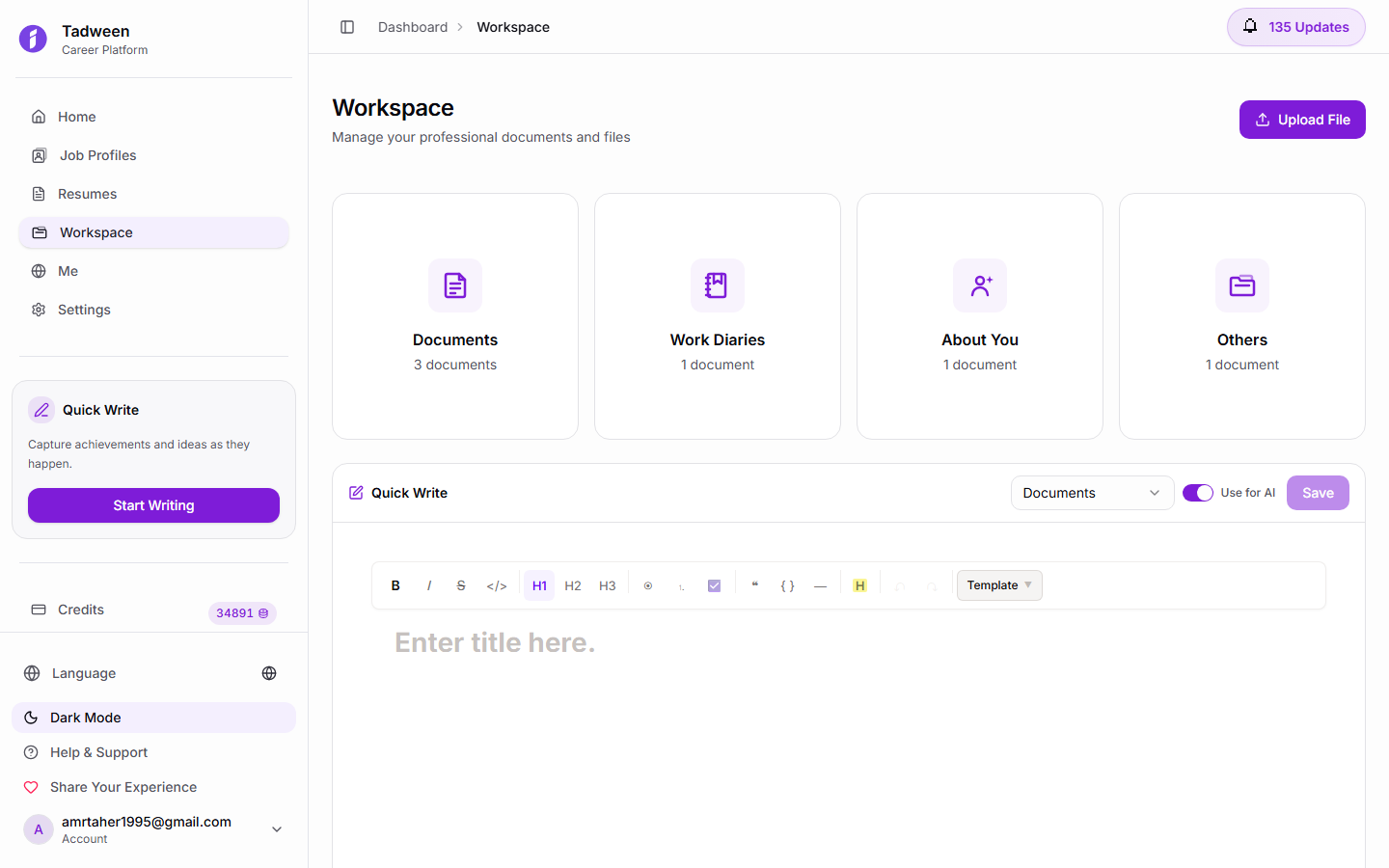
Tadween's workspace lets you log achievements daily and automatically connects them to your job profiles, resumes, and career documents.
How Tadween Turns Daily Logging Into Career Assets
Keeping a brag document in a spreadsheet or notes app works. But it creates an island: your achievements live in one place, and your resume, job profiles, and career documents live somewhere else. Every time you need to use your brag data, you're manually copying and reformatting.
Tadween was built to close this gap. The workspace is designed as a career journal where you log your daily wins, exactly like a brag document. But unlike a static document, Tadween understands context. When you log an achievement, it's automatically linked to your job profiles. When you generate a resume or a cover letter, the AI draws from your full history of logged achievements to write specific, evidence-backed bullets.
Here's what that looks like in practice:
- Log a win on Tuesday: "Led the post-mortem for the payment gateway outage. Identified root cause (race condition in retry logic) and implemented fix. Zero recurrence in 30 days."
- Generate a resume on Friday: Tadween's AI sees that entry, along with your other infrastructure and reliability achievements, and produces a bullet like: "Diagnosed and resolved payment gateway race condition causing intermittent transaction failures; implemented retry logic fix achieving 100% uptime over 30-day monitoring period."
- Prepare for an interview next month: Search your workspace for "incident response" and find every relevant entry, complete with dates, metrics, and context.
The daily habit stays the same: five minutes, four questions. But the output multiplies because every entry feeds your entire career system. Your brag document isn't just a record anymore. It's the engine that powers your resume, your promotion case, your interview prep, and your professional confidence.
For professionals managing multiple career tracks, this is especially valuable. Tadween supports multiple job profiles, so achievements from your consulting work, your side project, and your full-time role all live in one place, each feeding the right career documents.
Start Today. Not Monday. Not Next Quarter.
The best time to start a brag document was your first day at work. The second best time is today. Not because the advice is urgent, but because every day you wait is another day of achievements that slip through the cracks.
You don't need a fancy tool to begin. Open a document. Write down three things you accomplished this week. Include the impact. That's your brag document. You've started.
If you want to turn that habit into a full career management system, where your daily logs automatically power your resumes, cover letters, and job profiles, try Tadween for free. No credit card. No subscription. Just free credits to experience what it feels like when your career finally has a system behind it.
Five minutes a day. That's all it takes to never forget your own achievements again.
FAQ
What's the difference between a brag document and a resume?
A resume is a polished, targeted document designed for a specific audience. A brag document is a raw, private log of everything you accomplish. Think of the brag document as the source material, and the resume as one output. You add to your brag document daily; you update your resume when needed by selecting the most relevant entries.
How often should I update my brag document?
Daily is ideal: it takes less than five minutes when the details are fresh. If daily feels like too much, weekly works well too. The key is consistency. A rough weekly entry is far more valuable than a perfect entry you write once a quarter.
I work in a culture where self-promotion feels uncomfortable. Is this still for me?
Absolutely. A brag document is private. You're not posting it on social media or emailing it to your team. You're recording facts about your work so that you can accurately represent your contributions when it matters: during reviews, salary negotiations, or interviews. It's not bragging. It's documentation.
What if my work doesn't have measurable metrics?
Not every achievement needs a number. Qualitative impact counts: improved team morale, reduced confusion, better documentation, smoother handoffs. Describe the before and after. "Before: the onboarding process took three meetings and a week of shadowing. After my redesign: one self-serve guide and a 30-minute walkthrough." That's impact, even without a percentage.
How does Tadween help with brag documents specifically?
Tadween's workspace functions as a career journal where you log daily achievements. The difference from a plain document is that Tadween connects your entries to your job profiles: when you generate a resume or cover letter, the AI pulls from your logged achievements to write specific, evidence-backed content. Your brag document isn't static. It actively powers every career document you create. Free credits to get started, no subscription.
Your Achievements Deserve a System
Start logging your wins today with Tadween's career workspace. Five minutes a day builds the foundation for every review, promotion, and interview for the rest of your career.