
You Don't Have a Job Search Problem. You Have a Career Management Problem.
The best career moves happen when you're not looking for a job. Stop treating your career like an emergency and start running it like a system.

The Cycle You Already Know
You've seen this movie before. Maybe you've starred in it.
You land a job. It's good enough. You settle in. The months stack into years. You stop updating your resume, stop tracking your wins, stop thinking about what comes next. Your career runs on autopilot. Then something breaks. A restructuring. A toxic new manager. A layoff email that arrives on a Tuesday morning. Suddenly, you're scrambling. You dust off a resume that's three years stale. You spray applications across every job board. You accept the first reasonable offer because the anxiety of unemployment is unbearable. You settle in. The cycle restarts.
This isn't a job search problem. It's a career management problem. And until you see it that way, every job transition will feel like a crisis.
Job Searching vs. Career Management: Two Completely Different Games
Job searching is reactive. It starts with a trigger, usually pain, and ends with an offer. The goal is survival: find something, anything, before the savings run out or the stress becomes unbearable. It's a sprint fueled by panic.
Career management is proactive. It has no start date and no end date. It runs continuously, whether you're happily employed, quietly exploring, or actively in transition. The goal isn't to find a job. It's to build a career that consistently generates the right opportunities at the right time.
Here's the difference in practice:
- Job searching means updating your resume when you need a job. Career management means your resume is always current because you document wins as they happen.
- Job searching means networking when you need something. Career management means your network is already warm because you invest in relationships continuously.
- Job searching means figuring out what you want when you're forced to. Career management means you already know your next move because you've been thinking strategically all along.
- Job searching means taking what's available. Career management means choosing from options you've cultivated.
One puts you in the driver's seat. The other puts you in the back of an ambulance.
The professional who manages their career doesn't fear layoffs. They fear stagnation. Those are very different fears, and they lead to very different behaviors.
Why the Best Career Moves Happen When You're Not Looking


The best career moves aren't found on job boards. They emerge from years of quiet, deliberate positioning.
Think about the best career move you've ever witnessed. A colleague who landed a role that seemed tailor-made for them. A friend who transitioned into a new industry without the usual pain. A mentor who always seemed to have options, even in tough markets.
In almost every case, the move wasn't the result of a job search. It was the result of positioning that happened months or years earlier. The relationship they built. The project they took on. The skill they developed before it was urgent. The reputation they cultivated in their industry.
This is not luck. This is career management. The opportunities didn't appear out of nowhere. They were attracted by a professional who was visible, prepared, and clear about their direction.
When you manage your career proactively, something remarkable happens: opportunities come to you. Recruiters reach out because your profile tells a clear story. Former colleagues refer you because they know exactly what you do and what you're looking for. You get invited into conversations about roles that haven't been posted yet.
None of this happens when your career strategy is "I'll deal with it when I have to."
The Career Management Stack
Career management isn't a single habit. It's a system with interconnected layers. Think of it as a stack, each layer supporting the ones above it.
Layer 1: Self-Knowledge
The foundation. What are you genuinely good at? What energizes you versus what drains you? What does your ideal next role actually look like, not in vague terms ("something in tech") but in specifics ("a product leadership role at a Series B company in the Gulf, focused on fintech, with a team of 5-10")? Most professionals skip this layer entirely. They search for jobs without knowing what they're searching for. That's how you end up three years into a role that was never right.
Layer 2: Documentation
Your career generates evidence every single week: projects shipped, problems solved, skills sharpened, feedback received, metrics moved. If you don't capture this evidence in real time, it evaporates. Try to remember your top achievements from 18 months ago. Most people can't. That's not a memory problem. It's a documentation problem. A brag document or career journal maintained weekly takes 15 minutes and gives you the raw material for every resume, promotion case, and performance review for the rest of your career.
Layer 3: Positioning
How does the professional world see you? Your positioning is the intersection of your skills, your narrative, and your visibility. It's the answer to the question a recruiter or hiring manager forms in 30 seconds: "What does this person do, and why should I care?" Strong positioning means your LinkedIn profile, portfolio, and career documents all tell the same clear story. Weak positioning means different audiences get different, contradictory impressions of who you are.
Layer 4: Network
Not the "attend a networking event and collect business cards" kind. Real network building means maintaining authentic relationships with people in your industry. It means being helpful before you need help. It means staying visible in professional communities. The data is clear: most senior roles are filled through referrals and direct outreach, not job board applications. Your network is your career's distribution channel.
Layer 5: Strategy
Where are you going in 2 years? In 5? What skills do you need to develop? What experiences do you need to accumulate? What moves need to happen, and in what order? Career strategy is the layer that turns reactive job-hopping into intentional career building. Without it, you're making the most consequential decisions of your professional life on the fly, under pressure, with incomplete information.
Be the CEO of Your Career
Here's an analogy that changes how professionals think about this: you are the CEO of a one-person company called Your Career, Inc.
A CEO doesn't wait for a crisis to think about strategy. A CEO doesn't ignore market conditions until revenue drops to zero. A CEO tracks performance metrics, invests in capabilities, manages relationships with key stakeholders, and makes decisions based on where the company needs to be in three years, not where it was last quarter.
Now look at how most professionals manage their careers: no strategy, no tracking, no investment in capabilities beyond what the current job requires, no relationship management, no forward planning. They run their careers like a company with no CEO, drifting from quarter to quarter, reacting to whatever happens.
Being the CEO of your career means:
- Quarterly reviews: Every 90 days, assess where you stand. What have you accomplished? What skills have you developed? Is your current role still aligned with your long-term goals?
- Market awareness: Know what's happening in your industry. What skills are in demand? What roles are emerging? Where is the market moving?
- Talent investment: Dedicate time each month to learning something that makes you more valuable, not just in your current role, but in the career you're building.
- Stakeholder management: Your network is your board of directors. Keep them informed, seek their counsel, and maintain those relationships even when you don't need anything.
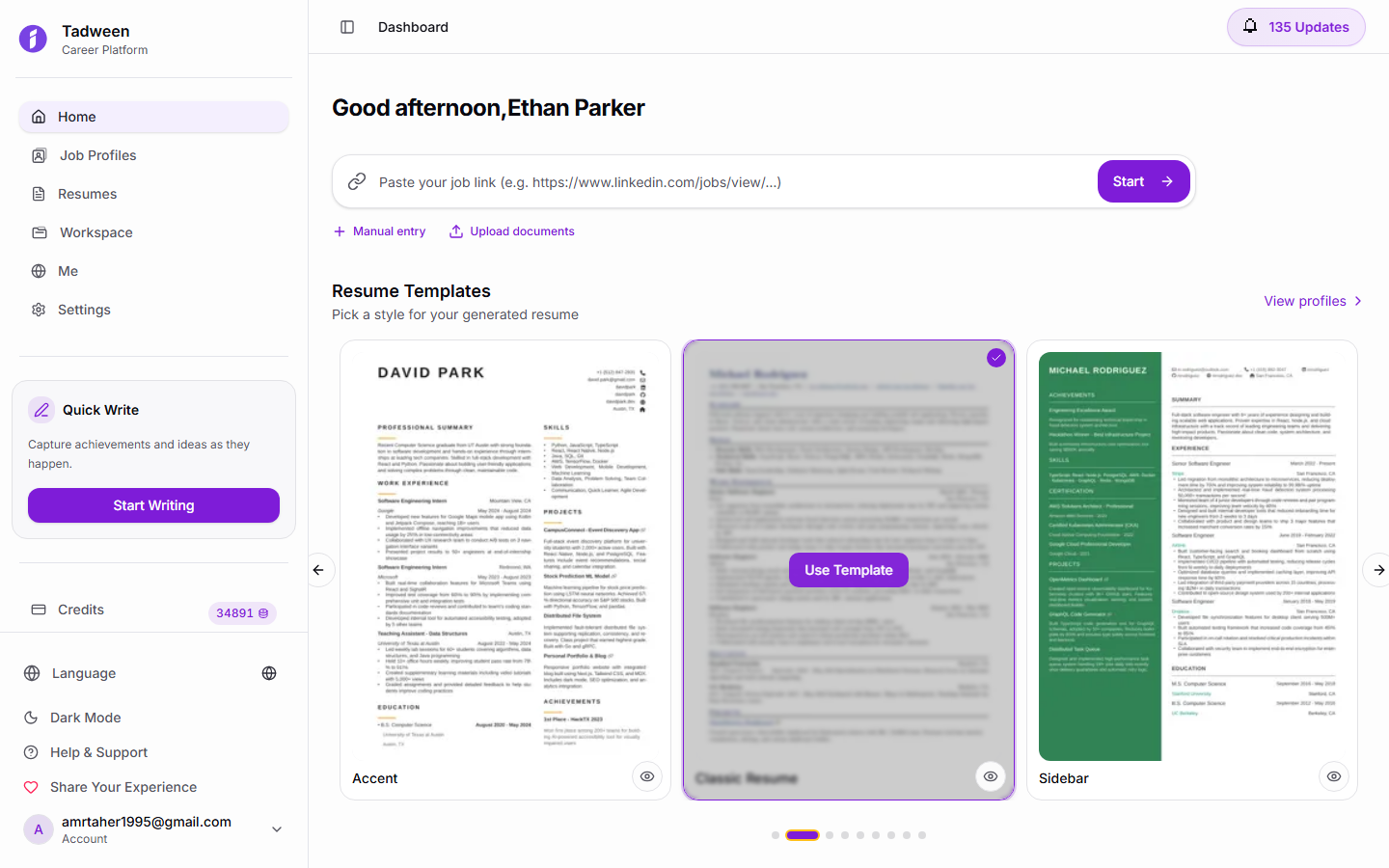
Tadween's dashboard gives you a command center for your career: track multiple job profiles, document achievements, and maintain your career strategy in one place.
What a Career Operating System Looks Like in Practice
A career operating system isn't complicated. It's a set of habits and tools that keep your career moving forward on autopilot, so you're never starting from zero. Here's what it looks like week to week:
Weekly (15 minutes): Add to your brag document. What did you ship? What problems did you solve? What feedback did you receive? This is the raw material for everything else.
Monthly (1 hour): Update your career documents. Refresh your resume and job profiles with recent wins. Engage with your network: comment on posts, send a quick check-in message, share something useful.
Quarterly (2-3 hours): Conduct your career review. Are you on track toward your goals? Does your positioning still reflect where you're heading? Are there skills gaps you need to address? Adjust your strategy.
Annually (half day): Big-picture planning. Where do you want to be in one year? Three years? What needs to change? This is when you make decisions about whether to stay, pivot, or accelerate.
That's roughly 2-3 hours per month. In exchange, you never have to panic-search for a job again. You never have to stare at a blank resume wondering what you've done for the past three years. You never have to accept a mediocre role because you ran out of time to find the right one.
A career operating system doesn't guarantee you'll never face a transition. It guarantees you'll face every transition from a position of strength.
From "I Need a Resume" to "I Need a Career Strategy"
The moment you shift from thinking "I need to update my resume" to thinking "I need a career strategy," everything changes. The resume stops being the product and becomes one output of a much larger system.
With a career strategy, your resume writes itself. It pulls from a well-maintained brag document. It's tailored to specific roles because you're clear about your positioning. It tells a coherent story because you've been intentional about your career trajectory.
Without a career strategy, your resume is a panicked attempt to reconstruct years of forgotten achievements while simultaneously trying to figure out what kind of job you even want. No wonder it feels miserable.
Tadween was built for this shift. It's not a resume tool that you open when you're desperate. It's a career management platform that you use continuously: to document your work, maintain multiple job profiles for different career tracks, build your public career page, and generate tailored documents whenever you need them. The resume is one feature, not the whole product.
Because the truth is, the professionals who thrive aren't the ones with the best resumes. They're the ones who never need to write a resume in a panic. They're the ones running their careers, not reacting to them.
Start managing your career like a CEO. Build your career operating system with Tadween. Free credits to start, bilingual Arabic and English, no subscription required.
FAQ
What's the difference between career management and job searching?
Job searching is a reactive, short-term activity triggered by a need (layoff, dissatisfaction, opportunity). Career management is a continuous, proactive practice of documenting your work, maintaining your positioning, building your network, and making strategic decisions about your professional direction. Job searching is something you do in a crisis. Career management ensures you rarely face one.
How much time does career management actually take?
About 2-3 hours per month. That breaks down to 15 minutes per week documenting your wins, one hour per month updating your career documents and engaging your network, and 2-3 hours per quarter for a strategic review. It's far less time than a single panicked job search, which typically consumes 10-20 hours per week for months.
I'm happy in my current role. Why should I manage my career now?
Because the best time to manage your career is when you're not under pressure to find a job. When you're happy and performing well, you have the clarity and leverage to build relationships, develop skills, and position yourself for your next move. Waiting until you need a job means starting from zero, under stress, with no runway.
What is a career operating system?
A career operating system is a set of habits and tools that keep your career moving forward continuously. It includes regular documentation of your achievements (brag document), maintaining up-to-date career documents, quarterly strategic reviews, and ongoing network cultivation. Tadween provides the platform layer for this system: track multiple career profiles, document your work, and generate tailored resumes and cover letters from your career context.
Can Tadween help if I'm already in a job search?
Absolutely. Tadween helps you build your career foundation quickly: create job-specific profiles, generate tailored resumes and cover letters, and build a public career page. But the real value comes after you land your next role, when you use Tadween to maintain your career system so you never have to panic-search again. Free credits to get started, no subscription required.
Stop Treating Your Career Like an Emergency
Build a career operating system that works whether you're job hunting or thriving in your current role. Document your wins, manage multiple career tracks, and never start from zero again.