
How to List Language Proficiency on Your Resume
Map the job's language tasks to what you can actually do, then write a short section that remains accurate in an interview.

A useful Languages section does more than attach a flattering adjective to each language. It tells the reader which language you can use, at what level or for which tasks, and what evidence supports the claim when evidence matters. Your finished output should be short enough for a resume and specific enough to survive a follow-up question.
Start with the vacancy, not with a list of every language you have studied. Mark whether the employer asks for a language generally, names a work task such as client calls or report writing, requires a certificate, or specifies a framework level. Then include the languages that help the reader judge your fit. UCLA's career guidance recommends listing relevant concrete skills and stating a proficiency level for languages rather than leaving the claim undefined.
Separate document language from language ability
An Arabic resume does not by itself prove that you can negotiate, present, or write technical reports in Arabic. An English resume does not prove the same in English. Decide first whether to submit one bilingual document or separate versions using Tadween's guide to choosing the right bilingual resume structure. Then make the Languages section describe your ability, not the layout of the document.
Plain labels such as fluent, professional, conversational, or native do not have one universal hiring definition. If you use one, add a task or context when the role makes the distinction important. “English: professional use in client calls and written reports” gives the reader more to inspect than “English: fluent.”
Assess the tasks before choosing the label
Check listening, speaking, reading, and writing separately. Europass's CEFR-based self-assessment distinguishes listening, reading, spoken interaction, spoken production, and writing, and lets users record genuine certificates. ACTFL's 2024 proficiency guidelines also describe listening, speaking, reading, and writing through what a person can do in real-world, spontaneous situations. These are separate frameworks. Do not create your own conversion table between them or treat either framework as a certificate you have not earned.
For each relevant language, write four private notes: the conversations you can handle, the documents you can understand, the writing you can produce, and the situations in which you still need support. If the abilities are uneven, keep the difference visible when it affects the job. A person may read technical material confidently while needing more preparation for an unscripted call.
Build the claim from evidence
Complete one row for each language that matters to the target role.
| Job requirement | Real task evidence | Resume wording |
|---|---|---|
| Client conversations | Calls or meetings you have actually handled | Professional speaking and listening for client discussions |
| Reports or correspondence | Documents you have written and reviewed | Professional writing and reading for reports and email |
| Named framework or certificate | Real level, issuer, and date you can verify | Framework level or test result, issuer, month and year |
| General relevance | Tasks you can explain without overstating | A concise level plus one useful task distinction |
Choose one description system
Use the system the vacancy or market gives you. If the employer names CEFR, ACTFL, a test, or a required certificate, report only the real result you hold. If it does not, a plain task-based description is often clearer. Marquette University's resume guide advises candidates to include a proficiency level for language skills; the exact wording still needs to match your evidence and the role.
- Plain task-based wording: useful when the employer has not requested a named scale. State the context you can handle.
- Named framework level: useful when the vacancy or audience recognizes that framework and you can support the level.
- Test or certificate result: useful when it is real and relevant. Include the issuer and date rather than implying permanent validity.
Do not mix a test score, a CEFR level, an ACTFL level, and an informal adjective into one invented universal scale. Pick one primary description. Add a task distinction only when it makes the claim more accurate.

Work from the vacancy to tasks, then to wording and proof. Starting with the strongest-sounding label reverses the logic.
Four examples to adapt
These examples are fictional patterns, not labels to copy automatically. Replace every task, level, issuer, and date with facts you can explain.
Home language with professional use
Arabic: Home language; professional speaking, reading, and writing for customer communication and internal reports.
“Home language” describes background, while the task line shows work use. If writing is not part of your experience, remove it rather than assuming that home use proves professional writing.
Professional use across two languages
Arabic: Professional use in client meetings and correspondence
English: Professional use in reports, presentations, and cross-team meetings
This pattern works when the tasks differ and that difference matters. It avoids pretending the two languages are identical across every skill.
Reading and writing stronger than speaking
French: Professional reading and writing; intermediate speaking for prepared discussions.
Only use “intermediate” if you can explain what it means in your own work. The task distinction carries more information than the adjective.
Real framework level or certificate
German: CEFR B2, [real issuer], [month year]; used for university coursework and presentations.
Use this structure only when the level, issuer, and date are real. A course completion certificate is not automatically a proficiency test. A beginner language that is irrelevant to the role can be omitted without hiding a material job requirement.
Place the section according to relevance
If the language is essential to the work, mention it near the summary or key skills and reinforce it with a truthful experience bullet. If it is useful but not central, use a compact Languages section. If one role proves the claim, connect the task to that role instead of repeating a vague label in two places.
Use the same underlying facts in English and Arabic versions, but adapt the wording naturally. “Professional working proficiency” does not need a mechanical Arabic translation. A phrase such as “استخدام مهني في المراسلات والتقارير” may be clearer when that is the real capability.
Turn the wording into a complete resume section
Once the language lines are accurate, review them beside the rest of the resume. Keep labels, dates, and evidence consistent across the summary, skills, education, certificates, and experience. If you need stronger supporting evidence, use the method for writing defensible resume claims without invented numbers.
Tadween's current Resume Builder is an optional place to edit structured resume content beside a live document preview. The approved English editor capture below shows that editing and preview workflow. It does not test a language, assign a proficiency level, verify a certificate, or guarantee an employer's interpretation.
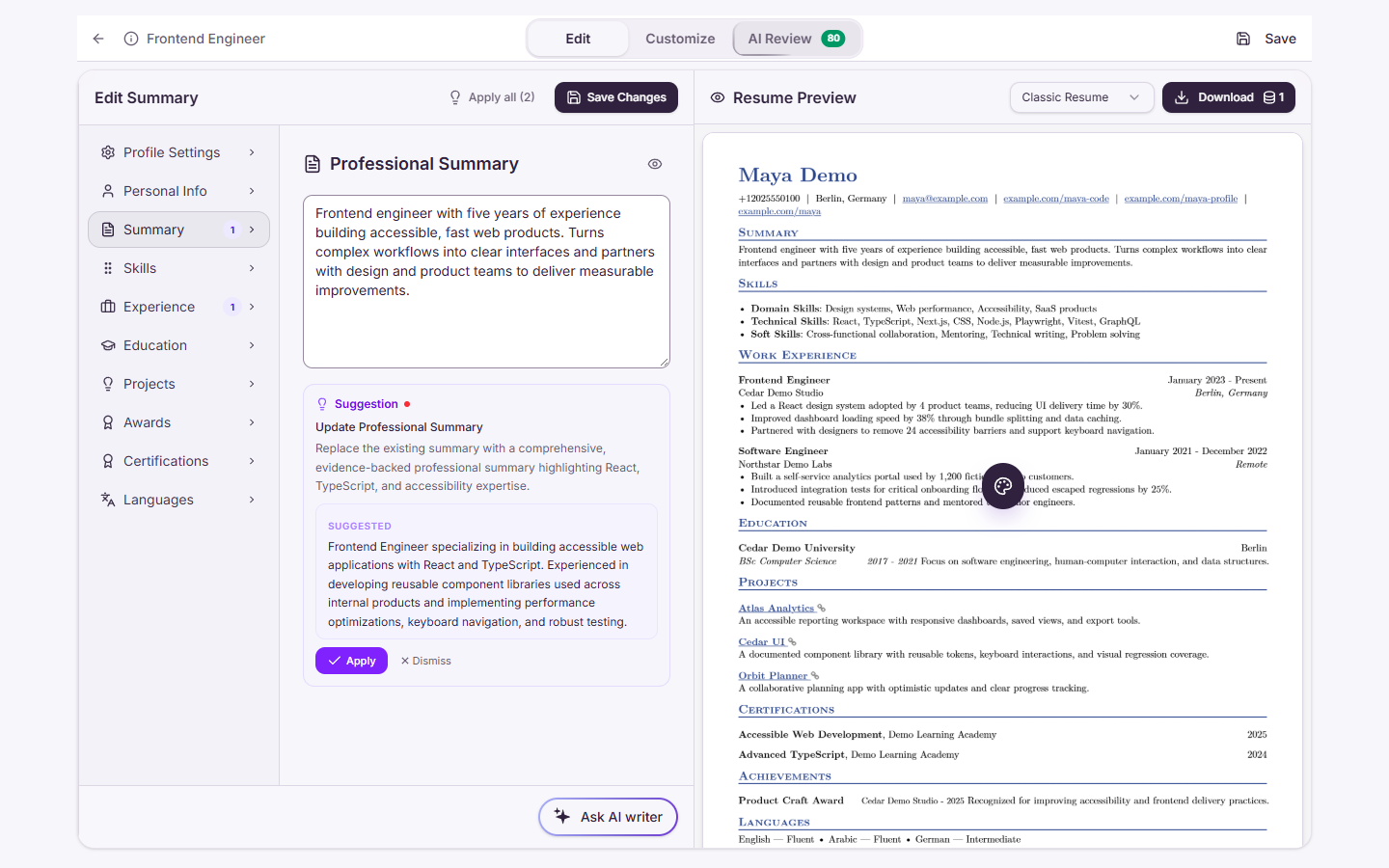
Place your chosen wording in the full resume and inspect how the section reads alongside the other evidence.
Run the interview-consistency check
Read each line as a promise. If the resume says you can lead client calls, could you handle an unscripted follow-up in that language? If it says professional writing, could you discuss the kind of document you produced and the review support you needed? If it names a level or certificate, can you show the real record when asked?
Do not lower an accurate level out of anxiety, and do not raise it to match a requirement you cannot yet perform. A gap may mean applying while stating the current level honestly, asking how the language is used, or choosing a role that fits better. The article cannot decide an employer's threshold, and no label guarantees selection.
Before-you-send checklist
- I included only languages that help the reader evaluate this application.
- I checked speaking, listening, reading, and writing instead of choosing one adjective first.
- Any task I named comes from real work, study, volunteering, or another honestly labelled context.
- Any framework level, test, certificate, issuer, and date is real and current in my records.
- I did not invent a conversion between CEFR, ACTFL, tests, and informal labels.
- The English and Arabic versions describe the same facts in natural wording.
- I can explain every line in an interview without changing the story.
Your final section may be only two or three lines. Its strength comes from accuracy: job requirement, real tasks, honest wording, and proof when needed. You can review Tadween's current career tools and use the Resume Builder as an optional place to fit those lines into the full document while keeping responsibility for the proficiency claim yourself.
Write a language section you can defend
Choose the relevant tasks, state the level honestly, and review the wording inside the complete resume.