
How to Write Strong Resume Achievements Without Inventing Numbers
Recover the strongest facts you can defend, show what changed, and keep your contribution accurate even when no KPI exists.
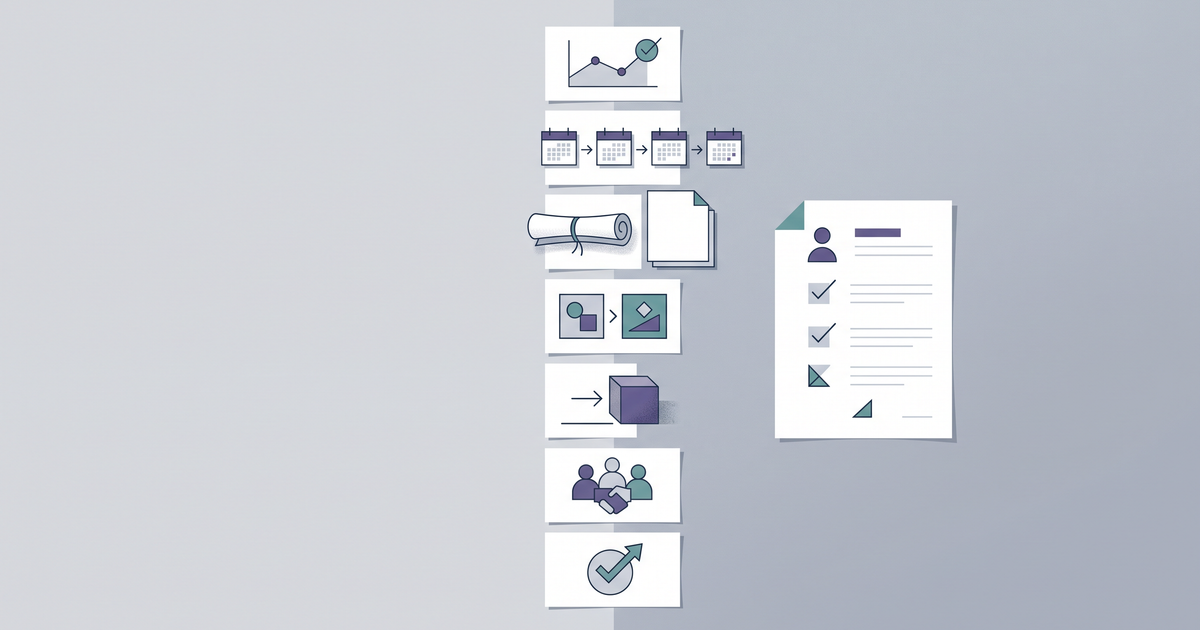
You do not need to invent a percentage to write a strong resume achievement. A number is one form of evidence, not the achievement itself. When a trustworthy result metric exists and you are allowed to disclose it, use it. When it does not, show a specific action, the work context, and a result you can explain in an interview.
This distinction matters when your employer did not measure the work, you joined a team effort, old records are unavailable, or the facts are confidential. Guessing a baseline, rounding an impression into a percentage, or borrowing a team result creates precision you cannot defend. A specific qualitative outcome is more credible than a fabricated metric.
Use an evidence ladder instead of forcing a number
Start at the top and move down only when the evidence is unavailable or unsafe to share. None of the lower levels is a consolation prize. The goal is the strongest truthful proof that fits the work.
- Verified outcome: an approved result you can trace to a report, record, or responsible owner.
- Scope or frequency: the real size, cadence, locations, cases, or stakeholders involved. This is context, not an outcome.
- Tangible output: a procedure, dashboard, training guide, release, lesson plan, handover, or other thing that exists because of your work.
- Before-and-after state: a manual process became documented, scattered requests became organized, or an unavailable resource became usable.
- Problem removed or capability enabled: your work prevented a recurring error, clarified a decision, or made a next step possible.
- User or stakeholder context: who used the work and why it mattered to them.
- Recognition or adoption: the work was approved, reused, adopted, selected, or trusted for a later task.
Numbers can appear at several levels. A team size, weekly frequency, number of locations, or portfolio of cases can give honest scope without pretending to measure impact. Label it accurately: “supported a five-person team” is not the same claim as “improved team performance by 20%.”
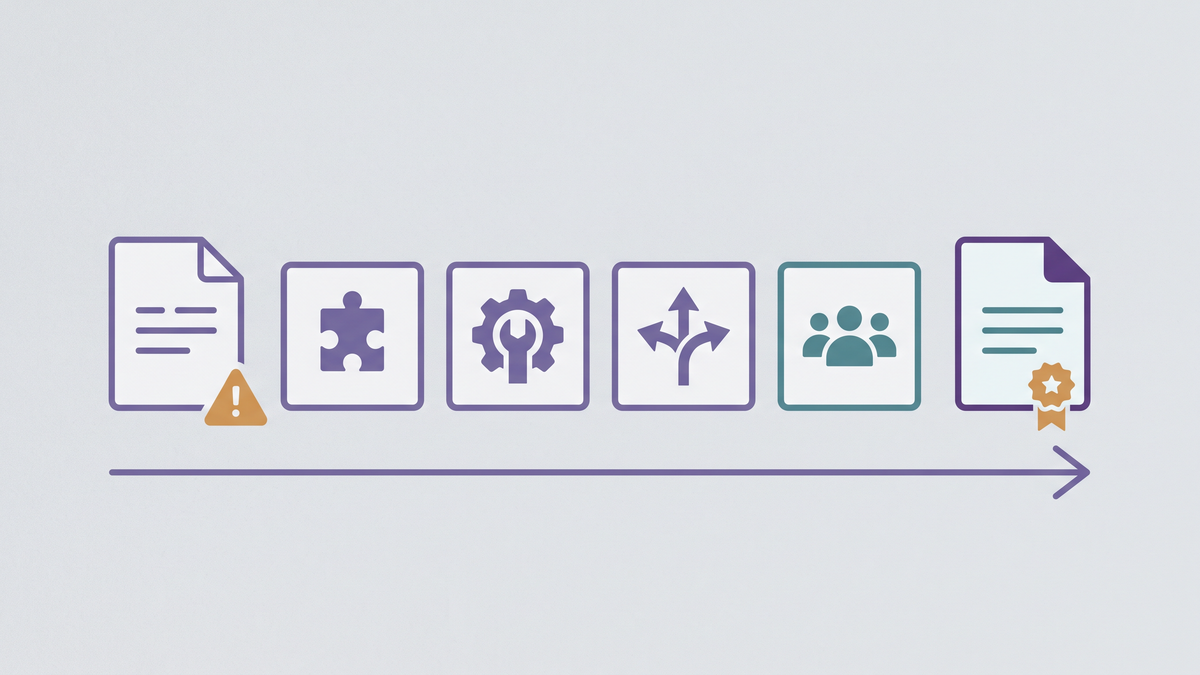
Recover facts before polishing the sentence. The evidence comes from the work, not from a stronger-sounding verb.
Recover facts before you write prose
Choose one duty from a real role and complete this worksheet. Short notes are enough:
- Need: What problem, request, risk, or gap existed?
- Your action: What did you personally decide, create, organize, check, teach, or deliver?
- Method: How did you do it? Name the process, tool, collaboration, judgment, or constraint that makes the work concrete.
- Change: What became available, clearer, safer, easier, faster, consistent, or ready for a next step?
- User: Who used the output or benefited from the change?
- Proof: Which detail can you explain and source if an interviewer asks?
Then choose one compact structure. Yale's career office recommends Action + Project + Result and stresses describing your own contribution. Missouri State teaches Problem + Action + Result while explicitly noting that metrics may not exist for every bullet. Michigan's Bullet Plus model uses Action Verb + What + How/Why/Impact and says to quantify when possible. These are drafting tools, not universal hiring rules.
Working formula: truthful action + specific work + method or context + defensible change.
Keep your share of a team result honest
Choose the verb from your actual authority. Led means you directed the work or decision. Owned means you were accountable for a defined outcome. Coordinated means you aligned people, timing, or inputs. Contributed means your work formed part of a shared result. Supported is accurate when you enabled another owner, and it becomes specific when you name how.
If the outcome belongs to the team, write your action first and the team outcome second: “Built the issue-triage checklist used by the support team during the product launch, contributing to a consistent escalation process.” Do not upgrade that to “Led the launch” unless you actually did.
Protect confidential information before adding detail
Specific does not mean exposed. Remove client and patient identities, private employee information, internal revenue, security controls, unpublished project details, and anything restricted by policy or agreement. Use a truthful permitted category such as “a regional healthcare client” only when that description is allowed and still accurate. Omit the detail when generalizing would be misleading. Never invent a substitute number.
Before keeping a fact, ask four questions: Do I know where it came from? Is it mine to claim? May I disclose it? Can I explain it without revealing protected information? If any answer is no, move to a safer evidence level.
Five fictional before-and-after examples
The examples below are fictional and privacy-safe. They demonstrate structure, not market benchmarks.
Operations and administration
Duty: Managed meeting documents.
Defensible bullet: Standardized agendas, decision notes, and owner fields for weekly leadership meetings, giving department heads one consistent record for follow-up.
Customer support with truthful scope
Duty: Answered customer questions.
Defensible bullet: Resolved product and account questions across email and chat during daily support coverage, documenting recurring issues for the product team.
Education and training
Duty: Trained new staff.
Defensible bullet: Created a role-based onboarding guide and practice exercises that gave new coordinators a consistent reference for their first assignments.
Technical or project work
Duty: Worked on system migration.
Defensible bullet: Mapped legacy data fields, tested transfer rules, and documented exceptions so the project team could complete migration reviews with a shared reference.
Individual contribution to a team outcome
Duty: Helped with a service launch.
Defensible bullet: Coordinated readiness inputs from operations and support, maintaining the launch checklist that the cross-functional team used to confirm handoffs.
At least three of these bullets contain no number at all. They are stronger than their duty versions because the action, output, user, or resulting state is visible. Add a real metric only if your evidence supports it.
Apply the rewrite in the full resume
Once the facts are clear, revise one role and read the bullets as a group. Remove repeated evidence, vary the proof type, and keep the most relevant points for the target role. The broader resume update guide can help with the surrounding sections, while the action verbs guide can help you choose a verb after you have established what you actually did.
Tadween's bilingual Resume Builder is an optional place to edit structured sections in English or Arabic while viewing the document. The approved editor view below shows the section workspace beside the live preview. It does not find missing metrics or validate your claims, so complete the evidence check yourself first.
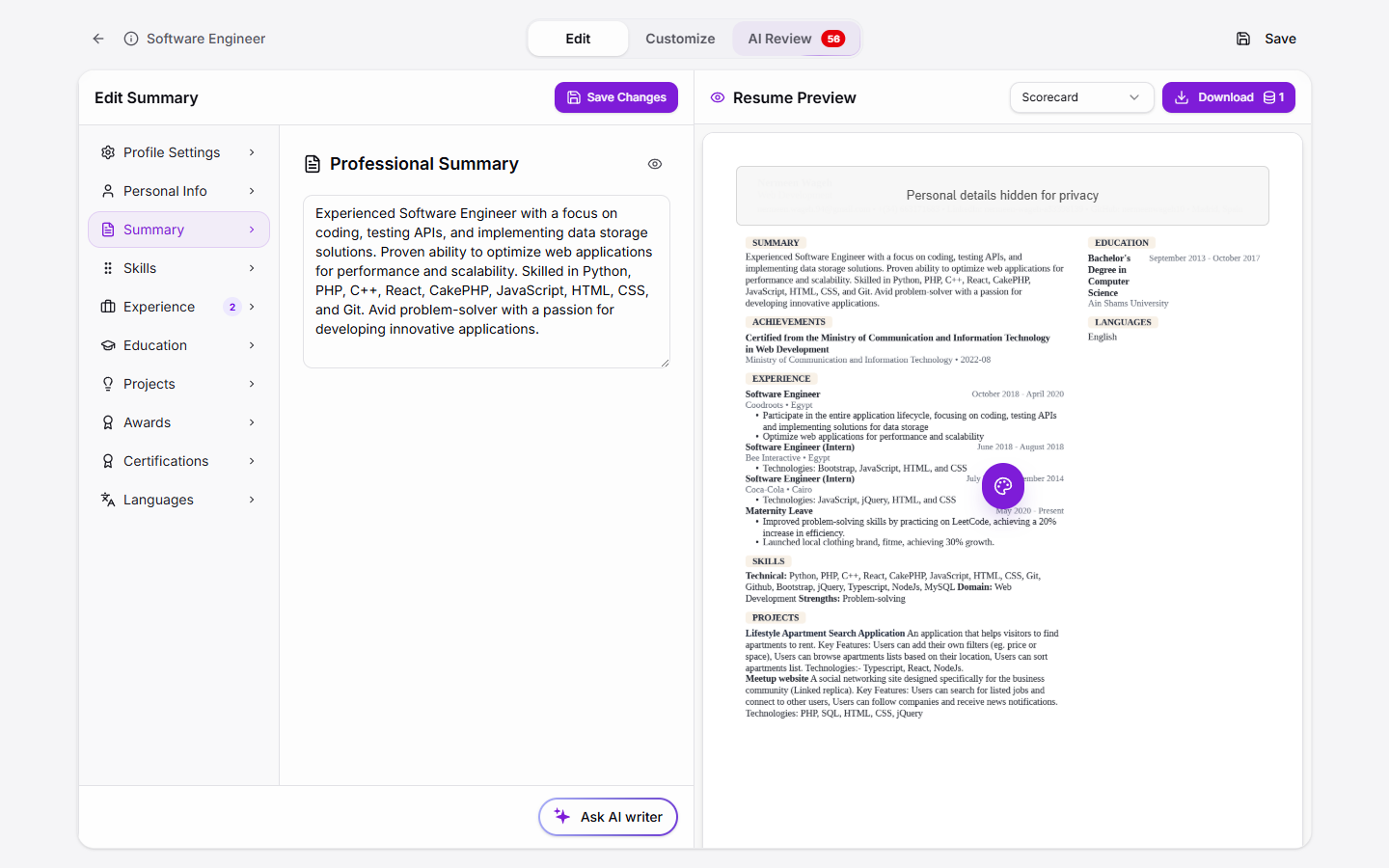
Use the structured editor and live preview to review the rewritten role as part of the complete page.
Run the credibility check before you submit
Read every achievement aloud and test it as an interview answer. Can you explain the source of each fact, your exact contribution, the method, and the result without changing the story? Remove unexplained precision, inflated verbs, private details, and generic claims such as “optimized efficiency.” If a bullet only names a responsibility, return to the worksheet and add the clearest evidence you truly have.
Check the Arabic and English versions separately when you maintain both. They should carry the same authority and factual boundary, even when the natural phrasing differs. Prince Mugrin University's Arabic CV guidance recommends action- and result-oriented bullets and quantifying whenever possible. The phrase “whenever possible” is the useful boundary: evidence matters, but invented precision never becomes credible because it appears in a polished sentence.
Finish one role today. Select three to four important bullets, use different evidence where appropriate, and keep a private note showing the source of any metric or scope detail. For future work, a simple achievement log will make the next revision easier. For the resume in front of you now, the defensible fact is enough.
Rewrite one role with evidence you can defend
Use the worksheet, keep your contribution precise, then review the bullets as a complete resume.