
How to List Freelance and Contract Work on Your Resume
Turn scattered projects into a clear experience section without changing dates, inventing an employer, or exposing confidential work.

Freelance and contract work belongs on your resume when it is real, relevant to the role you want, and specific enough to defend. The hard part is not proving that it counts. It is choosing a structure that helps another person understand what you did without turning ten short projects into ten confusing employers.
By the end of this guide, you will have one usable output: a targeted experience block with an accurate work-arrangement label, consistent dates, selected evidence, and links you are allowed to share. This is resume guidance, not a decision about whether a contract made you an employee, freelancer, consultant, or business owner. Use your agreement, invoices, payroll records, or other reliable records as the source of truth for that relationship.
First, name the relationship you actually had
Start with a private fact sheet before you write the polished entry. Record who engaged or paid you, what title or service describes the work, when it happened, whether it overlapped another role, and what proof you can safely discuss. A professional title should explain the craft, while a separate phrase can explain the arrangement. For example, UX Designer, Independent is clearer than calling yourself a founder when you did not run a company.
Do not present an end client as your employer if an agency or staffing company employed or paid you. A truthful line might read Data Analyst, North Agency, contract assignment for a retail client. If the client name is confidential, replace it with a useful non-identifying description such as regional retail client, but only if that description does not reveal the client indirectly. The aim is clarity, not a more impressive label.
Choose one of three structures
1. Group an ongoing independent practice
Use one Experience entry when you delivered the same kind of work for several clients over a sustained period. This keeps the timeline readable and lets you select the projects most relevant to the target job. The University of Iowa provides a dedicated freelance experience resume sample, while its broader guidance treats the resume as a tailored representation of relevant experience rather than a fixed form.
2. List a few substantial contracts separately
Use separate entries when two or three engagements were long, distinct, and important enough to explain on their own. Keep the agency, payer, employer, client, and end client relationships accurate. A Salt Lake Community College design resume example places a dated freelance practice alongside salaried roles, but its use of the title “Owner” is an example, not a title every freelancer should copy.
3. Move occasional relevant work into Projects
Use a Projects section when the work was occasional, skill-focused, or secondary to a salaried history. This gives the work evidence without implying a continuous independent practice. Metro State recommends emphasizing the education, projects, work, and other experience that is most relevant to a specific opportunity. Relevance decides placement, not whether paid work is somehow more legitimate than project work.

Match the structure to the pattern of work: sustained practice, a few substantial contracts, or occasional relevant projects.
Build every entry from five facts
- Professional title or service: name the actual craft, such as product designer, translator, or data analyst.
- Relationship label: identify yourself as independent, freelance, self-employed, fixed-term, agency-employed, or project contractor only when the label matches your records.
- Dates: use one month-and-year format throughout the resume.
- Scope line: state who or what kind of client you supported, the problem area, and the boundaries of your contribution.
- Evidence bullets: show the deliverable, your contribution, defensible scale, and an observable result.
Exact numbers are optional. Truth is not. If the result can be described through adoption, approval, reduced rework, a completed launch, a clearer process, or a usable deliverable, say that. If you need a method for recovering non-numeric evidence, use Tadween’s guide to writing resume achievements without inventing numbers.
Keep dates, clients, and proof legible
Overlapping dates are not a flaw when the work really overlapped. Show the same month and year ranges you can support. Add part-time, weekend projects, or alongside full-time work only when it prevents a misleading inference. Never shorten one role or extend another to manufacture an uninterrupted timeline.
You do not need a directory of every client. Select the work that best supports the target role. Name a client only when you have permission and the relationship is accurate. For confidential work, describe the industry, problem, or deliverable at a level your agreement allows. Do not publish screenshots, internal metrics, customer data, or identifiable details merely to make a bullet stronger.
A portfolio is proof, not a substitute for context. CareerOneStop advises adding a description of the project, the client or employer when appropriate, your contribution, and the result for each selected work sample. Before linking, confirm that you own or may share the work, remove private information, and test the URL in a signed-out browser.
Three reusable entry templates
Template A: one grouped independent practice
[Professional title] | Independent practice
[Month Year] to [Month Year or Present] | [Location or Remote, if useful]
[One sentence on client types, service scope, and target-relevant focus]
- [Problem or need] + [your contribution] + [deliverable] + [defensible result]
- [Second selected project or recurring responsibility, without confidential detail]
Template B: separate substantial contracts
[Professional title] | [Agency, payer, or your practice]
Contract assignment for [permitted client name or non-identifying description] | [Dates]
[Scope and relationship boundary]
- [Contribution and delivered outcome]
- [Relevant method, collaboration, or proof]
Template C: selected projects beneath a primary role
Selected Projects
[Project name or safe description] | [Your role] | [Date]
[Problem, contribution, deliverable, and observable result]
Four fictional examples
Designer returning in-house: “Product Designer, Independent Practice | Jan 2023 to Jun 2026. Designed onboarding and account-management flows for early-stage service teams; delivered tested prototypes and handoff notes that gave client developers a clear implementation path.” This groups a sustained practice and does not invent a studio.
Analyst with weekend work: “Selected Project: Inventory reporting cleanup | Data Analyst, weekend project | Mar to Apr 2026. Reworked inconsistent source tables into a documented reporting model and a repeatable validation checklist.” The overlap is visible and the result is non-numeric but inspectable.
Consultant with confidential clients: “Operations Consultant, Independent | 2024 to Present. Supported two regulated service organizations under confidentiality terms; mapped approval handoffs and delivered process documentation used in internal reviews.” The client category is broad only if it is safe to disclose.
Translator working in two languages: English may say “Arabic-English Translator, Independent,” while Arabic can naturally say “مترجمة مستقلة بين العربية والإنجليزية.” The facts, dates, and contribution remain the same; the title is adapted rather than translated mechanically.
Put the chosen structure into a complete resume
Once you have selected a structure, Tadween’s Resume Builder workspace can help you place it into editable sections and inspect the full document in a live preview. The current approved product capture shows the structured editor and preview, not an automatic classifier for freelance work. You still own every title, date, permission, and result.
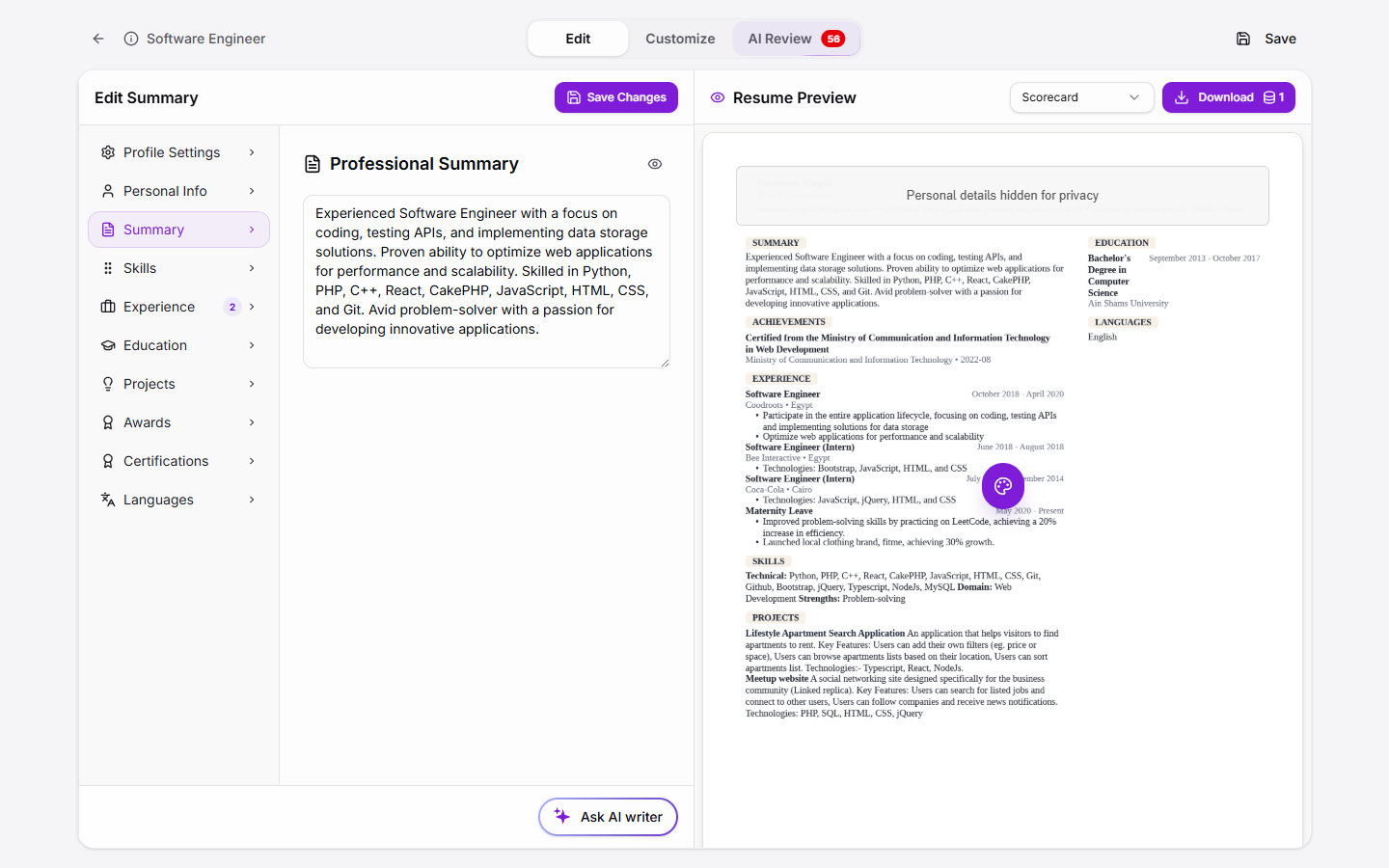
The approved English Resume Builder editor shows section-by-section editing beside the live document preview.
Then use the broader resume update guide to review the summary, skills, ordering, and older material around this new entry. The freelance section should support one target role, not force the rest of the resume to carry every project you have completed.
Run the final credibility check
- Is every professional title accurate rather than inflated?
- Do the month and year ranges match your records, including overlaps?
- Is the agency, payer, employer, client, or end client relationship clear?
- Do you have permission to name each client and share each sample?
- Have you removed confidential or personally identifying detail?
- Can you explain every contribution and result without inventing a metric?
- Do portfolio links work for a signed-out viewer?
- Could you support the entry and explain it calmly in an interview?
If one line fails the check, remove it, qualify it, or replace it with evidence you can defend. A truthful, well-structured entry is more useful than a conventional-looking history that falls apart under a simple follow-up question.
Build the entry, then check the whole story
Use the structure that matches your real work, keep every claim defensible, and review how the section reads inside the full resume.