
How to Answer “Tell Me About a Time You Failed”
Choose a real, contained story. Name what went wrong, own only your part, show the repair, and prove what you do differently now.

You know you should not say, ‘I have never failed.’ But the first real example that comes to mind may feel too risky, too personal, or too complicated to explain in an interview. The answer is not to invent a harmless story. Choose one true, bounded moment and show four things clearly: what did not work, which part was yours, how you responded, and what changed in your later practice.
This question cannot prove your character or predict how you will perform. Interviewers may use it differently. Current career-service guidance commonly frames it as a chance to discuss reflection, responsibility, recovery, and learning. The University of Houston career center recommends using a real failure rather than refusing the question or disguising a success, then focusing on what you do differently now. That is the useful target for your answer.
Choose the story before you write the answer
A strong response starts with selection, not wording. Test each possible story against five questions.
- Is it true? You should be able to answer a follow-up without adding invented details.
- Is it bounded? The event has a clear goal, decision, and outcome. You can explain it without recounting an entire year.
- Is it explainable? A listener outside your team can understand the stakes without private jargon.
- Is it relevant? It reveals judgment, communication, planning, quality, or another behavior that matters for the target role.
- Is it safe to share? It does not expose client names, personal data, protected complaints, security details, an investigation, or information restricted by policy or an NDA.
Reject an example when the central risk remains unmanaged, when it involves serious misconduct, or when it proves you still cannot perform a core requirement of the new role. Do not search for one universal ‘safe’ severity. A late escalation may be useful for one role and alarming for another. Your job is to choose a truthful story whose relevance and boundaries you can explain.
Use choose, own, repair, change
The method is simple enough to remember under pressure, but it prevents the two common extremes: blaming everyone else and accepting blame for everything.
1. Name what failed plainly
Give the goal and the missed outcome in one or two sentences. ‘I was coordinating the final handoff for a client report, and I missed the agreed delivery time because I escalated a data dependency too late.’ That is clearer than a long preface about how busy the team was. Embry-Riddle Career Services similarly advises choosing something you did not achieve or complete, then explaining what you learned or would handle differently.
2. Own only your part
Use ‘I’ for your assumption, decision, missed check, or communication gap. Use ‘we’ only for a genuinely shared decision. Accurate ownership might sound like: ‘The source data was delayed, but I was responsible for raising the risk. I waited until I had certainty instead of flagging it while there was still room to adjust.’ Do not take responsibility for discrimination, harassment, unsafe instructions, or another person’s conduct.
3. Show the repair
Describe what you did after recognizing the problem. You might inform a stakeholder early, correct the work, ask for expert review, reset expectations, or contain harm that could not be reversed. Repair is not a perfect ending. It is evidence that you did not hide, freeze, or repeat the same response.
4. Prove the change
Replace ‘I learned to communicate better’ with an observable practice: a risk checkpoint, peer review, decision rule, or escalation time. If it is true, add one brief later example. ‘On the next project, I raised the same dependency at the first warning sign and agreed on a fallback source before the deadline.’ The later behavior matters more than a dramatic lesson.

A useful answer moves forward: choose a bounded story, name your part, show the repair, then make the changed behavior visible.
Adapt STAR when the result was unsuccessful
STAR still works when the result was not positive. The University of Washington notes that the result can include an outcome that did not go as planned and what you learned. Keep Situation and Task brief. In Action, include both the original choice and the repair. In Result, state the honest outcome. Finish with the practice you changed.
Speaking scaffold: We were trying to… My part was… The outcome missed the goal because I… Once I saw it, I… Since then, I now…
This is a scaffold, not a script. Memorize the sequence, not every sentence.
Four fictional examples you can learn from
All examples below are fictional and privacy-safe. Do not present one as your history. Borrow the structure and replace every fact with your own.
Missed deadline after late escalation
‘I owned the final content handoff for a campaign. A data input arrived incomplete, and I waited too long to escalate because I thought I could recover the time alone. We missed the first review slot. I told the project lead, separated the critical pages from the optional ones, and delivered the priority set the same day. The launch moved by one day. Since then, I flag any dependency that threatens a milestone at the first warning sign and agree on a fallback owner.’
Quality error found after delivery
‘Early in my analyst role, I reused an old spreadsheet range and a total in the delivered report was wrong. I had performed a visual check but not reconciled the total against the source. I notified my manager, corrected the report, and sent the client a clean replacement with a short explanation. I then added a source-to-output reconciliation step and peer check for recurring reports. I have used that checklist since; I would not claim the error was harmless, but it changed my review process.’
Unclear handoff in a group project
‘In a university consulting project, I handed research notes to a teammate without confirming the format or deadline. The final presentation lacked two sources I assumed they would include. The group shared responsibility for the deck, but the unclear handoff was mine. I rebuilt the references section, told the group what I had missed, and we submitted a complete revision. In later projects, I close handoffs by naming the owner, expected output, and check-in time.’
A sound choice that missed its intended result
‘I proposed moving a customer webinar to a later time based on attendance data, but registrations fell instead of rising. I had checked the historic pattern but did not test the change with enough customers. I restored the original slot, contacted a sample of registrants, and learned that the new time conflicted with their workday. I now pair behavior data with a small customer check before changing an established schedule.’
Answers to avoid
- ‘I have never failed’ or a disguised strength such as caring too much.
- An invented story or a sample copied as personal history.
- A long account in which every cause belongs to the team.
- Taking full blame for decisions you did not make.
- Confidential detail that is not necessary to understand your behavior.
- A still-unmanaged risk central to the role you want.
You can anonymize a client, amount, system, or colleague while keeping the decision and sequence truthful. If removing private detail makes the story impossible to understand, choose another story.
Turn the story into a practice answer with Tadween
Once your facts are safe and accurate, Tadween’s Interview Coach can help you shape a selected real experience into an editable STAR response connected to resume evidence and possible interview questions. The feature does not verify truth or predict an offer. You still decide what is accurate and appropriate to disclose.
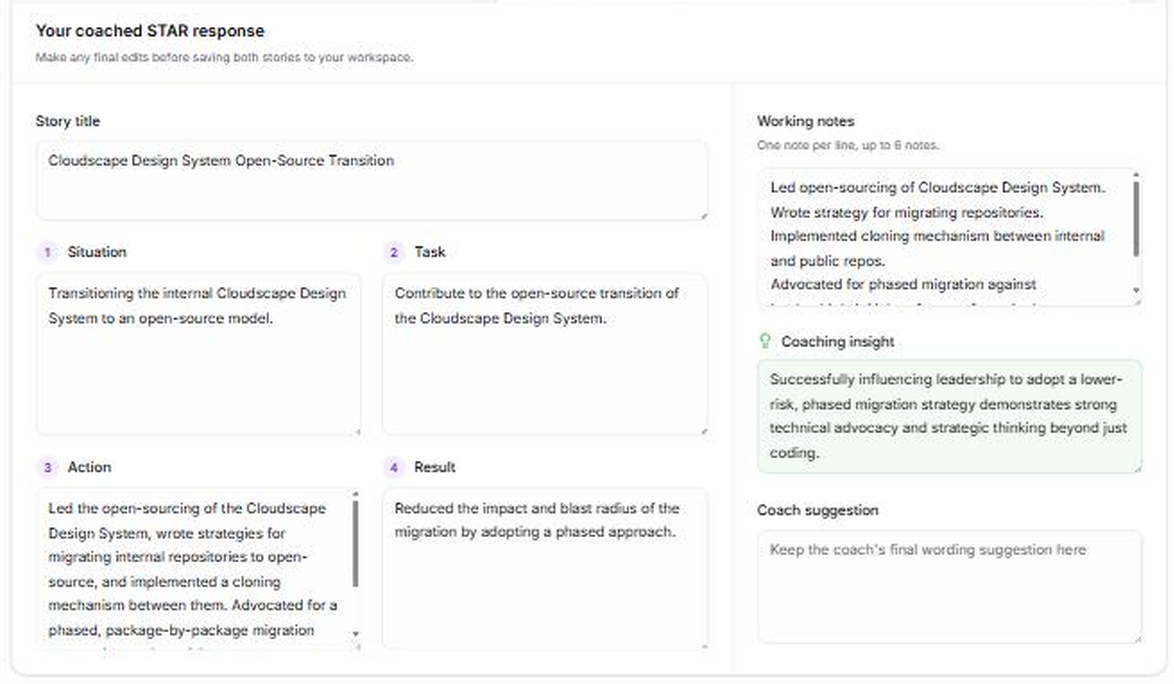
The approved English Interview Coach capture shows the editable response, coaching note, linked evidence, and possible questions that the reader can inspect.
Practice aloud, then trim
Read your answer once, close the notes, and say it aloud. Aim for a clear sequence rather than a perfect performance. If you need a broader story bank first, use Tadween’s interview preparation guide. If details are hard to retrieve, a private brag document can help you record real decisions and lessons before interview day.
- Can a listener name what failed after the first two sentences?
- Did you use ‘I’ and ‘we’ according to what actually happened?
- Did you show the repair without pretending the outcome was perfect?
- Is the changed practice observable?
- Can you remove one detail without weakening the evidence?
Your answer does not need to turn failure into triumph. It needs to show that you can face a real outcome, describe your part accurately, respond responsibly, and carry the lesson into the way you work now.
Shape one real experience into a clear answer
Choose a safe story first, then use Tadween’s interview tools to organize and rehearse it without inventing details.