
How to Answer “Why Are You Leaving Your Current Job?”
Tell the truth, protect what is private, and connect the move to the role in front of you.

You may know exactly why you want to leave and still struggle to say it in an interview. The full story might involve a manager, a changed role, health, family, pay, an unsafe environment, or a decision you would rather keep private. The interviewer does not need your private diary. They do need an answer that is accurate, consistent with your work history, and relevant to this move.
A useful answer has three parts: context, decision, and fit. State the employment fact or change neutrally. Explain the professional decision it created. Then connect that decision to something you have verified about the target role. Aim for roughly 20 to 40 seconds while drafting, but treat that as a trimming tool, not a universal interview rule or a promise of a better result.
Start with the full truth, then choose the interview-relevant truth
Write the unfiltered reason privately first. Do not edit it for tone yet. Then separate it into three columns:
- Verifiable fact: What actually changed? For example, the contract ended, the team was restructured, the scope moved away from the agreed work, or you chose to relocate.
- Decision: What direction did that fact lead you to choose? Name a responsibility, working condition, skill, or kind of contribution rather than a vague “new challenge.”
- Fit: What specific part of this vacancy supports that direction? Use the job description or something the interviewer has explained, not praise you cannot support.
The UTSA Career Compass advises candidates to be direct, clear, future-oriented, and not speak negatively about a former employer. That is useful as a communication boundary, but it does not require pretending a serious experience was positive. You can be neutral without changing the facts.
Drafting frame: “After [neutral context], I decided to look for [concrete direction]. This role stands out because [verified match].”
Before writing examples, prepare adaptable evidence, not a script. Your answer should survive a follow-up without forcing you to invent details.
Use context, decision, and fit in common situations
The examples below are fictional and privacy-safe. Do not copy their facts. Borrow the structure and replace every detail with your own chronology.
Growth or scope has plateaued
Example: “I have built a solid foundation in monthly reporting and stakeholder updates. The next step I am seeking is ownership of analysis from the initial question through the recommendation. This role includes that end-to-end responsibility, which is why it is a considered move for me.”
This is stronger than “there is no growth” because it names the work you want. If you discussed growth internally, you can say so. If you did not, do not claim that every option was closed.
The role changed or no longer matches the agreed work
Example: “The role gradually shifted from customer research toward operational administration. I can do that work, but I have decided to return to research and synthesis as my main contribution. The discovery responsibilities in this vacancy are the match I am looking for.”
Describe the scope shift, not the employer's motives. If the interviewer asks for more detail, give one observable example and stop before confidential projects or accusations.
Restructuring, redundancy, contract completion, or closure
Example: “My position was eliminated during a team restructuring. Since then, I have focused my search on roles where I can apply supplier coordination and process improvement together, which this position requires.”
Keep the employment category exact. A layoff is not a dismissal, a completed contract is not a resignation, and a business closure is not a performance event. Current Indeed guidance also recommends a brief honest reason, consistency with basic employment facts, and preparation for follow-up questions. Use that as practical guidance, not as a universal recruiter scoring rule.
A difficult manager, culture, workload, safety, or values concern
Example: “The working arrangement was no longer sustainable for me, so I decided to look for a role with clearer ownership and escalation paths. I noticed this team defines decision rights in the job description, and I would like to understand how that works in practice.”
This boundary is not a euphemism for changing a material fact. You do not have to disclose harassment, discrimination, a protected complaint, an investigation, health information, client identities, or legal details in an ordinary interview answer. If a disclosure could affect legal rights or a formal process, seek qualified advice for your location rather than relying on an interview article.
Compensation, schedule, relocation, family, health, or another private reason
Example: “My circumstances changed and I now need a role based in Amman. I am keeping the personal details private, but the location requirement is settled. This position is based there and also lets me continue the regional account work I have been doing.”
Name only the category and job condition needed to understand the move. Verify that condition before making it the center of your answer. The regional Bayt Arabic guide is useful for honest professional phrasing and spoken practice, but your answer still needs your own verified facts.
Short tenure or repeated moves
Example: “I joined expecting a product-support role, but the ongoing work was mainly outbound sales. I recognized the mismatch early and decided to focus on support roles where troubleshooting and customer education are central. I am now checking scope carefully, including how this team measures support work.”
Answer the visible timeline instead of hiding it. Explain what you learned about fit and what decision rule you are applying now. Do not promise that you will stay for a specific number of years.

Different situations need different factual boundaries, but the answer still moves from context to decision to fit.
Prepare the follow-up before you rehearse
A short answer can invite a reasonable question. Write one sentence for each follow-up that genuinely applies:
- Did you try to address it? State what you actually did, such as clarifying scope or asking about a development path. If you did not raise it, say that you made the decision after assessing the situation.
- Why will this role be different? Point to evidence in the vacancy or interview, then ask a precise question if the condition is still unclear.
- Were you laid off or dismissed? Answer the category directly. Do not rename a dismissal as restructuring. If there was a performance issue, keep the chronology factual, name what you changed, and avoid blame.
- Why leave before another offer? Explain the decision you made without inventing urgency, another offer, or financial certainty.
When the difficult experience includes a mistake you owned, show what changed after it rather than turning this answer into a long defense.
Run a final truth and relevance check
- Can every employment fact match your resume and basic chronology?
- Have you kept resignation, layoff, dismissal, contract end, and closure distinct?
- Did you remove blame, speculation, and details the role does not need?
- Did you keep one concrete direction instead of “growth,” “culture,” or “challenge” alone?
- Is the last sentence specific to this vacancy?
- Can you answer the likely follow-up without changing the story?
Now say the answer aloud twice. On the first pass, listen for blame, apology, and filler. On the second, change the final sentence so it fits the actual role. Do not memorize the wording. Keep the three points stable and let the sentences remain natural.
Once the facts and boundaries are clear, you can explore Tadween's interview features and rehearse in a Tadween Mock Interview. The current workflow supports spoken practice for a target role in English or Arabic. It does not verify whether your story is true, guarantee that this exact question appears, or predict an interview outcome.
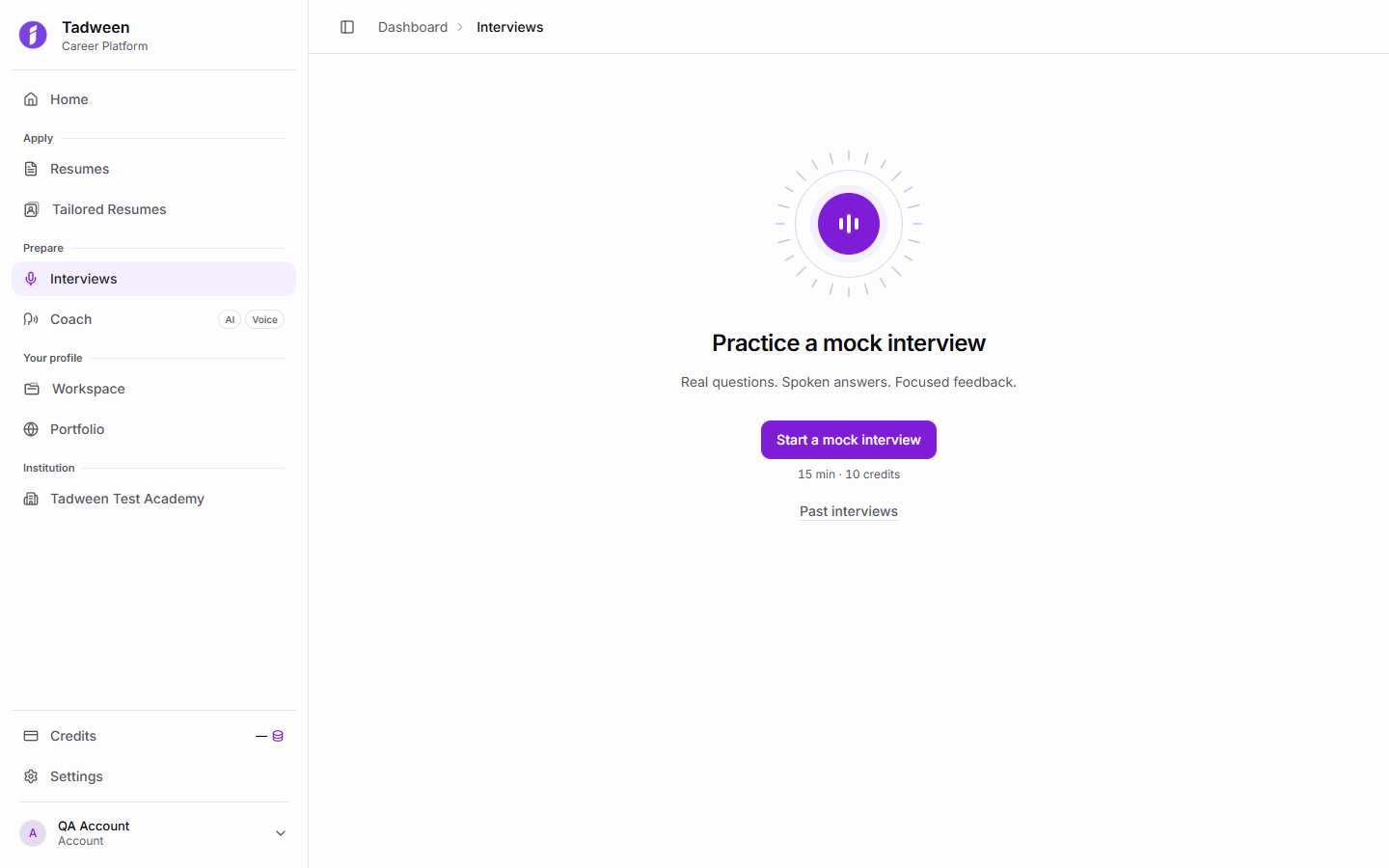
The current English entry screen begins the verified mock-interview flow. Configure the role, focus, and language inside the workflow before practice.
Practice the answer, not a performance
Keep the facts stable, vary the wording, and listen for a clear connection to the target role.